Thursday, 27 June 2013

A Tale of Two Scotlands

‘It was the best of times, it was the worst of times…’

When Charles Dickens penned those famous words he probably wasn’t thinking much about Scotland in the 21st century, yet their timeless wisdom matches the situation we find ourselves in.  Perhaps I’m being overly dramatic but we are living in a unique time in Scotland’s history.

Here's a kind message from our Croatian friends at our recent World Cup Qualifier (although I suspect it might have been taken down after Snodgrass scored!)

Today there are two Scotlands; one characterised by a confident persona that is hopeful about the future, and one mired in self doubt and despair.  The referendum on Scottish Independence will go a long way towards deciding which one will become our true identity.

A ‘Yes’ vote is a vote of self confidence.  It is the belief that we can do better, that we have something to offer and that we can take responsibility for our actions.  ‘Yes’ means that we reap our own harvest and ring our own till.  The successes we achieve will be the result of our own efforts and the choices we make will be our own.

"Yes we Canavan!" is a lot better than "No we shouldn't Darling..."

A ‘No’ vote is a vote of self doubt.  It is the belief that we can’t care for ourselves, that we have nothing to offer and that we want others to take responsibility and tell us what to do.  ‘No’ means we receive pocket money for our labour and strife.  Any success we achieve will be credited to others and every real choice will be made from afar.

Sign for Scotland believes that we can enter the best of times.  A renewed focus upon the challenges facing Scotland will help to us to resolve our problems.  A renewed sense of purpose will lead to a boom in the arts and literature, and a renewed belief that things can change if the people want them to will lead to a more ethical and principled politics.

We are the authors of ‘A Tale of Two Scotlands’ and the ending will be up to us.
Drew
 
If you like this blog, then please consider visiting our other sites:
Facebook - Sign for Scotland
YouTube - Sign4Scotland
Twitter - Sign4Scotland

Wednesday, 19 June 2013

He Who Pays The Piper (Part 1 – Party Donations)


One of the main reasons for supporting independence is the lack of any prospect of meaningful reform within the UK.  Regardless of which side gets in, there are certain aspects of Westminster governance that simply will not change.  As this blog could conceivably become the longest on this site we’re going to split it into three bite sized parts: donations, outside interests and honours.

"I can't see anything wrong with the current system," every Westminster MP (probably)

Donations
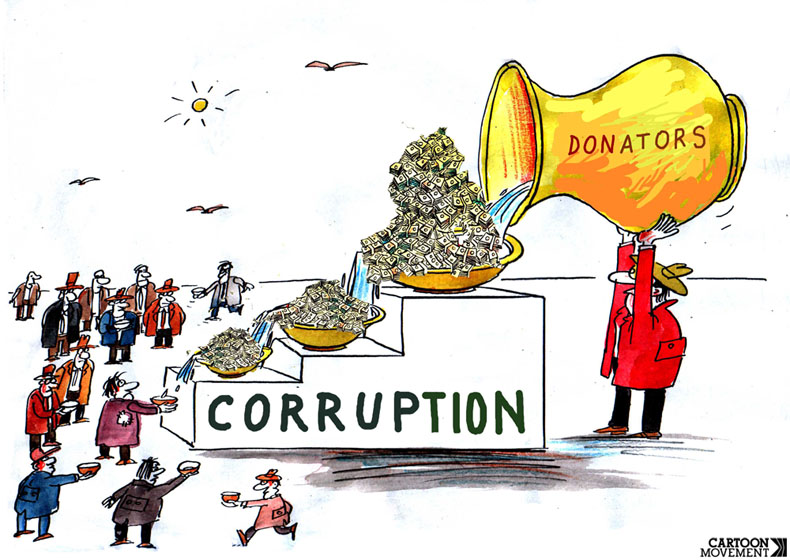
All political parties in the UK rely on private donations to fund their operations.  Many people believe that changing this will result in the public paying for negative political campaigns and mud slinging however we can see that the current system isn’t working.  Let’s look at where Westminster’s money is coming from.  These numbers are from 2011 and look at funding going to the Conservative Party – the party of power at Westminster (source - http://www.thebureauinvestigates.com/2011/09/30/the-biggest-conservative-donors-from-beyond-the-square-mile/):

£1,384,070 from Hedge Funds
£1,305,806 from Financiers
£1,158,000 from Fund and Asset Managers
£0,607,771 from Banking
£0,565,400 from Private Equity
£0,473,253 from Trading, Broking and Dealing
£0,193,157 from Financial Services
£0,189,400 from Insurance

This means that more than £5,876,000 was paid to the ruling party at Westminster from individuals and groups from the City of London.  Should we be surprised to see that those working in these industries are enjoying vast increases to their wealth whilst everyone else struggles?


"It's called 'London style trickle down economics'...our loose change makes the system work!" every Westminster donor (probably)

But there is big money to be found from those outside the city.  Donors linked to ATOS, the company which administers £3 billion worth of government contracts to carry out Work Capability Assessments, have given £1.3 million in donations to the Conservatives.  We’re sure this is just a co-incidence, however the perception that policies and contracts can be bought through donations is one of the reasons why so many people are put off politics.  This is the sort of thing that won’t change in the UK but could change with independence.

And our funding questions aren’t restricted to the Conservative Party.  We saw in June this year the details of a businessman being advised by the Labour Party on how to dramatically reduce tax payments by changing the way he made his donation.  And there are other aspects to how and when donations are made that deserve scrutiny.  And for those of you are new to this subject, here’s a reminder of when Labour were in power...


Many will argue that the examples we see above are not illegal.  We agree, and that is precisely the point.  These things will never be made illegal at Westminster unless a more convenient method of paying money to political parties is found.  And there’s a wider issue: are we expected to believe that these incredibly wealthy individuals and multi-national corporations are making these donations for purely altruistic reasons?

Mike Slade, Chief Executive of Helical Bar and significant donor to the Conservative Party, made this quote.  “You do run the thin line of someone saying: I’m only doing this to have access and influence, but that was what politics was always about.  It is a little unfair but there must be 20% truth in it”.

Is that the type of democracy we can have faith in?  According to the Bureau of Investigative Journalists, the Conservative Party had a scheme in place which allowed those who donated £50,000 or more a year a face to face meeting with David Cameron.  Once again this isn’t illegal, but it can’t be in line with the spirit of democracy.  (source - http://www.thebureauinvestigates.com/2011/09/30/analysis-can-money-buy-political-influence/)

"I, uh, approve of this system," Mayor Joe Quimby

Westminster is in the minority when it comes to party funding.  In Germany, 50% of political funding comes from the state, limiting how much influence any individual can have over policy whilst allowing smaller parties a chance to compete.  Canada allows no donations from businesses or trade unions, meaning that parties are funded by their members, a system which appears to work quite well.

In Scotland, we have the chance to put in place a fairer, more transparent system of party financing.  We can enshrine, in a written constitution, the principles by which we expect our elected officials to operate within, and ensure that the biggest policy shapers and influencers are the voters of Scotland.  If this is what you believe, then you have to vote ‘Yes’ in 2014

And if you’re still not convinced yet, then stay tuned for Part 2!
Drew
 
If you like this blog, then please consider visiting our other sites:
Facebook - Sign for Scotland
YouTube - Sign4Scotland
Twitter - Sign4Scotland

Friday, 14 June 2013

Who doesn't want independence

Who stands to gain and lose if Scotland becomes independent?  A ‘Yes’ vote will result in many changes over time, so let’s consider both sides, starting with the ‘winners’.

Having a more representative parliament that is closer to the people will result in better governance, more jobs, less poverty and efficient public services.  This is to the benefit of the vast majority of us in Scotland.  Those of us in minority groups (through language, ethnicity, etc) will enjoy greater protection from the presence of a written and easily understood constitution.  Archaic laws which only entrench the wealth of a few will be swept away by reforms, allowing the most dynamic and imaginative amongst us to become successful.

Independence offers a fairer share from a larger cake

A modern, progressive Scotland can also lead by example, and help support movements for reform in England, Wales and Northern Ireland.  This would be much more effective than our meagre 4% stake in Westminster.  Having a more ethical foreign policy will allow us to be more influential abroad, as we won’t be dismissed as hypocrites.

http://www.stopwar.org.uk/index.php/united-kingdom/2227-how-a-sycophantic-media-ignored-the-hypocrisy-of-david-camerons-qa-better-africaq-tour

http://blog.eurojobs.com/2012/08/britains-hypocrisy/

http://www.independent.co.uk/news/world/europe/david-cameron-faces-eu-charge-of-hypocrisy-over-demand-for-cuts-8341097.html

http://www.presstv.ir/detail/222543.html

http://www.guardian.co.uk/commentisfree/2010/jun/10/expecting-immigrants-speak-english-hypocritical (this one is particularly poignant as the UK’s policy is not in relation to speaking ‘a’ national language, but English.  Once again, Westminster ignores Scots, Welsh, Gaelic, Cornish and Sign Language).

 "Standard's are great, there are so many to choose from!" British Foreign Office (probably)

So who stands to lose if Scotland becomes independent?  Let’s start with politicians at
Westminster.  Scotland is a net contributor to the UK.  We provide 9.9% of all tax revenues but receive only 9.3% of expenditure, and this is including £17 billion (that’s 17 with nine ‘0’s at the end of it) per year which is classified as ‘Scottish Expenditure’ but isn’t actually spent here.  That’s a lot of money and a lot of jobs.  Could Westminster successfully compete without this subsidy?  They don’t believe they can.

Those who use warfare to advance foreign policy aims stand to lose too.  Anti-war sentiment in Scotland will be reflected in her parties following a ‘Yes’ vote, making it less likely that we’ll be dragged into unwanted conflicts.  Could those who want the UK to export war successfully engage in conflicts around the world without our unquestioned and uninterrupted support?  They don’t believe they can.

Many of those based in the City of London aren’t keen either.  If Scotland were to adopt tougher regulation on banks and financial institutions, for example, then we’d be able to gain more trust from investors.  Edinburgh, Scotland’s financial capital, could avoid the AIG, Madoff, MF Global, London Whale, Libor, CDS miss-selling scandals which have plagued London over the last few years, and become a real competitor for the South East.  Could the City of London successfully compete with a freed Scottish Economy?  They don’t believe they can.

"I say, old chap, the current system works rather well..." Lord Rupert 'Pongo' Threepwood, 12th Lord of Mocksbury

So who wins if Scotland becomes independent?  Primarily it is the majority of the people who actually live in Scotland.  Those who work hard in their jobs, those who need a little help through tough times, and those who have a real talent and skill can all expect to see life incrementally improve as successive Governments become more focused on our needs and wishes.

So who loses if Scotland becomes independent?  Primarily it is those who believe they cannot succeed on a more level playing field. Do the privileged few who attend the House of Lords genuinely believe they can match their current levels of wealth and power with their current level of effort and talent?  Do those who long for Britain to wage war to prove it is still a global power genuinely believe that their military campaigns can continue on the same scale without Scotland’s wealth and people?  Do those who currently profit from inherited wealth and power genuinely believe that they can still succeed when confronted by reforming Scottish Governments who have the support of the people?

"Blast it, I cannot do with any more working.  I was full up on the stuff years ago."

It is impossible to say what the future holds, but for the privileged few, their chances of holding onto power are much greater in a stagnating, and inflexible Britain, than in a dynamic, more proactive Scotland.  Many of the no campaign’s leaders are currently benefiting from the UK Government’s policies, either directly or indirectly.  Is it surprising that they speak out against changes and reforms that could force them to compete?
Drew

If you like this blog, then please consider visiting our other sites:
Facebook - Sign for Scotland
YouTube - Sign4Scotland
Twitter - Sign4Scotland
This blog first appeared on the Disabled People for Independence blog in April