Showing posts with label Pensions. Show all posts

Wednesday, 20 August 2014

The Negotiator

The strength of Scotland's position in post referendum negotiations is completely dependant upon the outcome of the vote. A Yes makes us much, much stronger. A no makes us weaker. Here are the reasons why:
 
 
Strength of Yes
Scotland as a country is fundamentally self-sufficient. We produce excesses of electricity, have abundant supplies of water, export food and textiles and generally have most of the other essentials of life. We have a balance of trade surplus as a result of our natural resources as well as other industries, and with a significant tourism sector we have no problems with brand recognition or sources of revenue.
 
The things that the UK offer aren't important. We don't need a vast military as we have no nearby threats, we don't need a permanent seat in the UN security council, and we certainly don't need nuclear weapons. Our largest market is provided by the EU (and which the EFTA could equally offer) and the currency is fully tradeable. There isn't anything that we need to have from Westminster.
 
The UK however has a debt problem that isn't getting better, and the £ needs more exports to guarantee its value. The UK also has significant trade with Scotland that it will need to protect and the prospect of leaving the EU is very real, making good relations a priority. And, strictly speaking, the liability for current pensioners will not change, as their national insurance contributions were paid to Westminster. Starting with no debt or pension payments will mean Scotland will begin with a very lucrative budget surplus.
 
Finally, the Westminster negotiators are rubbish. Because the path to power is guaranteed, the people who gain high politicial office don't require any special talent or skill. The Westminster system is a lazy system that lacks the competitive nature of a proportional parliament. We will have the more skillful negotiators, and we will be giving them the best possible hand.
  
All of this means that Scotland holds the advantage in any negotiations. And there are plenty of things that could be done to make Westminster squirm (like demand the immediate removal of Trident or insist on an audit of the UK's debt - both of which they will not want).

 
Weakness of no
A no vote leaves Scotland vulnerable. With independence no longer an option (thus making us dependent on Westminster) there is no incentive for any further devolution. Indeed, both halves of Westminster have an incentive to reduce the importance of Holyrood.
 
A no vote also means a cut to the Scottish budget is not only a possibility but a likelihood. The fact is, Scotland more than pays its way and is a net-contributor, but that won't stop Westminster politicians from demanding that spending is cut here. The current system makes no allowance for where money is earned and the only UK 'region' which will be viewed as an exception is London and the South East.

 
With no means to defend ourselves and every reason to cut, Westminster will view a post-no Scotland as a means to secure more votes in England, and deny reform for a generation.
 
You don't have to be a great negotiator to see the difference. A Yes vote means that Westminster is left over an oil and whisky barrel. No leaves us open to no end of cuts and the prospect of a weakened Holyrood. Even if you don't want Scotland to be independent, you can see how independence is the best way to protect our interests.
Drew
  
If you like this blog, then please consider visiting our other sites:
Facebook - Sign for Scotland
YouTube - Sign4Scotland
Twitter - Sign4Scotland

Sunday, 25 May 2014

Not in the News - Late May edition

Welcome to the sixth of our bi-monthly series looking back at the stories which the main stream media in Scotland didn't offer much attention to, and comparing them to those that hit the front pages. Our last edition covering the first two weeks of May can be found here.


U Know I'm Petrified! (of facts!)
What is the most important thing for the police to be investigating online? Terrorist cells, virus programmers, fraudsters, no, it's people who tweet factual and sarcastic messages that highlight UKIP policies!
 
A Green Party blogger re-tweeted an ironic list of '10 great reasons to vote UKIP'. Apparently, making people aware that UKIP intend to cut maternity leave, raise income tax for the poorest, scrap holiday entitlement, privatise the NHS, retract human rights acts, and cut the education budget whilst buying 3 aircraft carriers (all of these claims were sourced) is now worthy of a visit from your local bobby. We would also highlight UKIP's plans to scrap the Scottish Parliament but we're too afraid to do so!

The next coalition government...?
U Know I'm Petrified! (of consistency!)
If you watch BBC coverage then 1) you have our sympathies and 2) you will be familiar with the name Sanya-Jeet Thandi. Ms Thandi was a prominent member of the UKIP youth wing who left the party prior to the European elections. She stated on her blog that the party was running an "anti-immigrant campaign" and trying to "exploit the ignorance in British society". This was the lead political story on the BBC on Wednesday, the 14th of May.

 
But if you watch BBC coverage, then you will be less familiar with the name Gary Wilson, a Labour Party member who was the no campaign co-ordinator within the Edinburgh East Labour Party. Mr Wilson stepped down from this position and joined pro-independence group Labour for Independence.
"I had to step down from my role as I gradually realised that we are not in fact 'better together'. I have listened to all of the arguments whether economic, social or emotional and I am now convinced that independence is the right thing for Scotland." Gary Wilson, Labour for Independence
Why was one of these people highlighted by the BBC and the other ignored? We couldn't possibility say!
 
How news crosses a border
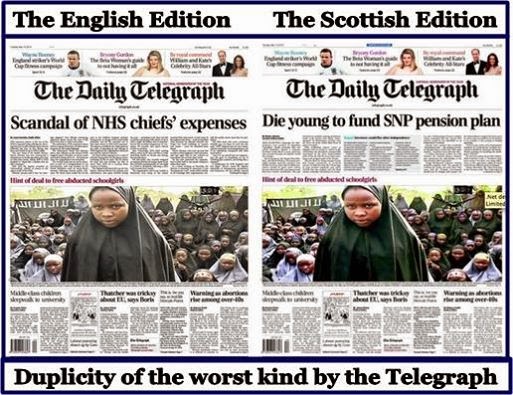
The Daily Telegraph showed once again their understanding of finance with their headline in Scotland reading 'die young to fund SNP pension plan'.


The story comes from the fact that people in Scotland can afford larger pensions at an earlier age for the same price we are currently paying due to our lower average life expectancy. A larger pension (or one which starts earlier) would help to alleviate the poverty which is a major contributor to our earlier deaths, but the Telegraph don't want to talk about that.
 
Reforming how state pensions are organised would also provide benefits and improve sustainability, but the Telegraph don't want to talk about that either.
 
And the principle of having alternative arrangements for state pensions in Scotland doesn't just come from the SNP, but are backed by experts such as Rachel Homes, author of the article 'Scotland better placed to defuse its share of UK pensions time-bomb', but the Telegraph don't want to talk about that too.

If you believe the pension needs of Scotland should be considered, then don't let the Telegraph know - they may think you're a dangerous separatist!
Of course, if we had pensions like those of our neighbours, and if we didn't have unnecessary and widespread poverty and destitution, which is exacerbated by the Westminster system that the Telegraph defends, then we would see much smaller variations in life expectancy. But we're not likely to see the Telegraph produce headlines about that. At least, not in their pretendy, regional Scottish editions (hint: here, here and here).
 
Rince and repeat
We don't need to say much beyond our blogs from the 22nd of April 2013 and the 16th of February:


As pointed out by Reverend Stuart Campbell, "It [the 'no' campaign] seems to be set on an infinite loop". As for the Scotsman...we at Sign for Scotland know they can make worse covers than these.
 
Oil Well that ends Well
"UK's oil, coal and gas 'gone in five years'" was the headline on the BBC on the 16th of May. It follows from countless other stories from 'no' supporting media outlets which have for decades been telling us that North Sea oil is about to run out (you can see links to 29 of them on the Wings over Scotland blog entitled 'The oil debate for busy people').
  

We've been lied to repeatedly by politicians and London centric media outlets for decades whilst Westminster has wasted our natural resources. What is worst is that many people are left unaware of the real situation. Every journalist in Scotland should be ashamed whenever blatently wrong statements such as "we don’t have the resources – like oil and gas – we’d need to keep Scotland afloat" are made.
 
Of course, this latest scare this goes against numerous reports of record investment in the North Sea oil industry as well as the UK Government's own internal expections of future revenue. This story has been lampooned repeatedly and shows that the only thing drying up are the excuses coming from the Westminster Defence League.
 
How valued are journalists?
At the tail end of April, the National Union of Journalists wrote a little to the BBC's Director General, Tony Hall, requesting that the broadcaster resign from anti-independence group the Confederation of British Industry. They stated that the temporary suspension of membership during the official referendum campaigning period wasn't enough. The BBC Scotland members of the NUJ voted to back the following motion:
"This Chapel is concerned by the damage being done to the work of its members, and to the reputation of BBC journalism, by the Corporation's membership of the CBI.

We note that the CBI is seeking to de-register with the electoral commission as a non-party campaigner for the Union. But the damage of assocation remains.

Please, Director General, back your Scottish journalists, allow us to do our jobs, re-assert our impartiality, and immediately resign from the CBI." National Union of Journalists letter to Tony Hall
 
And the respose from the BBC? To not even suspend membership as previously promised:
"As the CBI is no longer registered with the Electoral Commission as part of the Scottish Referendum Act, the BBC believes that it is no longer necessary to suspend its membership." BBC Statement, Thursday, 15th of May
With disrespectful actions such as this, it is no surprise that internal surveys are showing an increasing disillusionment within the British State Broadcaster's Scottish division.
"When asked if "Communication at the BBC is open and honest" only 10 per cent at BBC Scotland NCA agreed." Newsnet Scotland, reporting on the findings of the BBC's latest internal survey, Sunday 18th of May
Unfortunately, it isn't just the BBC who are ignoring the NUJ:
In the communications, one senior union official expresses his frustration at the refusal of the Scottish newspapers to cover the story saying: "the papers have - once again - ignored us. And largely ignored the story..." Newsnet Scotland, 20th of May 2014
Still, it was hilarious to find that the CBI's 'junior' member of staff who signed the application to officially make the organisation part of the 'no' campaign turned out to be CBI Senior Campaign Advisor Jon Harrison and Senior Political Adviser Richard Maughan. But that is of little comfort to the NUJ, who have to do their best in very difficult circumstances.
 
When poll results are misleading
Back in the summer of 2013, Panelbase, a polling agency, produced an opinion poll which showed Yes in the lead. The methodology for this poll, where the referendum question was the third question asked, was criticised by experts including Professor John Curtice.

On the 18th of May, ICM, a polling agency, produced an opinion poll where the referendum question was the third to be asked. Professor Curtice 'hasn't said a word about the same problem'. The only difference we can see...this opinion poll showed extra support for 'no'.
"But in this new poll showing a bigger 12% No lead, the referendum question was asked third - which ought to set alarm bells ringing immediately, because we know that responses to later questions can be substantially influenced by the wording of earlier ones." Scot goes Pop, 19th of May 2014
Of course other polling agencies have been doing the same.


The poll could even got the proportion of male and female voters, as well as other factual details available from census information, wrong! There isn't much point in conducting opinion polls if the numbers they produce are wrong. Unless you are using these polls as a campaigning tool.

The story is...Sign for Scotland?
Sign for Scotland received it's first mention on the BBC (although this certainly isn't their first mention on our website...see here, here, here, here, here above and below for just a few examples!). The headline 'Scottish independence: Deaf voters critical of referendum campaigners' with the first line reading 'Scottish independence referendum campaigners have neglected the needs of deaf voters, it has been claimed'. This article was also mentioned on the Limping Chicken and through the BBC's See Hear Facebook page.

Kirsty, at Yes Scotland HQ last year
The story is about the number of Sign Language DVDs of the White Paper has been issued (29). They spoke to John Denerley of Deaf Connections who said "it's ridiculous, shocking, and frankly embarrassing only 29 copies have been ordered." This comment matched the theme of the piece with the article almost entirely focused on the Scottish Government and Yes Scotland, with no direct criticism of the 'no' campaign. The mention of Sign for Scotland came as part of the response from 'Yes Scotland' (neither ourselves nor Scottish Deaf Independence were approached by the BBC).


As we noted in our Facebook response, the BBC report failed to mention the BSL version of the Scottish Government's White Paper (which you can view here: http://vimeo.com/81532918 and had received over 500 views by the time of the article being published) the size of our group which now has over 1,000 likes and more than 1,600 followers on Twitter (https://twitter.com/Sign4Scotland) or our friends at Scottish Deaf Independence (https://www.facebook.com/ScottishDeafIndy?fref=tshttp%3A%2F%2F).

The BBC found this information through a freedom of information request. As far as we know, no such request was made on UK government produced anti-independence documents.

  
We have produced over 20 videos and Scottish Deaf Independence have made even more. Perhaps if the British State Broadcaster did research beyond 'no' campaign press releases they would know that!

P.S. We'd like to say thank you to Newsnet Scotland for posting an article about this story.

Good morning Scotlandshire!
Back in March, Newsnet Scotland started a public fundraiser for the producing an academic study to review an aspect of BBC output. The ambitious goal of £6,500 was reached and exceeded with 259 donors giving an average of nearly £30 each reaching a final total of £7,065.
 
Newsnet Scotland decided to monitor Good Morning Scotland and the results were startling:


The research team (headed by Professor John Robertson) made several key findings:
  • Broadcasts were balanced, in crude numerical terms, but, in every other respect, unfair to the Yes campaign and favouring the Better Together (no) campaign.
  • Broadcasts began too often with bad news for Yes and, too often, featured heavy repetition of such messages over several hours in a manner conducive to unconscious absorption of warnings.
  • Statements, from the Yes perspective, were often reactive while those favouring BT were commonly initiating.
  • Interviewers intended, too often, to adopt aggressive techniques with Yes supporters while only doing so on two occasions with BT supporters.
  • There was a selection and use of expert witness of dubious credibility and of evidence from partisan sources, the broadcasts were clearly unfair to the Yes campaign.

Certain quotes from the report were disturbing to read:
"A further piece of evidence emerging from these broadcast transcripts which seems clearly to favour BT was the tendency of interviewers and interviewees to interrupt, almost interrupt and to cut in quickly to break flow of statements in support of the Yes campaign. The totals give a ratio of almost exactly 3:1 in favour of BT." Academic Study, May 2014

"The repeated treatment of Sturgeon with multiple interruptions and irritable tones is notable and worthy of reflection. No accusation of deliberate discriminatory practise is suggested but this form of aggressive interviewing directed at a confident and articulate woman and not matched with male equivalents such as Lord Robertson or the former Pentagon adviser is unsettling." Professor John Robertson, May 2014
This report is very similar to one produced in January which found longstanding bias in BBC and STV news programmes. Will the British State Broadcaster react to this analysis? We can think of 193 million reasons why they might not.
 
And finally...
We loved the story 'Too gutless to even lie' from Rev Stuart Campbell at Wings over Scotland. It covers how a newspaper can manipulate a story in such a way that gives an impression which is the opposite of reality. If you only have time to look at one link in this edition of 'not in the news', then make it this one.
 
Join us again in June for our next look at what's 'not in the news'!
Drew

If you like this blog, then please consider visiting our other sites:
Facebook - Sign for Scotland
YouTube - Sign4Scotland
Twitter - Sign4Scotland

Thursday, 10 April 2014

Why the SDA?

We at Sign for Scotland recently sent out a request to a number of pro-independence political parties asking for a few words about their aspirations for an independent Scotland. We hope to show the different visions for Scotland that we'll be able to vote for in 2016 and beyond, and to help people consider the possibilities that independence can bring.

The first to respond were the Scottish Democratic Alliance (SDA). We'd like to thank them for their speedy and enthusiastic reply.


Why the SDA?
The Scottish Democratic Alliance advocate a progressive, populist small 'c' conservatism that is diametrically opposed to the elitist, dogmatic brand emanating from Westminster's blue, yellow and red Tories. And their puppets here in Scotland.

In a nutshell the SDA's view is to put people first. Not corporations or the rich. We want corporations to be profitable; entrepreneurs to get rich because these are mechanisms which should serve to make people's lives better. The SDA support high-quality public services like free education, and healthcare. We support working folk being paid at least a living wage to ensure a good quality of life - with a citizen's pension providing dignified retirement.

The SDA supports the idea that sovereignty and independence are inseparable, and applauds those who have brought Scotland to this historic referendum. At this crucial time, however, the SDA feels that there is now the danger of losing sight of these principles in favour of political expediency and that the Independence movement is becoming just another group of politicians pursuing power and ending up offering only bland policies which seem designed to create a copy of the current UK - "independence-lite".

This manifests itself in the retention of Sterling and the Bank of England; the switch to becoming a member of NATO and the automatic assumption of membership of the European Union. The SDA considers all of these policies to be fundamental sacrifices of sovereignty and thus assumes to itself a role in preserving the conscience of Scottish Independence.

The SDA offers to 2014 independence referendum voters an alternative vision - a vision of a Scotland quite distinctive from its current persona. It offers a second enlightenment to Scots with the imagination to consider new ways of governing a modern community unencumbered by the 300 years of feudal society and privilege which is fast destroying the United Kingdom. In old fashioned political parlance, the SDA promote policies, some of which could be termed 'right' and others which could be seen as 'left'.

The SDA's commitment is to Scotland's independence and the implimentation of the party's policies after a YES majority referendum vote to build an economically vibrant, socially just, lean but competently governed, successful modern country, for the benefit of all Scottish citizens. If you take the time to look at our website, you will see a radically but intellectually sound basis for government - a different kind of government.

The SDA, the party of true independence, considers sovereignty to be the essence of independence. A Scottish government adopting SDA policies or administered by SDA members will not permit foreign military bases within its territory other than by invitation in times of war or National Emergency - all as provided for, in a new written Constitution for Scotland. Of course the administration will remain free to enter into trade and defence agreements other than under terms which prejudice this sovereignty. That sovereignty extends to the National Currency and the issue of banking licences granted under the terms of the Constitution of Scotland whereby their National Currency shall remain sovereign and protected from predation or manipulation by private interests - whether domestic or foreign.

There is a wealth of further information on our website. See About, Our Vision and Policies.

Twitter: @sdemoalliance
Facebook: https://www.facebook.com/ScottishDemocraticAlliance
Web: http://scottishdemocraticalliance.org/

  
We at Sign for Scotland would once again like to thank the Scottish Democratic Alliance for replying to our request as quickly as they did. They are an example of a political party that could flourish in an independent Scotland and we wish them well. If reading this had made you interested in finding out more about the SDA then please do visit their website and Facebook pages.
 
  
We hope to be able to run more blogs like this in the run up to September's referendum. If you are a member of a pro-independence party and would like to write about what your party could offer, then you can email us at: sign4scotland@gmail.com.
Drew
 
If you like this blog, then please consider visiting our other sites:
Facebook - Sign for Scotland
YouTube - Sign4Scotland
Twitter - Sign4Scotland

Sunday, 6 April 2014

Sea of troubles

Ok, or not ok, that is the referendum question according to the 'no' campaign.


If you aren't heading to a food bank yet, if you haven't yet been affected by the endless wars we pay for in tax and in lives, if you can still afford to underwrite HS2, Crossrail and all the other 'UK expenditure' that seems to be almost exclusively for the benefit of the swing seats in the south east of England, then they say that you should be content with your lot. They reason that it is greedy for you to want better and that the problems of those around you are not your problems, because your life is still 'ok'. You don't need to aspire to more, because things are 'ok'.
 

Well today I’m going to say that the way things are, the way they have been, and the way they will be under a Westminster system, are not ok. They are deeply and profoundly wrong. And I’ll go one step further and say how and why an independent Scotland will be better. But first, how is the UK not ok.
 
According to Unisef 19.8% of people under Westminster live in poverty. We spend 30 times as much into researching arms and weapons than renewable energy, despite the latter being 8 times more significant to our economy, and we have an unelected second chamber, where 150 of its members have financial interests in the private healthcare industry, scrutinising and amending our laws. This is appalling.

 
Arrangements such as those in the House of Lords sow the seeds of corruption. Why do those who are paid £300 per day, plus expenses, for a few hours or in some instances a few minutes attendance need to have outside interests at all? Does Westminster find it difficult to attract people to such a role that only those on the payrolls of special interest groups are able to scrutinise our laws?
 
And why, when we are a wealthy nation, are our pensions amongst the lowest in value in Europe? Why do our pensioners receive less than a third of those in Sweden, a small independent country with no significant oil or gas reserves? Why do we receive this lower amount so much later than nearly all of our European friends? Why?
 
Imagine that we can start over. Imagine that we, the people of Scotland, had a rule book in place for how our country is run which we all took a part in writing. Imagine that we, the people of Scotland, have the last and most important say over the decisions facing us, instead of the few who make up parliament. Imagine that we, the people of Scotland, decided our own priorities, and had a wider choice beyond simply the british elite who wear red ties or the british elite who blue ones.

  
You don’t have to imagine. This is the future with independence. We will write a constitution following a Yes vote which will safeguard our rights. We will be sovereign and it is our views that are final. And we will have a proportional electoral system, which means that everyone’s vote counts.
  
Under First Past The Post, the system entrenched at Westminster, the only two parties who can ever form the government are discouraged from debate. They know that to get in they don’t need to prove that they are intelligent, thoughtful, representative or even competent. All they need to do is make the other side seem unelectable, and wait for their turn to govern.
  
Their policies aren’t decided by principle, but by polling, and that is why there is so little difference between the two wings of Westminster. Tell me, who do you vote for if you are against war? The side which brought us the 1990 gulf war or the one who brought us the 2003 version? Who do you vote for if you support the freedom of the press? The side which smashed up computers in the Guardian newspaper’s head office under anti-terror laws, or the side which introduced and abused those very same laws?
  
If believe that employers national insurance should be scrapped, or that Trident should be removed, or that we shouldn’t be paying to station military personnel in 80 countries around the world, or the monarchy, or fracking, or the use of depleted uranium in weapons testing on our coast, who do you vote for?

  
A proportional system is different because it encourages diversity. It is not good enough to say why we shouldn’t vote for so-and-so, you need to say why we should vote for you. You have to show that you are competent, you have to inspire us with a change we want to see, you need to act in the best interests of the people because if you don’t we’ll kick you out and won’t let you waltz back in 8 years later. We can have a Labour Party that represents the interests of the working class. We can have a Tory Party that represents the interests of entrepreneurs and small business owners. We can have a Liberal Democrat Party that can guarantee civil liberties and local democracy and we can have a whole host of new parties which ally with our values.
  
To the Westminster duo who are guaranteed to share power no matter what they do, poverty is ‘ok’, Trident is ‘ok’, and the UK is ‘ok’ because they’re ‘ok’. Well that isn’t good enough for me. Westminster won’t be ok as long as we have children growing up in poverty within a few miles of a stockpile of weapons of mass destruction, or as long as we have elderly people being cold in their homes in sight of north sea platforms, or as long as we have unfair and unjust policies imposed on us from governments we didn’t elect.
  
To me Westminster won’t be ok as long as members of the armed services continue to receive P45s as we waste money on aircraft carriers. They won’t be ok as long as they can enter the offices of newspaper editors and smash up computers, as they did with the Guardian last year, and they won’t be ok as long as they test and dump depleted uranium into our coastline.

  
This is far from ‘ok’, it is abhorrent. To vote ‘no’ is to support and entrench this perverse and immoral system of government. It is to give up hope of a better future and to leave our children powerless to the whims of Westminster. We are the first, and possibly the only, generation that has the chance to bring the power back to Scotland and to right the wrongs that exist in our country. We can’t leave the thinking to Westminster and hope that they somehow slow the decline of Britain or act in the manner we want them to; we have the take responsibility for ourselves and be the change we want to see.
  
Let us ingrain in the minds of our children that they shouldn’t settle for governments that can ignore them. Let us show in deed and in spirit that they should take responsibility for their actions and have the courage to stand by their convictions, and let us place no limits to their ambitions, or say to them ‘we decided this far for you and no further’.
  
  
Is it nobler to suffer the slings and arrows of outrageous Westminster, or to vote ‘Yes’ against their Sea of troubles?
   
I want to take part in writing a codified constitution. I want to know that my vote has value and that we can’t be ignored. And I want the wealth of Scotland to be used for the benefit of her people. The things I want can only be achieved with independence, and that is why I want you all to vote ‘Yes’. 
Drew
 
If you like this blog, then please consider visiting our other sites:
Facebook - Sign for Scotland
YouTube - Sign4Scotland
Twitter - Sign4Scotland

Sunday, 24 November 2013

Should your opinion matter?

Yes Scotland is campaigning for a more democratic and representative government for Scotland.  They want your opinion to matter.  They want you to have a greater choice of political parties to choose from.  They want you to get involved in writing a constitution for Scotland.  They want you to be closer to the seat of power.


The no campaign doesn't have any enthusiasm for this kind of control.  Indeed, their campaign so far suggests that they don't want your opinion on a whole range of subjects.  Let's take a few examples...

Currency
The Scottish National Party want to continue the Sterling Zone which is currently in place for at least 10 years after independence, with the only exception being that Scotland has a representative on the Bank of England board.  The Scottish Green Party, the Scottish Socialist Party and the Scottish Democratic Alliance want Scotland to have it's own currency which would be controlled by our parliament.  We're certain that the Labour Party, Conservative Party and Liberal Democrats will produce their own policy options after a 'Yes' vote, allowing the people of Scotland to choose the path that follows closest to their values.

The 'no' campaign suggest that 'creating' a Sterling Zone would be risky, difficult and might not happen at all (although they don't explain why).  Neither of the parties who can form the UK government offer any alternatives to the current set-up.

Better Together strategist
Trident
The main parties who make up Yes Scotland want to follow the wishes of the majority of Scots and have nuclear weapons removed from Scotland as soon as it is safe to do so.  People who disagree with this stance would still be able to vote Labour, Conservative or Lib Dem, who may advocate for the weapons to stay.

The 'no' campaign claim that an independent Scotland would not be able to remove Trident as:
a) The bill for moving and re-homing these weapons would, for reasons that have yet to be explained that would go against the historical precedence set by Russia following the end of the USSR, fall on Scotland.
b) Faslane, where the weapons are currently stored, would, against international law, be annexed by England.
c) NATO, which is primarily composed of non-nuclear states, would, for reasons that defy logic, insist that Scotland must host these weapons or be refused membership, thus leaving us in the same situation as stable non-Nato states as Sweden and Ireland.

Once again, your opinion doesn't matter with 'no'.

"You, run your own country without us?  Don't be silly old chap!" Bullingdon Club Statement (probably)

Defence
The SNP want to increase overall military spending in Scotland to match those of stable, independent Denmark.  This would be funded by having the tax revenue raised in Scotland staying in Scotland.  The defence underspend that we have suffered runs into the billions which would result in more military personnel for less money.  The Scottish Green Party wish to have military spending cut further, to levels enjoyed by stable, independent Ireland.  The size of our military and the scope of its operations would be dependent upon who the people of Scotland elected, allowing us to tailor our armed forces to match our needs and to react to changes around the world.

The 'no' campaign states that only Westminster should decide military policy.  They claim that a Scottish Defence Force would be incapable of operating as well as that which Denmark or Ireland enjoy (despite having equal or superior funding) for reasons which they have yet to explain.  The UK's position as 4th largest military spender in the world is unlikely to change as both of the parties who can form the government are in complete agreement.


Pensions
Yes Scotland want to introduce a triple-lock to pensions, ensuring that the purchasing power of the state pension remains the same.  Pensions are more affordable in Scotland however there are advocates for reform to guarantee a fairer, sustainable system.  But on the first day following independence, most pensions schemes will remain exactly the same as many are already administered in Scotland.

The 'no' campaign have no vision for how to improve the pension system, only vague threats which ignore Scotland's superior economic position.  They state that the EU (which they simultaneously claim will not accept an Independent Scotland as a member) will demand that the black hole in certain pension schemes will need to be filled instantly following independence.  This goes against historical precedence as other nations have managed to negotiate delays in the full application of this legislation.  It is important to note that the pension shortfalls were under Westminster guidance.

For more on pensions, see this comprehensive piece from Wings over Scotland.

These are just four of the areas where Yes Scotland want you to be a stakeholder in your country, but the no campaign don't.  So if you feel that your opinion should matter, if you want choice, if you want debate and if you want your children to be guaranteed to always have the governments they elect, then you need to vote Yes.

Otherwise, you're letting others decide.
Drew

If you like this blog, then please consider visiting our other sites:
Facebook - Sign for Scotland
YouTube - Sign4Scotland
Twitter - Sign4Scotland

Friday, 26 April 2013

A Scare A Day...Pensions edition

This is the first of our 'Scare a Day' posts.  We say first because unfortunately we believe this will become a regular feature until the referendum.  Hopefully we're wrong and we can focus on more positive topics, such as our potential to diversify our economy, create a more peaceful foreign policy and reduce poverty and homelessness.

 "Independence...independence?!  NNOOOOOOooooooo............" BBC Scotland viewer survey

Today's 'scare' story comes from the BBC and focuses on pensions.  You can look at it here.  It raised quite a number of points so lets look at them one at a time:

1) Who would make state pension payments in an independent Scotland and take responsibility for any entitlements built up prior to independence?

A) Your entitlement to the state pension or pension credits on Day One of an independent Scotland will be the exact same as your entitlement before independence (Yes Scotland website).  This part depends upon the outcome of the negotiations between Holyrood and Westminster, although it is likely to be based on residency.  We can't say for certain because Westminster refuses to discuss the details.

2) Who would be responsible for unfunded public sector pension liabilities built up prior to independence?

A) Scotland currency spends a smaller share than the UK of both our national wealth and tax revenues to deliver pension and welfare payments in Scotland.  So the pension or pension credit you receive is more affordable for Scotland than it is for the UK (Yes Scotland website).  This part also depends upon the outcome of negotiations.  We can't answer because Westminster MPs don't want you to know.

3) What pension regulation and protection arrangements would an independent Scotland need for private sector pensions?

A) Your private pension will not be affected by Scotland becoming an independent country.  Your contract with your pension provider will continue as now (Yes Scotland website).  Ultimately, pension policy would depend upon who we elect.

4) And how would EU solvency requirements for defined benefit and hybrid pensions schemes be met across the UK if Scotland became an independent country?

A) Finally, we come across a question where the answer isn't available on the first page of the Yes Scotland pensions Q&A section.

The answer to this is in two parts: first, many countries within the EU (and outwith) have agreements in place to allow temporary deficits in private pension schemes, and there is no reason why Scotland could not be included in those.  There are many Scottish companies who employ workers abroad, and few nations would want to lose these jobs trying to block something that doesn't affect them.

Second, who allowed the massive funding gaps in private pensions?  Which parliament raided the pension funds and left them precious little protection from the financial markets?  Which parliament has created this problem and left it to us to pick up the tab?  Taking control over pensions, and ensuring that the hard earned funds that people need to rely on aren't abused, is one of the main reasons for independence.

"The mainstream media are not biased," every mainstream media outlet.

We at Sign for Scotland believe that journalism is about investigating the facts, removing fiction and distortion, fairly representing differing viewpoints and avoiding personal bias.  Unfortunately the BBC doesn't agree:

"We reported the opinions as expressed at that time. We featured an opposing voice. We report other opinions, such as those you cite, when they are made known, and quote those who disagree with them, too. It is called journalism." (email from editor of Reporting Scotland - 24th April 2013).

When someone believes the above idiology, they don't realise when they are being biased.  We've mentioned media bias before (Recording this Moment - A challenge) and others have done the same (Bella Caledonia - On Balance) but it needs repeating to help these journalists understand that their job is more than to just parrot the views of the powerful.  Their job is to bring better understand.

Can BBC Scotland genuinely say that they left their viewers with a greater level of understanding?  I don't think so.
Drew

If you like this blog, then please consider visiting our other sites:
Facebook - Sign for Scotland
YouTube - Sign4Scotland
Twitter - Sign4Scotland