Showing posts with label Environment. Show all posts

Sunday, 14 September 2014

Not in the News - Referendum Special

Normally on our Not in the News segments, we poke fun at the main stream media (and in particular the British state broadcaster) for examples of bias and mis-information. That would have been tricky this week, as nearly everything the BBC, Sky News and the newspapers have done falls into this category, so instead we're going to offer our favourite moments from the referendum campaign.
  
Here is the Yes Scotland campaign from our perspective.
  
Favourite image
Our favourite image had to come from Bella Caledonia's poster competition. Our pick was one of the 20 finalists and we feel it summed up Independence perfectly. Vote YES and the Scottish butterfly can catch up with all our friends:


Other images include 'Scotland's future in Scotland's hands' by Yes Scotland, '142 countries have chosen independence' by Indy Poster Boy and 'Love Scotland, Be Yourself, Vote Yes', by Brave Many.
 
  
Favourite photo we've taken
This one was really tough because we have meet so many wonderful people and seen such fantastic sights beyond anything we were expecting. But we had to pick 1 and we decided that this image of Sign for Scotland with Mark Coburn, Indy Cyclist, was our favourite. Mark has done a great job not just for Yes Scotland, but also for Maryhill Foodbank and he's definitely one of our heroes:
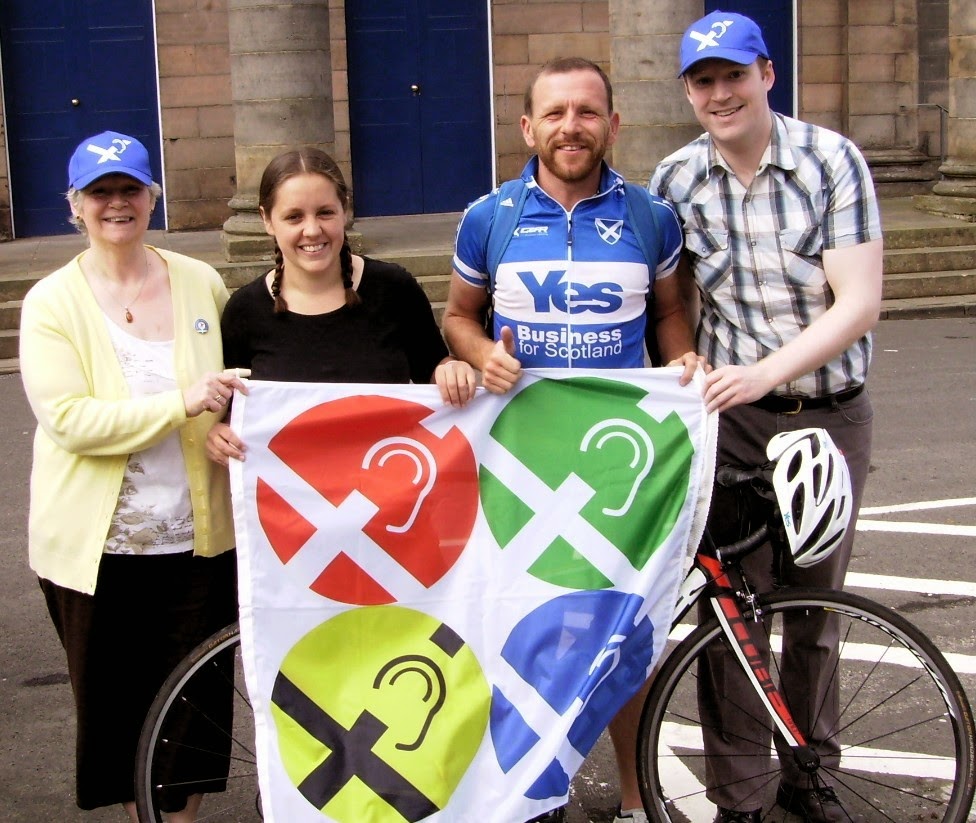
  
 
Other images include at the 2013 Independence March and Rally, at the Scrap Trident Rally in Glasgow and wee Mo meeting Yes Scotland board member Tasmina Ahmed-Sheikh:
 
  
Favourite photo we've seen
The British state broadcaster has been at the heart of the no campaign and our favourite photo from online comes from one of the BBC bias demonstrations. This has become even more poignant following the outburst by senior BBC political correspondent Nick Robinson.
 
  
Other images include Kirsty from Yes Scotland, the Radical Independence take-over of Glasgow and the Yes Scotland message to our friends from across the EU.
 
 
Favourite video
We've seen so many great videos during this campaign, but for us at Sign for Scotland, we find ourselves returning to this rendition of our national anthem by the ladies of 'Signed Songs R Us'.
  
  
Other videos include messages from Pink Indy Lassies, 'The morning after' by Lady Alba and the Independence Live broadcast of Veterans for Independence (which featured a live BSL signer).
 
 
Favourite blog post
Now this will be tricky! There have been so many great features that we have read during the campaign and so many more that we haven't that this is going to be just a very incomplete list, but the one that made the strongest connection with the Sign for Scotland team came from Wee Ginger Dug; 'Proud like a Yes swan'.
  
Other memorable reads include 'The McCrone Legacy' by Dale Ross on Wings over Scotland
And Derek Batemans fantastic slapdown of the Editor of the Scotsman in 'To the Editor'
 
Favourite resource
There are lots to choose from the Yes side of the campaign and because of that we've going to stick to the most prominent (although a special mention for Peter Bell's Referendum 2014 has to be made as he has been a great friend to Sign for Scotland and his comments to stories are always thought-provoking and based on reason).
  
The number 1 resource has to be the Wee Blue Book. Get it, share it, download it, send it to everyone you know and send it to everyone you don't know. The more people who read it, the more who will vote Yes.
  
The Scottish Government's White Paper on Independence (the summary of which can be viewed in multiple languages, including BSL), Business for Scotland, and Newsnet Scotland are all well deserving of praise.
 
  
Friends we've lost
I'm certain that everyone will know someone they have lost who would have wanted to see an independent Scotland, so this space is for them. RIP Margo MacDonald.
 
 
Friends we've gained
We've seen so many people campaigning for a better Scotland and we consider each of them a friend. So many thanks to Labour for Independence, Women for Independence, Scots Asians for Yes, the different political parties who back a Yes vote, Scottish CND, the Sunday Herald, Blair Jenkins, Dennis Canavan and everyone else at Yes Scotland.
  
 
Shameless plug
And finally, here are our 3 most popular videos from the campaign: I'm voting Yes, Reasons for Independence and Journey to Yes.
 
 
All that is left to say is 'thank you' to the 1,700+ people who have given us a 'like' on Facebook, the 2,000+ people who follow us on Twitter, those who contributed to our blog reaching over 70,000 hits and those who have added to the 5,000+ views we've had on our YouTube channel.
  
We are so close to regaining the powers we need to make a better Scotland. A more representative democracy, an end to paying for Westminster's waste and folly, a more peaceful foreign policy, a constitution written by us which will guarantee our rights, a cleaner environment, a more competitive economy and the breakup of media monopolies is the prize on offer. Let's take it with both hands and Vote YES!
Drew (and everyone else at Sign for Scotland HQ)

Wednesday, 20 August 2014

The Negotiator

The strength of Scotland's position in post referendum negotiations is completely dependant upon the outcome of the vote. A Yes makes us much, much stronger. A no makes us weaker. Here are the reasons why:
 
 
Strength of Yes
Scotland as a country is fundamentally self-sufficient. We produce excesses of electricity, have abundant supplies of water, export food and textiles and generally have most of the other essentials of life. We have a balance of trade surplus as a result of our natural resources as well as other industries, and with a significant tourism sector we have no problems with brand recognition or sources of revenue.
 
The things that the UK offer aren't important. We don't need a vast military as we have no nearby threats, we don't need a permanent seat in the UN security council, and we certainly don't need nuclear weapons. Our largest market is provided by the EU (and which the EFTA could equally offer) and the currency is fully tradeable. There isn't anything that we need to have from Westminster.
 
The UK however has a debt problem that isn't getting better, and the £ needs more exports to guarantee its value. The UK also has significant trade with Scotland that it will need to protect and the prospect of leaving the EU is very real, making good relations a priority. And, strictly speaking, the liability for current pensioners will not change, as their national insurance contributions were paid to Westminster. Starting with no debt or pension payments will mean Scotland will begin with a very lucrative budget surplus.
 
Finally, the Westminster negotiators are rubbish. Because the path to power is guaranteed, the people who gain high politicial office don't require any special talent or skill. The Westminster system is a lazy system that lacks the competitive nature of a proportional parliament. We will have the more skillful negotiators, and we will be giving them the best possible hand.
  
All of this means that Scotland holds the advantage in any negotiations. And there are plenty of things that could be done to make Westminster squirm (like demand the immediate removal of Trident or insist on an audit of the UK's debt - both of which they will not want).

 
Weakness of no
A no vote leaves Scotland vulnerable. With independence no longer an option (thus making us dependent on Westminster) there is no incentive for any further devolution. Indeed, both halves of Westminster have an incentive to reduce the importance of Holyrood.
 
A no vote also means a cut to the Scottish budget is not only a possibility but a likelihood. The fact is, Scotland more than pays its way and is a net-contributor, but that won't stop Westminster politicians from demanding that spending is cut here. The current system makes no allowance for where money is earned and the only UK 'region' which will be viewed as an exception is London and the South East.

 
With no means to defend ourselves and every reason to cut, Westminster will view a post-no Scotland as a means to secure more votes in England, and deny reform for a generation.
 
You don't have to be a great negotiator to see the difference. A Yes vote means that Westminster is left over an oil and whisky barrel. No leaves us open to no end of cuts and the prospect of a weakened Holyrood. Even if you don't want Scotland to be independent, you can see how independence is the best way to protect our interests.
Drew
  
If you like this blog, then please consider visiting our other sites:
Facebook - Sign for Scotland
YouTube - Sign4Scotland
Twitter - Sign4Scotland

Sunday, 3 August 2014

What would you like in the constitution?

The UK does not have a written, codified constitution. It is the only country in the EU to not have such a document and one of just five in the world (the others being Israel, New Zealand, Saudi Arabia and Canada - although Canadian provinces do have the right to create their own constitution).
 
But what difference does this make? A constitution guarantees the rights and freedoms of all citizens. It ensures that everyone is equal in the eyes of the law and that power lies with the people and not parliament. Constitutions are also important because they can ensure that new laws meet certain standards.

 
The following comes from the National Archives of Australia:
Seven reasons why our Constitution is important to you
  • Australia wouldn't exist without the Constitution. In the 1890s the people of six British colonies (now the states) agreed to unite under one Constitution as the Commonwealth of Australia.
  • We Australians were the first people in the world to vote on our national Constitution. And today, the Constitution can only be changed if we agree to it through a referendum.
  • Imagine trying to envisage what life would be like in 100 years time – and creating a Constitution to meet future needs. That's just what the key players did in the 1890s – they created a Constitution that still has relevance to our complex life today, with our mobile phones and internet connections.
  • Our federal parliament was designed by the Constitution. It allows for an upper and lower house and for elections every three years. It also ensures that Senators and Members of the House of Representatives are directly chosen by the people. And, if we want to, we can stand for Parliament ourselves.
  • Our Constitution obliges all Australians to obey the law – even politicians and governments. The High Court was set up as a separate power from the Parliament and has, at times, overturned decisions made by the Australian Government as unconstitutional.
  • The Constitution also has an impact on our personal lives by dividing up powers between the Commonwealth and the states. The Commonwealth makes laws on a range of issues (such as regulating marriage and divorce) but allows other powers (such as providing roads and transport) to remain with the states. 
  • The Australian Constitution provides some rights for all Australians, such as freedom of religion and the right to compensation if the government acquires your property. 
Instead of having a clear, easy to understand constitution, the UK Government prefers to have power at Westminster. This means that the protections our Australian cousins enjoy are not equally guaranteed to us.

Other countries use their constitution to protect certain groups, including the Deaf. In Austria they included an amendment which reads: "Austrian Sign Language is recognised as an independent language. The laws will determine the details." This may not appear to be much, but every law passed in the Austrian parliament has to ensure that this rule is not broken.

Österreichischer Gehörlosenbund meeting in Austria
Section 17 of the Finnish constitution reads: "Right to one's language and culture [...] The rights of persons using sign language and of persons in need of interpretation or translation aid owing to disability shall be guaranteed by an Act."
 
There are other examples from Europe, Africa and Latin America. This is something which we can push for and improve upon in a Scottish Constitution.
 
The Scottish Government's proposed interim constitution, to be adopted in 2016, includes the following:
  • Setting up an "inclusive and participative" constitutional convention in 2016 to draw up a permanent constitution
  • Giving Scots the right to a healthy environment
  • Committing the government to removal of nuclear weapons
  • Prioritising the promotion of international peace
  • Enshrining the principle of local government
It also contains this message:
"Many constitutions contain provision about national and official languages and although there is no language provision in the Scottish Independence Bill the Constitution Convention, as stated in Question 589 of Scotland's Future, could consider the constitutional status of Scotland's languages such as English, Gaelic, Scots and British Sign Language." The Scottish Independence Bill: A consultation on an interim constitution for Scotland, Page 67
This shows that the needs of BSL users in Scotland are being considered, but we need both a Yes vote in September and to ensure that we get involved.

The final constitution will be written by us, the people who live in Scotland and anyone can contribute. To highlight this point, we have put below our submission to the consultation. It lists what we would like to see entered into the constitution. We want this message to be considered before any law is passed:


But what would you like included in the constitution? You can send a submission to the Scottish Government's consultation which can be found here. But don't forget, the only way to gain a constitution is if Scotland has the powers of an independent country (so we need to vote Yes!).
Drew
 
If you like this blog, then please consider visiting our other sites:
Facebook - Sign for Scotland
YouTube - Sign4Scotland
Twitter - Sign4Scotland

Sunday, 27 July 2014

Not in the News - Late July Edition

Welcome to the eighth of our bi-monthly series looking back at the stories which the main stream media in Scotland didn't offer much attention to, and comparing them to those that hit the front pages. Our last edition covering early July can be found here.

 
One hundred million billion quadrillion jobs could be lost!
We were treated to a headline in the Scotsman 'newspaper' in mid July entitled: "Labour claim 1m may lose jobs after independence". What is the basis for this headline (because obviously it isn't reality)? The latest idea being pedalled is that everyone in the rest of the UK will suddenly, and inexplicably, stop wanting to make money or have quality goods and services if it involves Scotland in any way.

Note: this is how you are supposed to react.
Currently, Scotland exports £47,600,000,000 worth of goods to the rest of the UK every year. There will continue to be free trade between our borders (as there is between all EU and EFTA states) so there will not be any legal barriers to trade. And our wealth isn't magically created by Westminster. The suggestion, therefore, can only be that people who live in England (and the companies that are based there) will suddenly and blindly hate anything Scottish solely because we don't want anything to do with Westminster anymore. This is plainly wrong and I feel embarrassed for anyone who tries to make such an argument.
 
But being wrong and embarrasing doesn't mean that the Scotsman won't print it!
 
Nobody loves you (if you believe Westminster)
On the 15th of July, EU President Jean-Claud Juncker stated the European Union was not looking to expand beyond its current borders in reference to membership applications from Balkan states. Despite his spokeswoman confirming that "[Juncker] was not referring to Scotland when he talked about a five year pause in EU accession", the controlled British media proceeded to attack the Yes campaign:
 
"Alex Salmond's dream of staying in the EU dealt a blow by new President of the European Commission" (Daily Record)
"Unionists hail Juncker 'hammer blow' to Scotland's EU place" (Financial Times)
"Independence: Juncker deals blow to Scots EU plans" (Scotsman)
"Juncker deals blow to Alex Salmond's EU claims" (Telegraph)
  
And, despite the EU president's spokeswoman's statement coming during the afternoon, that evening's Reporting Scotland broadcast on the BBC at 6:30pm still suggested that his speech was somehow directed against Scotland. It took the BBC until 8:40pm to correct its story.

 
Another victory for the modern media over the dinosaur press. Of course, none of this stopped Liberal Democrat MP Charles Kennedy from using Prime Minister's Questions to help David Cameron repeat this same, debunked nonsense the very next day. Democracy in-action!
 
Vote for us to remove the policy we introduced and defended!
The Liberal Democrats have finally realised that the Bedroom Tax was a stupid idea and are now against the policy. It was known before it was introduced that it would hurt the poorest in society, but that didn't stop their leaders breaking Liberal principles and supporting it anyway.
 
 
So the Westminster Liberal Democrats are now asking people to elect them because they promise to oppose the policy they introduced. The question is, can you trust their promises? Or would you rather a Liberal Party free from Westminster's influence comes to the fore? Only a Yes vote can create the latter.
 
Absolutely nothing is going on
Absolutely nothing is going on with online opinion polls, linked in accounts or YouTube videos. Yes nothing. We can't image a single thing that could possibly be going on. If it it were possible (which is isn't) we can't image anything that would be done. Therefore nothing is happening and every link here is absolutely and totally wrong.
 
These people do not exist and have never existed, ever.
There are no hints that website posts or news broadcasts are being censored, and no belief that Westminster is using its vast resources to manipulate public opinion.
 
 
And because there is nothing going on (not that there is anything that could go on) we know that our intelligence services provide value for money and will make no further comment.
 
Just some of the reasons why I (and many others) don't like BBC management
We've already covered some of the evidence of BBC bias during 2014, yet they keep adding more and more. So instead of detailing the most recent examples one by one, I though it would be better to put the latest stories into a single list.
 
The BBC? Stick it up your Juncker! (a report by Newsnet Scotland at how the BBC knowingly misrepresented a statement made by EU President Jean Claude Juncker to encourage people to vote no).
BBC Justifies Telly Poll Tax By Claiming Poor Watch More TV (the order-order website highlights the public statements made by the BBC's Director of Policy, James Heath).
Protest BBC Bias...with The Indy Kitteh (a video by McV looking at recent and past examples of BBC bias and why it is important that we expose their lack of impartiality).
Better Together 'tipped off' on BBC debates (a Sunday Times article about how the BBC informs the official no campaign in advance of filming programmes such as Question Time so that they can fill the audiance with anti-independence campaigners.
BBC Scotland told to rethink news output amid questions over indy balance (a Herald report looking at the reasons why trust in the BBC in Scotland is low)
SNP calls on BBC to address 'serious concerns' after report questions news coverage (analysis from Newsnet Scotland on an Audience Council Scotland report which highlighted recent examples of BBC bias)
The BBC, home of the facts (a look at how the BBC quietly changed its figures regarding the effect of Scottish Independence on UK GDP)
 
The BBC is impartial in the sense that they don't care if you are lied to or just mislead. As long as they receive their 30 pieces of licence fee silver from Westminster then they are happy.
 
The sad passing of Gerallt Lloyd Owen
We were saddened to learn of the passing of Welsh poet Gerallt Lloyd Owen. His family kindly asked people who wished to make a donation to send them to the Yes Scotland campaign. It is a really kind gesture and one that is very much appreciated across Scotland.


Spine, brain and heart transplant needed
Former politician Gordon Brown, who still receives £66,000 per year to represent his constituency of Kirkcaldy and Cowdenbeath, made the claim that patients in Scotland were 'at risk' of not receiving organ donations if we make decisions for ourselves.
 
The story didn't make any sense and was quickly proved to be false following confirmation from the NHSBT Donor Line:
"I can confirm that Scottish independence will not affect organ donation and the system will continue as it does currently." Tom Kempster, ODR Assistant (in answer to a question from Reverend Stuart Campbell)

  
The sad part of this story is the slavish reporting of the lie from Mr Brown by the Scotsman, the Courier and STV. They lacked the spine to challenge the former Prime Minister, they lacked the brains to find out the facts, and they didn't have enough heart to admit that they were wrong. Fortunately, as we can confirm, these parts will still be available in an independent Scotland.
 
Let the games begin!
The start of the Commonwealth Games took place in July, but the Secretary of State for Portsmouth, Alistair Carmichael, had important words of warning. It is wrong for this international event to be used in an attempt to influence the outcome of the referendum...

 
...that was what the London Olympics were for!

Blinded by the light!
Whilst we do have a full section above looking at various BBC related stories (7 in total, all from just the past 2 weeks), we thought we had to include this story separately. Staff at BBC Scotland "headquarters" at Pacific Quay have to phone an office in Redditch, Worcestershire, if they want to open their own window blinds. This, rather pathetically, is not a spoof. Staff at the BBC in Scotland can't even control how much light comes in through their windows.

An example of what BBC staff would see if they were allowed to look out of the window
I'm sure it won't matter for much longer. Regardless the outcome of the referendum it will be curtains for the BBC in Scotland!
 
The Wind Rises
Not in the news in July was the story that wind farms are the cheapest method of energy generation in Denmark.
 
According to 'tck tck tck', onshore wind energy now provides over 50% of Denmark's power needs and is cheaper than even coal or natural gas:
"New analysis shows that onshore wind plants due online in 2016 will cost half the price of coal and natural gas plants, coming in at around 4 cent euro (3 UK pence) per kilowatt hour.

Countries strong on renewables are also winning the global energy efficiency race." tck tck tck, 21st of July 2014
The report also looks at the investment in clean technology by Germany, which has been ranked as the most energy efficient major economy in the world by the American Council for an Energy-Efficient Economy. China's rapid advancement was also noted.

  
The controlled media in the UK didn't report this story, with the Telegraph screaming: "Stop building offshore wind farms, says Centrica". But what did they not report...
 
Centrica are the owners of British Gas, who favour nuclear power plants such as the disasterous project at Hinkley Point. They claim that giving more public money to projects by themeslves and the rest of the big 6, instead of to smaller energy companies, will provide the cheapest fuel prices. This, however, goes against the evidence we have so far:
"[Energy Secretary Ed] Davey agreed a minimum price of £92.50 for every megawatt hour (MWh) of energy Hinkley Point generates – almost twice the current wholesale cost of electricity. The price is also index-linked to inflation, meaning EDF can expect revenue of about £121 per MWh by 2023, the analysts calculated. That means the price of gas will need to increase by at least 130% to make the government's agreement pay by making nuclear power more attractive than gas." Guardian newspaper, October 2013
 
Still, you can't expect the newspapers to highlight to the public the same truths that they tell to investment groups.
New analysis shows that onshore wind plants due online in 2016 will cost half the price of coal and natural gas plants, coming in at around 4 cent euro (3 UK pence) per kilowatt hour. - See more at: http://tcktcktck.org/2014/07/wind-declared-cheapest-energy-source-denmark/63626?utm_content=buffer60340&utm_medium=social&utm_source=facebook.com&utm_campaign=buffer#sthash.q95cHvSN.dpuf
 
New analysis shows that onshore wind plants due online in 2016 will cost half the price of coal and natural gas plants, coming in at around 4 cent euro (3 UK pence) per kilowatt hour. - See more at: http://tcktcktck.org/2014/07/wind-declared-cheapest-energy-source-denmark/63626?utm_content=buffer60340&utm_medium=social&utm_source=facebook.com&utm_campaign=buffer#sthash.q95cHvSN.dpuf
Join us again in the middle of August for our next look at what's 'not in the news'!
Drew
 
If you like this blog, then please consider visiting our other sites:
Facebook - Sign for Scotland
YouTube - Sign4Scotland
Twitter - Sign4Scotland

Tuesday, 17 June 2014

The folly of Trident

Nuclear weapons have no military use. They can't destroy every target, they can't be used anywhere near your own troops and their expense draws funds away from conventional forces, including personnel, equipment and technology. They are utterly worthless against terrorism and always run the risk of being detonated by accident.
  
Even arguments that they prevent war only apply to superpowers like America and Russia, and even then it is debatable.
  
Nuclear weapons have one purpose, destroying mass civilian areas. Mutually Assured Destruction was based on the principle that neither side of the cold war would launch a full scale attack as the retaliation would result in the slaughter of their own citizens in every town and city. And yet this still didn't stop military personnel from suggesting that they should go ahead and do it anyway.
  
Let's look at the effects of what they were contemplating:


Look at how it destroys people's lives:


Look at the devestation it creates:


The effects of an nuclear attack can be classed into four categories: Instantaneous, Near-immediate, Short term and Long term.

Instantaneous
"The heart of a nuclear explosion reaches a temperature of several million degrees centigrade. Over a wide area the resulting heat flash literally vaporises all human tissue. At Hiroshima, within a radius of half a mile, the only remains of most of the people caught in the open were their shadows burnt into stone." CND UK
Near-immediate
"People inside buildings or otherwise shielded will be indirectly killed by the blast and heat effects as buildings collapse and all inflammable materials burst into flames. The immediate death rate will be over 90%. Various individual fires will combine to produce a fire storm as all the oxygen is consumed. As the heat rises, air is drawn in from the periphery at or near ground level. This results in lethal, hurricane force winds as well as perpetuating the fire as the fresh oxygen is burnt. Such fire storms have also been produced by intense, large scale conventional bombing in cities such as Hamburg and Tokyo.

People in underground shelters who survive the initial heat flash will die as all the oxygen is sucked out of the atmosphere.

Outside the area of total destruction there will be a gradually increasing percentage of immediate survivors. However most of these will suffer from fatal burns, will be blinded, bleeding from glass splinters and will have suffered massive internal injuries. Many will be trapped in collapsed and burning buildings. The death rate will be higher than in a normal disaster since most emergency services will be incapable of responding due to their equipment being destroyed and staff killed. The sheer scale of the casualties would overwhelm any country's medical resources. The International Red Cross has concluded that the use of a single nuclear weapon in or near a populated area is likely to result in a humanitarian disaster that will be "difficult to address". There is currently no international plan in place to deliver humanitarian assistance to survivors in the case of a nuclear attack. Most casualties would receive at best minimal, palliative treatment. The best they could hope for would be to die in as little pain as possible." CND UK
Short Term
"Survivors will be affected within a matter of days by radioactive fall-out. The extent of the fall-out will vary according to whether the nuclear bomb detonates in the air (as at Hiroshima) or upon impact on the ground. While the former will entail more blast impact, the latter will throw up much larger quantities of radioactive debris into the atmosphere.

The effects of exposure to high levels of radioactive fall-out include hair loss, bleeding from the mouth and gums, internal bleeding and haemorrhagic diarrhoea, gangrenous ulcers, vomiting, fever, delirium and terminal coma. There is no effective treatment and death follows in a matter of days.

At lower levels of exposure, while there is an increased chance of at least short term survival, the death rate remains high. Those who do survive face many complications. Pregnant women are likely to miscarry or give birth to babies with a range of disabilities. Healing from injuries is often slow, leaving distinctive scar tissue. Damage to the immune system is probable." CND UK
Long Term
"Radiation-induced cancers will affect many, often over twenty years later. Certain cancers such as thyroid cancer in children are particularly associated with exposure to radiation. The children of those exposed to radiation are statistically more likely to be born with abnormalities and suffer from leukaemia. Because of the long period between exposure and the onset of cancer, it is difficult to attribute a particular cancer to a particular cause. The correlation is described as epidemiological, rather as the connection between smoking and lung cancer was statistically established before the medical links had been uncovered.

Nuclear weapons cause severe damage to the climate and environment on a scale incomparable to any other weapon." CND UK
 
The question to ask is: who are willing to use these £100,000,000,000 weapons against? Since Britain first gained access to atomic bombs in October 1952, we have been involved in the following countries and conflicts:
 
Korea (Korean War), Kenya (Mau Mau Uprising), Cyprus (Cyprus Emergency), Egypt (Suez Crisis), Ireland (Border Campaign), Brunei (Brunei Revolt), Indonesia and Malaysia (Indonesia-Malaysia Conflict), Oman (Dhofar Rebellion), Yemen (Aden Emergency), Argentina (Falklands War), Iraq (Gulf Wars), Serbia (Bosnian and Kosovo Wars), Afghanistan (Fourth Anglo-Afghan War), Sierra Leone (Sierra Leone Civil War) and Libya (Libyan Intervention).
 
Which cities should we have destroyed? Should we have slaughtered the 516,000 people who lived in Pyongyang in the early 1950s? Maybe killing the 2,991,000 people in Cairo during the Suez Crisis would have helped? Perhaps levelling Buenos Aires and its 9,920,000 inhabitants would have ended the Falklands conflict quicker? The answer is none: but then what is the point of a deterrent if it is never used?
 
The money that was wasted on nuclear weapons could have been spent in other aspects of the military (or on improving the lives and economy of people at home), so what was the point of them? Did Soviet Premier Konstantin Chernenko say "we launch an attack tod- wait, Britain has a 520 atomic bombs and we only have 45,000, we need to call the whole thing off!"?

 
And then there is the risk of accidents (and there have been lots of very close calls). Here are a few examples:
 
A B52 bomber and a KC-135 tacker aircraft collided over Palomares village in south east Spain. The B-52's four hydrogen bombs (each 100 times more powerful than that dropped on Hiroshima) fell from the craft. Two remained intact whilst the others leaked radiation into the surrounding farmland and coast. Despite other munitions onboard exploding, none of the atomic bombs detonated.
  
Nuclear weapons damage at RAF Lakenheath, Suffolk, 1956
A US airforce B-47 crashed into a storage facility and leaked burning fuel over 3 Mark 6 atomic bombs. Here is the comment from the official report:

"Preliminary exam by bomb disposal officer says a miracle that one Mark six with exposed detonators sheared didn't go."


This story was widely covered in the international press.
"HMS Argyll fired a torpedo by mistake during a training drill at the Devonport dockyard in Plymouth south west England, where nuclear submarines are also docked.

The incident occurred on Wednesday afternoon, during the Navy’s Flag Officer Training.

Workers were shocked to see a 2.6-meter long torpedo shoot out of the side of a ship, fly 200 meters through the air, blast a hole through a security fence and then slam into a metal storage container." Russia Today, 14th of March 2014
These stories (and the many others like them) don't tend to get discussed by the pro-war lobbyists at Westminster. Despite the effects of an accident being partly understood, it is safest to not have these weapons in our territory at all, and to encourage others to do the same.

 
The images we used above are pretty graphic, but they are nothing compared to what you will find with a simple google search. Nuclear weapons have no strategic value. They are a relic of the cold war and are far more trouble than they are worth. Scotland should not have these weapons. Scotland should not be threatening others with industrial slaughter.
  
Our military spending should be focused on the things that actually keep us safe, our military personnel and their equipment. We should look towards offering the world something positive, not violent obsenities. With independence we can rid nuclear, chemical and biological weapons from our shores and legitimately push for disarmament through our example.
Drew
 
If you like this blog, then please consider visiting our other sites:
Facebook - Sign for Scotland
YouTube - Sign4Scotland
Twitter - Sign4Scotland

Thursday, 1 May 2014

What are the key questions for you?

I was delighted to see BDA Scotland hosting a debate in Edinburgh earlier this year. These types of events are fantastic because it allows as many people as possible to take part in the referendum. Sign for Scotland had a few friends in the audience that day who all said that they had enjoyed themselves and I managed to watch a bit of the live stream of the event. It was a great contribution and one we wholeheartedly thank the BDA for.

So earlier this week I was excited to read the article that BDA Scotland had written about the event. The article focused on 5 'key' questions:
  1. Will the BSL Bill slip down the priority order with the Scottish Parliament if Scotland becomes independent?
  2. Will current provision provided to Deaf people in the UK be continued in an independent Scotland? Example DSA (Disabled Students Award): ATW (Access to Work) and BBC?
  3. Some policy areas that affect Deaf people such as education and health have already been devolved to Scotland. How will independence affect Deaf people in a way that is meaningful to raise Deaf awareness and improve wellbeing of Deaf people?
  4. With recent events in Ukraine which went independent from Russia - are we stronger together or weaker?
  5. SNP want Scotland to become an independent state but keep the pound. It shows they could not run on their own and rely on Westminster for economy and stability.
This blog is going to look at each question in turn, provide some responses and then pose 5 more which are key questions for me.


Importance of BSL
The first question is specifically in regards to the BSL Bill that is going through the Scottish Parliament. I personally don't see why independence would affect the passing of this bill. We know that there are numerous MSPs who take an interest in Sign Language, including Humza Yousaf (minister for external affairs and international development), John Finnie (independent MSP) and Nicola Sturgeon (Deputy First Minister), each of whom were kind enough to feature in our 'I'm voting Yes' video earlier this year.

 
The further point I would make is in regards to the treatment of languages by Westminster and Holyrood. At Westminster, every oath of allegiance must be made in English with only Welsh, Gaelic and Cornish allowed in the form of additions. Compare this to the Scottish Parliament, where in this term alone we have seen swearing in ceremonies in English, Gaelic, Doric, Urdu, Italian and French with no restrictions made.
 
In 2011, as part of the Scottish Government's national conversation, Deputy First Minister Nicola Sturgeon addressed a room of BSL users and the Scottish Green Party produced the first party election videos aimed at the Deaf and hard of hearing. All of this suggests that BSL will be better promoted through governments we control than at distant, archaic Westminster.
 
Disabled Students Award, Access to Work and the BBC
The White Paper produced by the Scottish Government (a BSL version of which can be viewed here) looks at the different options available to an independent Scotland in regards to social welfare. We don't need to accept unfair policies such as the bedroom tax because social welfare expenditure is a much lower percentage of our income than it is in the rest of the UK.
"In 2011/12, the most recent year for which statistics are available, 38 per cent of Scottish tax revenues were spent on social protection[173], compared with 42 per cent for the UK as a whole" White Paper, Chapter 4 'Health, Wellbeing and Social Protection'
The BBC currently shows programmes in over 100 countries, with over 75 nations tuning in at the same time to watch the Dr Who 50th anniversary special. To suggest that Scotland cannot afford the £20 million that Irish television pays for most BBC channels when we currently hand over £193 million every year (which will instead be added to a Scottish broadcaster) is disingenuous at best. The only reason we wouldn't have BBC channels is if we didn't want them.

How will independence affect Deaf people in a way that is meaningful to raise Deaf awareness and improve wellbeing of Deaf people?
The best way to respond to this question is to look at the examples of our neighbours. The following is from a report by The Aspiring Polyglot which analysed Deaf Communities throughout history:
Deaf Swedes During the Late 20th and Early 21st Century
More recently, with a progressive, socialist government committed to a quality lifestyle for all its citizens, Deaf Swedes were able to enjoy a superior lifestyle (Wallin, 194, 1996).  Schools for the deaf were noted for their exceptional success in the instruction of deaf children.  These positive outcomes could be attributed to the bilingual philosophy that had been adopted by the Swedish deaf educational system.  A key part of this program involved members of the Deaf community, who taught Swedish sign language to families with deaf children (Andersson, 1994; Mahsie, 1995).

As soon as families with a deaf child were identified, they were referred to local Deaf-run organizations for support and were paired with Deaf adults who introduced them to Deaf culture’s ready-made solutions for effective living.  In this sense, Deaf adults served as linguistic and cultural role models by providing sign language and cultural lessons.

By being exposed to successful Deaf adults and the readily available solutions to problems of daily living from the Deaf community, the period of grief and frustrations associated with having a deaf baby was remarkably brief for these Swedish parents.  For example, with an early start in learning sign language for both parents and deaf children, communication difficulties were minimized, paving the way for a healthy family relationship right from the beginning.

For Deaf adults in Sweden, government-supported interpreting services were readily available, making it possible for them to participate fully in all aspects of society, including the workforce, social and cultural arenas, and social service (Wallin, 1994). The Aspiring Polyglot
 
Independence allows us to look at the example of our neighbours and to impliment policies tailored to our circumstances. We can take the best legislation not just from Westminster, but from all over Europe and the World and try new ideas of our own. Independence isn't a solution but the means to solutions. It gives options that voting 'no' just can't offer.

With recent events in Ukraine which went independent from Russia - are we stronger together or weaker?
The UK, despite it's vast military spending, has not been able to do anything to influence the situation in Crimea or Eastern Ukraine. In terms of influence and power, the UK is well below the United States, China, Russia and India and is struggling to keep up with Brazil, South Africa, France, Germany, Japan and Nigeria.
 
Westminster has held a veto in the UN security council yet has not used this in isolation for over 40 years, rending its role pointless.

Finally, we look at war. Scotland has been involved in 137 separate conflicts, in 171 different countries, since 1707. This this really the strength you want? Do you really want to have weapons of mass destruction parked a few miles away from our largest city whilst our coastal defences are dependent upon Twitter?

 
Independence means that we can tailor our defence, recruit more personnel, and stop uranium weapons testing in our soil. These are the features that define a strong country.

SNP want Scotland to become an independent state but keep the pound. It shows they could not run on their own and rely on Westminster for economy and stability.
Let's look at everything that wrong with this statement:
1 - Independence allows us to elect whoever we want. This means that no party is guaranteed to be in power (something that cannot be said about Westminster) and thus if we don't vote SNP in 2016 then we won't get SNP policies. A Yes vote is backed by many parties who want Scotland to have its own, independent currency, including the Scottish Green Party, the Scottish Socialist Party and the Scottish Democratic Alliance.
2 - The use of the word 'but' makes no sense. Many countries share currencies.
3 - 'It shows that they could not run on their own and rely on Westminster for economy and stability' is simply nonsense. It shows that they believe this is the best option (not only for Scotland, but for the rest of the UK whose financial stability is in our interests to maintain). Indeed the White Paper lists three other options which are more than capable of working.

And now for my top 5 key questions:
1 -20% of kids in Scotland grow up in poverty. This is more than double the rate of independent Denmark and independent Norway. Is this unnecessary poverty a price worth paying for keeping Westminster in power?

2 - Scotland is an energy exporter with vast resources, yet 1 in 3 households in our country suffers from fuel poverty. Why is it that under Westminster our winter death rate is twice that of independent Sweden and independent Norway even though they suffer harsher climates?

3 - Why has Scotland been involved in 137 separate conflicts in 171 different countries around the world. What guarantee do we have that Westminster won't drag us into more illegal wars in the future?

4 - Westminster has a history of lying to the people of Scotland, from luring us into illegal wars, to the infamous McCrone report which was hidden from the Scottish people for decades. What guarantee do we have that Westminster won't continue to lie to us in the future?

5 - Why has none of the over 50 countries in the world to have gained their independence from Westminster ever went back to London rule?

 
The Scottish BDA do a great deal of excellent work and I hope that they continue to improve access to the referendum debate for BSL users. I also hope that they will look at broadening the range of their key issues in future.
  
If you have 5 key questions, then tell us in the comments below. Our next scheduled blog will be on Sunday, the 11th May. In the meantime, you can watch our latest 'Why Yes' video!

Drew
 
If you like this blog, then please consider visiting our other sites:
Facebook - Sign for Scotland
YouTube - Sign4Scotland
Twitter - Sign4Scotland