Showing posts with label Democracy. Show all posts

Sunday, 14 September 2014

Not in the News - Referendum Special

Normally on our Not in the News segments, we poke fun at the main stream media (and in particular the British state broadcaster) for examples of bias and mis-information. That would have been tricky this week, as nearly everything the BBC, Sky News and the newspapers have done falls into this category, so instead we're going to offer our favourite moments from the referendum campaign.
  
Here is the Yes Scotland campaign from our perspective.
  
Favourite image
Our favourite image had to come from Bella Caledonia's poster competition. Our pick was one of the 20 finalists and we feel it summed up Independence perfectly. Vote YES and the Scottish butterfly can catch up with all our friends:


Other images include 'Scotland's future in Scotland's hands' by Yes Scotland, '142 countries have chosen independence' by Indy Poster Boy and 'Love Scotland, Be Yourself, Vote Yes', by Brave Many.
 
  
Favourite photo we've taken
This one was really tough because we have meet so many wonderful people and seen such fantastic sights beyond anything we were expecting. But we had to pick 1 and we decided that this image of Sign for Scotland with Mark Coburn, Indy Cyclist, was our favourite. Mark has done a great job not just for Yes Scotland, but also for Maryhill Foodbank and he's definitely one of our heroes:
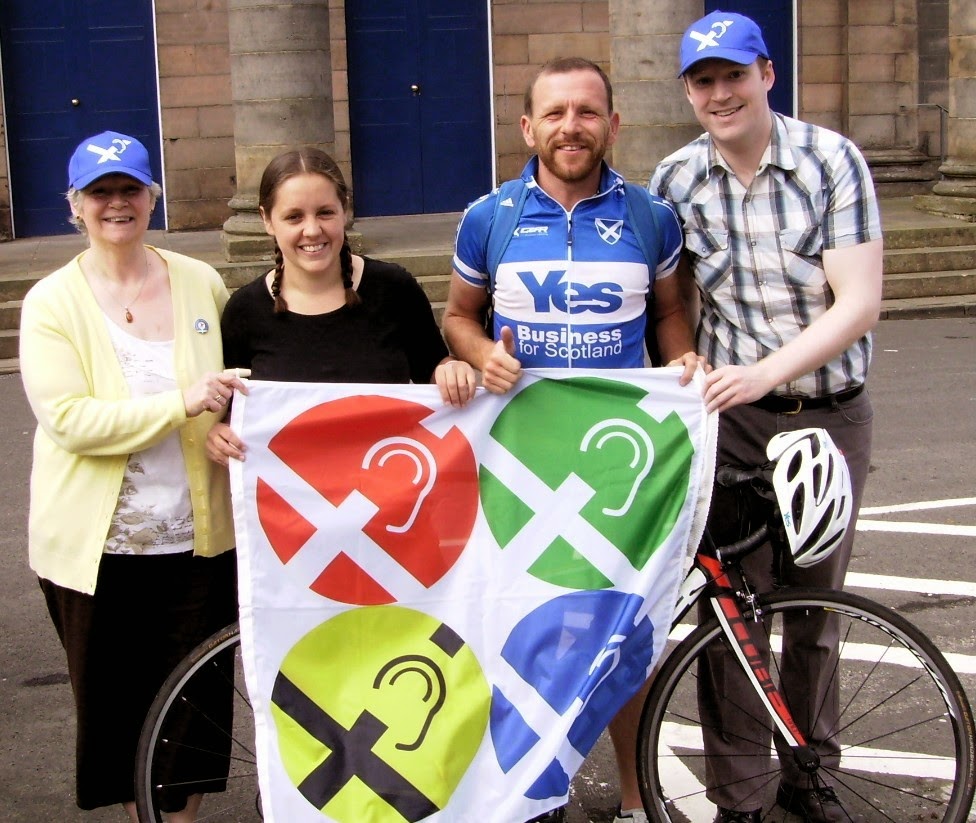
  
 
Other images include at the 2013 Independence March and Rally, at the Scrap Trident Rally in Glasgow and wee Mo meeting Yes Scotland board member Tasmina Ahmed-Sheikh:
 
  
Favourite photo we've seen
The British state broadcaster has been at the heart of the no campaign and our favourite photo from online comes from one of the BBC bias demonstrations. This has become even more poignant following the outburst by senior BBC political correspondent Nick Robinson.
 
  
Other images include Kirsty from Yes Scotland, the Radical Independence take-over of Glasgow and the Yes Scotland message to our friends from across the EU.
 
 
Favourite video
We've seen so many great videos during this campaign, but for us at Sign for Scotland, we find ourselves returning to this rendition of our national anthem by the ladies of 'Signed Songs R Us'.
  
  
Other videos include messages from Pink Indy Lassies, 'The morning after' by Lady Alba and the Independence Live broadcast of Veterans for Independence (which featured a live BSL signer).
 
 
Favourite blog post
Now this will be tricky! There have been so many great features that we have read during the campaign and so many more that we haven't that this is going to be just a very incomplete list, but the one that made the strongest connection with the Sign for Scotland team came from Wee Ginger Dug; 'Proud like a Yes swan'.
  
Other memorable reads include 'The McCrone Legacy' by Dale Ross on Wings over Scotland
And Derek Batemans fantastic slapdown of the Editor of the Scotsman in 'To the Editor'
 
Favourite resource
There are lots to choose from the Yes side of the campaign and because of that we've going to stick to the most prominent (although a special mention for Peter Bell's Referendum 2014 has to be made as he has been a great friend to Sign for Scotland and his comments to stories are always thought-provoking and based on reason).
  
The number 1 resource has to be the Wee Blue Book. Get it, share it, download it, send it to everyone you know and send it to everyone you don't know. The more people who read it, the more who will vote Yes.
  
The Scottish Government's White Paper on Independence (the summary of which can be viewed in multiple languages, including BSL), Business for Scotland, and Newsnet Scotland are all well deserving of praise.
 
  
Friends we've lost
I'm certain that everyone will know someone they have lost who would have wanted to see an independent Scotland, so this space is for them. RIP Margo MacDonald.
 
 
Friends we've gained
We've seen so many people campaigning for a better Scotland and we consider each of them a friend. So many thanks to Labour for Independence, Women for Independence, Scots Asians for Yes, the different political parties who back a Yes vote, Scottish CND, the Sunday Herald, Blair Jenkins, Dennis Canavan and everyone else at Yes Scotland.
  
 
Shameless plug
And finally, here are our 3 most popular videos from the campaign: I'm voting Yes, Reasons for Independence and Journey to Yes.
 
 
All that is left to say is 'thank you' to the 1,700+ people who have given us a 'like' on Facebook, the 2,000+ people who follow us on Twitter, those who contributed to our blog reaching over 70,000 hits and those who have added to the 5,000+ views we've had on our YouTube channel.
  
We are so close to regaining the powers we need to make a better Scotland. A more representative democracy, an end to paying for Westminster's waste and folly, a more peaceful foreign policy, a constitution written by us which will guarantee our rights, a cleaner environment, a more competitive economy and the breakup of media monopolies is the prize on offer. Let's take it with both hands and Vote YES!
Drew (and everyone else at Sign for Scotland HQ)

Friday, 22 August 2014

Plans A, B, C, D and E (I know you don't care about currency but it's the only thing the Westminster Defence League talk about)

We at Sign for Scotland were recently asked about the best way to respond to people who bring up the topic of currency. So here is our handly little guide. Just remember that the best references  to this subject can be found in the 'Wee Blue Book' (starting on page 11) and on the Business for Scotland website (especially the article 'Euro, Pound Sterling or Scottish Pound'). The different options available to us are also listed on the Scottish Government's White Paper on Independence (starting page 109).
 
If the show 'Spice and Wolf' can use a wolf deity to explain economics then so can we!

Currency Union
The term ‘Currency Union’ can be a bit mis-leading. It has nothing to do with using the £ itself (as options 2 and 3 below will prove), it only means that the Bank of England will continue to act as ‘lender of second last resort’ (see reference [1] and [2]). The main feature of this approach is that things remain the same for people on both sides of the border. There will be no transaction costs and banks operating in Scotland have a local lender with the ability to shore up their finances. This option gives the Scottish Parliament no direct control over the supply of money, although we have the flexibility to set our own tax types and rates [3] [4].
  
This approach was successfully used by Luxembourg and Belgium for over 7 decades [5] and could be replaced with any of the other options listed at a future date. Below is a video in BSL explaining why Westminster will want a currency union, and why they are pretending to be against it during the referendum campaign.

 
Sterlingisation
Sterlingisation means using a currency without having a central bank. This is the same as ‘Dollarisation’ and is a popular choice around the world [6]. In our case, Sterlingisation results in us using the £ as normal, as well as reduced debt payments to Westminster. This is because the Bank of England holds a number of assets that would be withheld from us [7], and thus we would not be liable for any debt that was accrued to secure those assets.
  
Sterlingisation would not affect the guarantee on savers, which means savers with up to €100,000 in their accounts will continue to be protected [8]. Banks operating in Scotland would not be guaranteed bailouts should they fail, which will force them to act more responsibly [9]. This can be achieved without agreement with Westminster and be replaced with any of the other options listed at a future date.

Scottish Currency pegged to the Pound
The third option is for Scotland to have its own currency that will have the same value as the £. Bank of England notes would continue to be accepted in Scotland, and the Scottish Parliament could, at a future date, decide to remove the peg (see option 4) giving much more freedom of choice to future generations.
 
A Scottish Central Bank would be formed (or an existing bank in Scotland could be changed into a central bank) which would adopt the same functions that the Bank of England currently has. The strength of this central bank would depend upon the post-referendum negotiations: if our share of the Bank of England’s assets were transferred, then the corresponding levels of UK debt would be transferred too. If no assets were transferred, then Scotland would have vastly reduced debt payments. This is the option that Switzerland successfully uses today [10]. Any transaction costs would be small as a Scottish Pound and a Bank of England Pound would have equal value.

The new no campaign poster
Scottish Currency that floats freely
This approach would see Scotland have its own Central Bank and currency. There would be transaction costs when trading with the UK if we picked this choice similar to those we have when trading with the rest of the world. The advantage of this option is that full control over the supply of money would be held by the Scottish Parliament. The result of this option would be that Scottish bank notes would have a higher value than those produced by the Bank of England [11], which means that anyone holding Scottish currency (i.e everyone in Scotland) would become wealthier, as our money could purchase more goods from abroad than before. The downside is that our exports would become more expensive to others and tourists would view Scotland as a more pricey place to visit.

We're pretty sure Holo is not refering to this story here
Euro
Scotland cannot officially use the Euro due to ERM2 [12]. ERM2 demands that any country that wants to join the Eurozone has to be using a currency that is ‘pegged’ to the Euro for at least 2 years. Scotland can only meet this qualification if we adopt option 4 for at least 2 years (which isn’t physically possible as our independence day will be the 24th of March 2016 [13]). Scotland could unofficially use the Euro in the same way as we could use the £ in option 2 however there are few immediate advantages with this approach.
 
  
After Independence there will be even more options to pick from however those will be discussed and debated at elections. We, the people who live in Scotland, will get to decide what we want. That's the spirit of democracy and something that Westminster doesn't offer. And it's one of the best reasons to vote Yes.
Drew
 
If you like this blog, then please consider visiting our other sites:
Facebook - Sign for Scotland
YouTube - Sign4Scotland
Twitter - Sign4Scotland

List of references:
[1] Crisis, Conditions, and Capital – The Effect of International Monetary Fund Agreements on Foreign Direct Investment Inflows [Nathan M Jensen, Department of Political Science, Washington University, St. Louis] - http://jcr.sagepub.com/content/48/2/194
[2] U.S. planned British economic bailout in the 1970s, newly released documents reveal…with haunting echoes today [Dan Atkinson, Mail on Sunday Economics Editor] - http://www.dailymail.co.uk/news/article-1266871/A-warning-British-economy-haunting-echoes--34-years-on.html
[3] The race that’s never run [Reverend Stuart Campbell, Wings over Scotland] - http://wingsoverscotland.com/the-race-thats-never-run/
[4] Tax rates online [KPMG, international audit, tax & advisory company] - http://www.kpmg.com/Global/en/services/Tax/tax-tools-and-resources/Pages/tax-rates-online.aspx
[5] Belgium-Luxembourg Economic Union [Encyclopaedia Britannica] - http://www.britannica.com/EBchecked/topic/59408/Belgium-Luxembourg-Economic-Union
[6] Dollarization [How Money Works, William F Hummel] - http://wfhummel.cnchost.com/dollarization.html
[8] Deposit Guarantee Schemes [The EU Single Market, EC Europa] - http://ec.europa.eu/internal_market/bank/guarantee/index_en.htm
[9] An independent Scotland should use the pound without permission from rUK, says new ASI report [Adam Smith Institute] - http://www.adamsmith.org/blog/money-banking/an-independent-scotland-should-use-the-pound-without-permission-from-ruk/
[10] Swiss National Bank pegs franc to euro [The Week, Business magazine] - http://www.theweek.co.uk/business/2433/swiss-national-bank-pegs-franc-euro
[11] Scottish independence gets boost from Hong Kong’s money markets [South China Morning Post] - http://www.scmp.com/news/hong-kong/article/1224903/scottish-independence-gets-boost-hong-kongs-money-markets
[12] Euro, Pound Sterling or Scottish Pound? [Gordon MacIntyre-Kemp, Business for Scotland] - http://www.businessforscotland.co.uk/euro-pound-or-scottish-pound/
[13] How will Scotland become independent? [Yes Scotland] - http://www.yesscotland.net/answers/how-will-scotland-become-independent

Wednesday, 20 August 2014

The Negotiator

The strength of Scotland's position in post referendum negotiations is completely dependant upon the outcome of the vote. A Yes makes us much, much stronger. A no makes us weaker. Here are the reasons why:
 
 
Strength of Yes
Scotland as a country is fundamentally self-sufficient. We produce excesses of electricity, have abundant supplies of water, export food and textiles and generally have most of the other essentials of life. We have a balance of trade surplus as a result of our natural resources as well as other industries, and with a significant tourism sector we have no problems with brand recognition or sources of revenue.
 
The things that the UK offer aren't important. We don't need a vast military as we have no nearby threats, we don't need a permanent seat in the UN security council, and we certainly don't need nuclear weapons. Our largest market is provided by the EU (and which the EFTA could equally offer) and the currency is fully tradeable. There isn't anything that we need to have from Westminster.
 
The UK however has a debt problem that isn't getting better, and the £ needs more exports to guarantee its value. The UK also has significant trade with Scotland that it will need to protect and the prospect of leaving the EU is very real, making good relations a priority. And, strictly speaking, the liability for current pensioners will not change, as their national insurance contributions were paid to Westminster. Starting with no debt or pension payments will mean Scotland will begin with a very lucrative budget surplus.
 
Finally, the Westminster negotiators are rubbish. Because the path to power is guaranteed, the people who gain high politicial office don't require any special talent or skill. The Westminster system is a lazy system that lacks the competitive nature of a proportional parliament. We will have the more skillful negotiators, and we will be giving them the best possible hand.
  
All of this means that Scotland holds the advantage in any negotiations. And there are plenty of things that could be done to make Westminster squirm (like demand the immediate removal of Trident or insist on an audit of the UK's debt - both of which they will not want).

 
Weakness of no
A no vote leaves Scotland vulnerable. With independence no longer an option (thus making us dependent on Westminster) there is no incentive for any further devolution. Indeed, both halves of Westminster have an incentive to reduce the importance of Holyrood.
 
A no vote also means a cut to the Scottish budget is not only a possibility but a likelihood. The fact is, Scotland more than pays its way and is a net-contributor, but that won't stop Westminster politicians from demanding that spending is cut here. The current system makes no allowance for where money is earned and the only UK 'region' which will be viewed as an exception is London and the South East.

 
With no means to defend ourselves and every reason to cut, Westminster will view a post-no Scotland as a means to secure more votes in England, and deny reform for a generation.
 
You don't have to be a great negotiator to see the difference. A Yes vote means that Westminster is left over an oil and whisky barrel. No leaves us open to no end of cuts and the prospect of a weakened Holyrood. Even if you don't want Scotland to be independent, you can see how independence is the best way to protect our interests.
Drew
  
If you like this blog, then please consider visiting our other sites:
Facebook - Sign for Scotland
YouTube - Sign4Scotland
Twitter - Sign4Scotland

Friday, 8 August 2014

FREEDOM (of information)!

We at Sign for Scotland have been busy making our first freedom of information request. On the 5th of July we sent a message to the Scotland Office asking them how many BSL copies of their anti-independence leaflet 'What staying in the United Kingdom means for Scotland' had been issued (the one that was sent to every household in Scotland at our expense).
 
This was inspired by the BBC's FoI request made in May regarding the number of copies of the White Paper on Independence that had been ordered in BSL. The answer (which we didn't receive until today - the 8th of August) might surprise you:
 
'What staying in the United Kingdom means for Scotland'
Number of BSL copies: 0 (zero)

Back in May, John Denerley, from Deaf Connections, stated that the number of BSL copies of 'Scotland's Future', the White Paper on Independence, had been "...ridiculous, shocking, and frankly embarrassing...". We wonder if the BBC will seek a similar quote from him regarding the UK Government's 0 availability (there wasn't even an option on-line to view or request a BSL version).
 
As reported on Newsnet Scotland, the information from the Scottish Government's White Paper has been available in a number of locations and formats. At that time, the BSL summary of Scotland's Future, which is over 2 hours and 20 minutes long, had received over 500 plays, and videos from ourselves and Scottish Deaf Independence had received even more.


But the UK Government's lack of consideration for the Deaf isn't the main issue. The topic that should be our focus is in regards to the BBC. Three questions emerge:
 
First - Did the BBC make a Freedom of Information request regarding Deaf access to the UK Government's referendum material as they did for the Scottish Government's?
 
Second - If not, why not? Freedom of Information requests are not difficult and had produced a story that featured prominently on their news website and was commented on widely. If they did, then why did they withhold this information from the public, and who was involved in the decision?

And finally - Now that they are fully aware, will the BBC give this story the same prominence as they gave to their anti-independence report? If not, why not?

You can view the Scotland Office's full response below. Despite the date showing as the 28th of July, we only received this letter by email today after requesting an update earlier this week. As of yet, no physical copy has been delivered.

 
Unlike the BBC, we are happy to offer them the right of reply to our article.
Drew
  
If you like this blog, then please consider visiting our other sites:
Facebook - Sign for Scotland
YouTube - Sign4Scotland
Twitter - Sign4Scotland

Sunday, 3 August 2014

What would you like in the constitution?

The UK does not have a written, codified constitution. It is the only country in the EU to not have such a document and one of just five in the world (the others being Israel, New Zealand, Saudi Arabia and Canada - although Canadian provinces do have the right to create their own constitution).
 
But what difference does this make? A constitution guarantees the rights and freedoms of all citizens. It ensures that everyone is equal in the eyes of the law and that power lies with the people and not parliament. Constitutions are also important because they can ensure that new laws meet certain standards.

 
The following comes from the National Archives of Australia:
Seven reasons why our Constitution is important to you
  • Australia wouldn't exist without the Constitution. In the 1890s the people of six British colonies (now the states) agreed to unite under one Constitution as the Commonwealth of Australia.
  • We Australians were the first people in the world to vote on our national Constitution. And today, the Constitution can only be changed if we agree to it through a referendum.
  • Imagine trying to envisage what life would be like in 100 years time – and creating a Constitution to meet future needs. That's just what the key players did in the 1890s – they created a Constitution that still has relevance to our complex life today, with our mobile phones and internet connections.
  • Our federal parliament was designed by the Constitution. It allows for an upper and lower house and for elections every three years. It also ensures that Senators and Members of the House of Representatives are directly chosen by the people. And, if we want to, we can stand for Parliament ourselves.
  • Our Constitution obliges all Australians to obey the law – even politicians and governments. The High Court was set up as a separate power from the Parliament and has, at times, overturned decisions made by the Australian Government as unconstitutional.
  • The Constitution also has an impact on our personal lives by dividing up powers between the Commonwealth and the states. The Commonwealth makes laws on a range of issues (such as regulating marriage and divorce) but allows other powers (such as providing roads and transport) to remain with the states. 
  • The Australian Constitution provides some rights for all Australians, such as freedom of religion and the right to compensation if the government acquires your property. 
Instead of having a clear, easy to understand constitution, the UK Government prefers to have power at Westminster. This means that the protections our Australian cousins enjoy are not equally guaranteed to us.

Other countries use their constitution to protect certain groups, including the Deaf. In Austria they included an amendment which reads: "Austrian Sign Language is recognised as an independent language. The laws will determine the details." This may not appear to be much, but every law passed in the Austrian parliament has to ensure that this rule is not broken.

Österreichischer Gehörlosenbund meeting in Austria
Section 17 of the Finnish constitution reads: "Right to one's language and culture [...] The rights of persons using sign language and of persons in need of interpretation or translation aid owing to disability shall be guaranteed by an Act."
 
There are other examples from Europe, Africa and Latin America. This is something which we can push for and improve upon in a Scottish Constitution.
 
The Scottish Government's proposed interim constitution, to be adopted in 2016, includes the following:
  • Setting up an "inclusive and participative" constitutional convention in 2016 to draw up a permanent constitution
  • Giving Scots the right to a healthy environment
  • Committing the government to removal of nuclear weapons
  • Prioritising the promotion of international peace
  • Enshrining the principle of local government
It also contains this message:
"Many constitutions contain provision about national and official languages and although there is no language provision in the Scottish Independence Bill the Constitution Convention, as stated in Question 589 of Scotland's Future, could consider the constitutional status of Scotland's languages such as English, Gaelic, Scots and British Sign Language." The Scottish Independence Bill: A consultation on an interim constitution for Scotland, Page 67
This shows that the needs of BSL users in Scotland are being considered, but we need both a Yes vote in September and to ensure that we get involved.

The final constitution will be written by us, the people who live in Scotland and anyone can contribute. To highlight this point, we have put below our submission to the consultation. It lists what we would like to see entered into the constitution. We want this message to be considered before any law is passed:


But what would you like included in the constitution? You can send a submission to the Scottish Government's consultation which can be found here. But don't forget, the only way to gain a constitution is if Scotland has the powers of an independent country (so we need to vote Yes!).
Drew
 
If you like this blog, then please consider visiting our other sites:
Facebook - Sign for Scotland
YouTube - Sign4Scotland
Twitter - Sign4Scotland