Showing posts with label Change. Show all posts

Wednesday, 25 June 2014

Not in the News - Late June edition

Welcome to the seventh of our bi-monthly series looking back at the stories which the main stream media in Scotland didn't offer much attention to, and comparing them to those that hit the front pages. Our last edition covering early June can be found here.

 
Westminster's £140,000 questions (that we aren't supposed to know the answers to)
It turns out that Westminster has spent £140,000 of taxpayers money on examining Scottish attitudes to independence.


Whilst they are entitled to this, they would not be entitled to share this information with one side of the debate and not formally declare this spending with the Electoral Commission as it offers a distinct and unearned advantage. This was point of a recent freedom of information request made by Reverend Stuart Campbell at Wings over Scotland.


Westminster's £720,000 no campaign leaflets (that the Electoral Commission isn't counting)
The BBC's Tim Reid highlighted a story in June that the UK Government was planning on spending £720,000 of taxpayers money on posting anti-independence leaflets to almost every house in Scotland. This will not be counted against the official no campaign expenditure limit.

 
This isn't particularly surprising. Voters in Quebec will be familiar of state government interventions in referendums and how important they can be. Just see this story from CBC News from 2007. What is surprising is that voters in England, Wales and Northern Ireland are willing to have their taxes spent in this manner (unless this becomes classified under 'Scottish Expenditure').
 
A desperate smear and a regular smear
With 100 days to go the no campaign held a rally. This was how it was described by the Times newspaper:
“[Alistair Darling] was the only politician to speak at the Better Together rally in Glasgow. All the others were ordinary men and women who had volunteered to talk about why they were campaigning to keep Scotland in the United Kingdom.
They were led by Claire Lally, a mother from Clydebank, with a child with serious health problems.” Times newspaper, 10th of June 2014
It was later revealed that this wasn't necessarily accurate, as Ms Lally is in fact a member of Labour's shadow cabinet in Scotland and has been for some time. You can see this screenshot from Jackie Baillie MSP's website welcoming her. And STV highlighted Ms Lally introducing and launching Johann Lamont’s Scottish Labour leadership bid in November 2011.


There is nothing wrong with Ms Lally declaring her support for a no vote, however it is mis-leading to suggest that she is not involved in politics. This prompted an advisor to the First Minister, Campbell Gunn, to contact a newspaper to highlight this point.
 
The issue came when Mr Gunn (wrongly) said that she was also the daughter-in-law of former Lord Provost of Glasgow Pat Lally (who shares the same name). This was incorrect and the advisor issued a public apology.
 
This created the following headlines: "Claire Lally row: First Minister under pressure to fire special adviser" (The Courier), "The dark side has lured Gunn across the line" (Telegraph) and "Make no mistake, Alex Salmond approves of abusive tactics" (Express).

"Only Yes supporters make abusive comments," MSM (probably)
The independence campaign has been bitter at times. Last year, on "Scottish Labour for Scotland" Facebook page, a person named 'Daniel Kelly' made this remark following the announcement that Alex Salmond's aunt had passed away:
"Don't you wish his dear old dad did the same."
When faced with criticism that many senior members of the Labour Party were both members of the group and friends with Daniel Kelly, the official Labour Party response at the time was:
"This desperate smear campaign falls at the first hurdle because this Facebook page is not owned, managed, or operated by Scottish Labour, and it will not detract from the rantings and ravings of SNP candidates - sacked or otherwise - online."
Despite the ill-tempered language, the independence movement in Scotland has been one of the most peaceful in history. It is an inspiration around the world and should be praised. To ensure this remains the case we would prefer if the media stopped presenting the campaign as one side attacking the other (especially when many of the alleged perpretrators have been the victims of death threats).

 
How much hurt Ms Lally experienced from the mistaken identity of her father will never be known (although we suspect it was less than that suffered by David Ferguson in 2010). Hopefully the media will recognise that using terms such as 'attack' and 'vile' are not accurate or helpful, and that blame should be placed upon the few morons who do commit actual abuse, instead of against everyone with a computer who supports independence.
 
Oh dear, Scotsman "newspaper"...
The referendum campaign has been terrible for the Scotsman newspaper. A massive fall in sales, coupled with the disastrous 'Klan Alba' headline which had suggested that anyone considering voting Yes could be Klu Klux Klan and Nazi sympathisers, the tabloid has struggled badly, and in June they took another step towards oblivion with the posting of an untrue statement against Reverend Stu of Wings over Scotland.

  
The Scotsman edition from Friday the 13th of June claimed that he had 'used the site [Wings over Scotland] to call on nationalist campaigners to photograph their opponents so that they can be publically identified." This wasn't true as the response from Revened Stu explains. The newspaper pulled the article from their website, but no correction or apology was issued until the 19th.
 
We don't believe that the Scotsman has much of a future whether Scotland votes Yes or no. The paper appears to have lost any sense of professionalism and will only be remembered as an example of the controlled media at its very worst.
 
Lights, camera, action!
The much ridicled 'no' campaign cinema adverts were recorded at Pacific Quay, the headquarters for the BBC in Scotland. Impartiality from the British State Broadcaster...not a chance!

 
We don't need no education (another Brown in the Westminster wall)
Amongst the promises of more powers (also see here) for the Scottish parliament, there was hints as to what powers the UK Government is looking to take from Scotland. Former Prime Minister Gordon Brown spoke of his desire for education (which has always been in Scottish hands) to be controlled by Westminster.

Gordon Brown's school days
This 'one nation' approach to education is likely to see £9,000 per year tuition fees, and more privatisation of education services. Control over education, health and our legal system can all be lost if we vote no. Only independence guarantees that the wishes of the people of Scotland always matter.

Of course, you could trust Westminster's promises (just don't trust their memory).

BBC Strangelove (or how I learned to stop thinking and love the bomb)
Oh the BBC. They are, by far, the most frequent contributor to our 'not in the news' series. Without them we wouldn't receive our near daily laugh at how ridiculous our media currently is or how, time after time, they consistently miss the point or completely ignore reality. On this occasion, they were discussing the results of the annual British Social Attitudes survey.
 
Here are the results of people's attitudes to the question: 'Are you in favour or against Britain having its own nuclear weapons?'

 
This question does not consider independence or our opportunity to remove Trident and other non-conventional weapons from Scotland, only the principle of whether Britain should host Atomic Bombs. As you can see, the attitude in Scotland is very different from that in England and Wales. So how will this be reported on the BBC in Scotland?

Oh BBC in Scotland. Shall we list the problems with this graphic? Thankfully, Scot Goes Pop has already done this:
  1. The overall survey shows that the Scottish Public are against Britain having nuclear weapons, so it is ridiculous to argue that people want Trident to stay in Scotland when they are against the weapons in principle.
  2. Most respondents are therefore looking at the practical situation based on the assumption that these weapons will remain (essentially because they have already been asked if they want Atomic bombs or not).
  3. This is a sub-sample poll, which means that the margin of error is larger than normal. The 9% lead for the UK scrapping Trident is much more robust than the 4% lead for these weapons staying on the Clyde on the basis that they will remain in the UK arsenal.
There is also a fourth issue: the question asked to people in Scotland was different to those in England and Wales. Despite the BBC reporting that the question was '"do you think that the United Kingdom should be required to remove its weapons in an independent Scotland," the real question asked was:
"How much do you agree or disagree with the following statement? If Scotland becomes an independent country, Britain's nuclear weapons submarines should continue to be based in Scotland." Social Attitudes Survey Question
The Vanguard-class submarines are capable of using alternative munitions, meaning that this question doesn't address the central issue. Of course, the only reason someone would ask such an awkwardly worded question is if they wanted to show artificial support for nuclear weapons in Scotland.
 
The BBC, providing comedy instead of news for just £145.50 a year (perhaps we are being unfair - if they did start reporting news then the Westminster MPs who control their funding may act upon their threats. It's much safer to stay in their good books, isn't it?).
 
Everyone hates you
We've mentioned before that the most cynical aspect of the no campaign is its attempts to portray Scotland as having no value. The international version of this has came back in recent days, with David Cameron asking the Chinese Premier Li Keqiang stating, unsurprisingly, that large centralised states should remain large centralised states.

 
But around the same time, China was making other anouncements, including one confirming support for Argentina's claim over the Falkland Islands (also known as 'Las Malvinas'). Westminster politicians seem happy to support attacks on Scottish sovereignty, but less enthusiastic regarding their control.
 
Cupcakes (a subject close to my heart)
The licence fee is expensive, isn't it? £145.50 for colour TVs. Imagine what you could buy with that money in your pocket. Enough for cupcakes for an entire production crew with change left over! We know this because one BBC executive did just that!

 
Shane Allen, comedy commissioning controller (which I am sure is an absolutely vital job), thought it would be a nice gesture to buy cupcakes for staff involved in the making of two programmes he was involved with. He then thought it would be even nicer if he passed on the £120.00 bill to us. Thank you Shane. I'm glad that I could contribute to the cupcake bill at the BBC!
 
But what other food and drink costs do the BBC pass on to licence fee payers? Well someone did make a freedom of information request but the British State Broadcaster is a little slow in responding...

Money, Money, Money
The BBC (yet again) got its facts wrong.


In the original report regarding the first days of the Republic of Ireland, the BBC wrongly claimed that the Pound ceased to be used and that the state created its own currency from day one. In the corrected version they finally acknowledged that this wasn't true. The Pound was used for 7 years without any issues. We have already explained why this would be the case in our blog 'so who else can't use the pound?'
 
Money, Money, Money (2)
The Sun newspaper was the latest to show that it doesn't understand how currencies work. In June, they produced the headline SCOTS CURRENCY 'BEING PLANNED', which unfortunately for the Sun, wasn't true.
"The lie that an independent Scotland couldn’t use the pound is the most brazen and indisputable falsehood of the entire referendum debate. Even though there’s no chance in any sane reality of Scotland being kicked out of the EU or NATO even temporarily, it’s nevertheless not possible to state as an absolute 100% certainty that neither thing would happen.

But currency is different. It’s an unarguable fact that Scotland could keep using Sterling with or without an official currency union. Everybody knows it. If you put it directly to any No-camp politician (as almost no journalist ever does), they’ll harrumph and grump and say why it’s a bad idea and try to change the subject, but eventually they’ll admit that yes, it’s true – Scotland COULD keep the pound.

And then they’ll put out another leaflet maintaining the lie that it couldn’t." Wings over Scotland, 20th of June
Are you on the list?
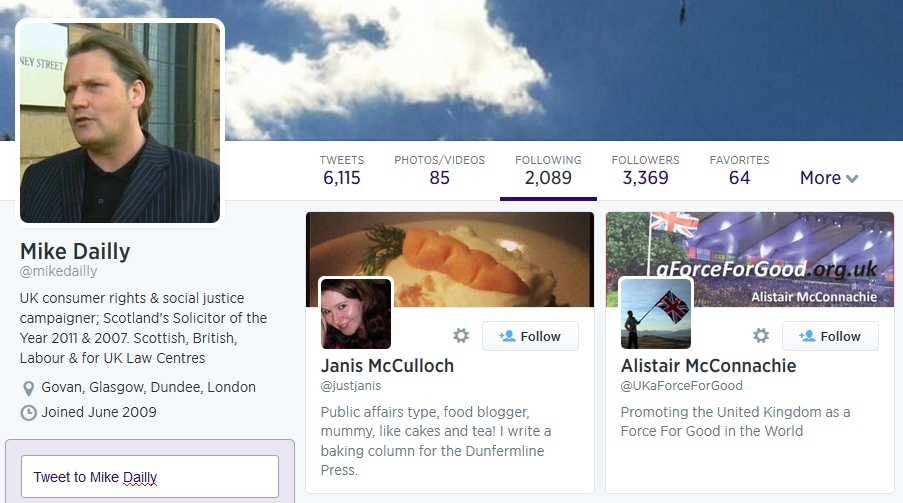
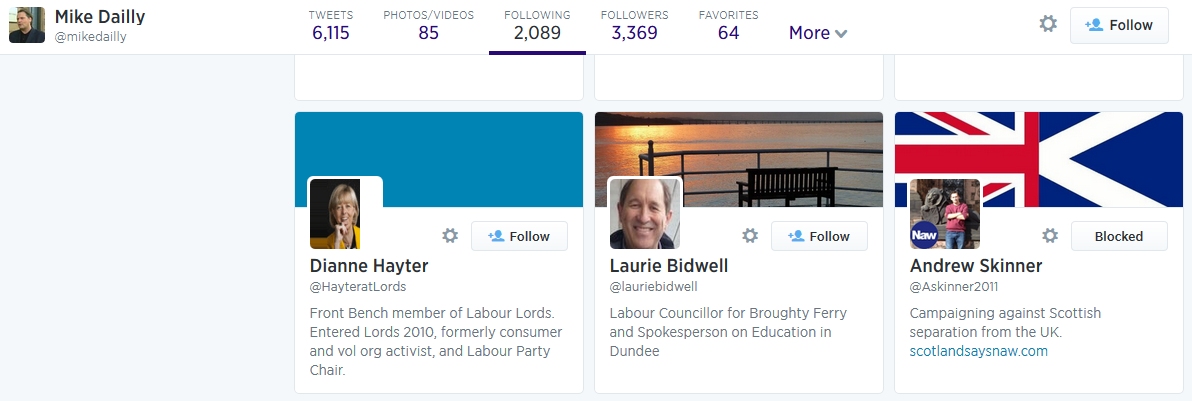
During June, Mike Dailly from Govan Law Centre made an announcement on Twitter that he was "working on publishing a list for the national media of who supports @RevStu on social media". @RevStu is the personal twitter account for Wings over Scotland founder Reverend Stuart Campbell.
"Ironically for a self-professed socialist and trade union fan, Dailly appeared to be suggesting that he was engaged in creating some sort of a blacklist to be circulated to the media, in which anyone who followed me would be incriminated by association.
 
That this is perhaps a somewhat inconsistent policy for someone who follows the Holocaust-denying ex-UKIPper and present-day loony Alistair McConnachie (see here), and extremist Loyalist nutcases Andrew Skinner and “Stronger United”, among lesser trolls, seems to have gone over Mike’s head somewhat." Reverend Stuart Campbell, Wings over Scotland
And the outcome of this action from Mike Dailly? The number of followers for @RevStu increased by over a third within 24 hours.

 
You can also buy "I'm on the list" items at the Wings over Scotland store!
 
What you can't (but we can) say
Newsnet Scotland released an episode of Duggy Dug entitled 'the no nightmare' in June. The cartoon showed a possible future for Scotland based on statements and policy aims made by the UK Labour and Conservative Parties (the only parties who can form the government at Westminster).

Duggy Dug, the latest evil and dangerous Cybernat!
The video included a cartoon of Johann Lamont MSP dressed in a House of Lords robe with a badge entitled 'Vermin in Ermine'. This was to symbolise that her opposition to independence could be motivated by a potential reward from the British state. The phrase 'Vermin in Ermine' was heavily criticised by certain figures and the official no campaign:
"This is yet another absolutely disgraceful attack on a woman by a nationalist group. We hope that Newsnet do the decent thing, take down the film and apologise. Calling someone 'vermin' because you happen to disagree with them is just not on." Better Together (no) spokesperson.
However, the term 'Vermin in Ermine' was originally coined by former deputy Prime Minister Lord John Prescott. In a statement, a Newsnet Scotland spokesperson said:
"We used John Prescott's 'vermin in ermine' term in order to illustrate the hypocrisy that surrounds Labour politicians when it comes to the House of Lords'. Newsnet Scotland, 21st of June
 
Newsnet also highlighted that claims the video was against women were mis-guided as the animator behind the Duggy Dug cartoons is herself female. We're sure that the newspapers will highlight this double standard and that the no campaign will apologise for their mistake and see the funny side of this parody (or maybe not).
 
Protest? What protest?
The protest against austerity in London was recorded in much of the international press in June. An estimated 50,000 people were present making it a pretty significant story. But the BBC and other controlled media outlets barely offered a mention.
 
 
The BBC had time to cover a much smaller protest by some London Taxi drivers, and to track down a Scot who was cheering on Uruguay at the World Cup, but not this? It's almost as if they were simply there to protect and advance the interests of the British State.
 
Any time, just not then...
On Sunday, the 22nd of June, we met by the news that there would be a debate between First Minister Alex Salmond [Yes] and Alistair Darling MP [no] on STV. On Tuesday, 24th of June, we were told that this wasn't going to take place. The reason...the no campaign didn't like the proposed date.

Yes, the same no campaign which cried, "if he [First Minister Alex Salmond] wants a debate, Alistair Darling...is ready to have one any time, any place, any where," pulled out of the debate because of its timing. Although this has caused much laughter amongst the online community (see here) it does prevent voters in Scotland from receiving both sides of the argument and thus hurts our democracy.
 
The decision by the no campaign to withdraw follows similar approaches taken by various no campaigners across Scotland. They have refused to have a debate between Alistair Darling and Dennis Canavan (the chair of the no and Yes campaigns respectively), refused to have a debate hosted by the Electoral Reform Society between Yes and no campaigners in Glasgow (or to help jointly arrange a meeting with Yes activits) and even told a unionist MSP not attend a debate by 'better together bosses'.

"I would debate, if only I had a little courage," Alistair Darling (probably)
Whilst there has and will be coverage of this attempt to scupper a debate, the controlled media will not highlight all the other instances where voters have been denied a chance to challenge both sides. Of course, there is a reason why those desperate for a no don't want you to see the arguments.

Does David Cameron know where the UK is?
The twitter account UK Prime Minister (@Number10gov) issued a tweet on the 23rd of June stating "By staying united we have much more to share and much more to gain. #UNITEDKingdom" along with a picture of what Mr Cameron's staff must have thought was the UK. There was just one large problem.
 
The Isle of Man Government issued the following reply:

 
In the words of Pride's Purge: "[I]s it only me finds the levels of amateurishness emanating from Cameron’s office truly embarrassing? 
  
Join us again in the middle of July for our next look at what's 'not in the news'!
Drew
 
If you like this blog, then please consider visiting our other sites:
Facebook - Sign for Scotland
YouTube - Sign4Scotland
Twitter - Sign4Scotland

Tuesday, 17 June 2014

The folly of Trident

Nuclear weapons have no military use. They can't destroy every target, they can't be used anywhere near your own troops and their expense draws funds away from conventional forces, including personnel, equipment and technology. They are utterly worthless against terrorism and always run the risk of being detonated by accident.
  
Even arguments that they prevent war only apply to superpowers like America and Russia, and even then it is debatable.
  
Nuclear weapons have one purpose, destroying mass civilian areas. Mutually Assured Destruction was based on the principle that neither side of the cold war would launch a full scale attack as the retaliation would result in the slaughter of their own citizens in every town and city. And yet this still didn't stop military personnel from suggesting that they should go ahead and do it anyway.
  
Let's look at the effects of what they were contemplating:


Look at how it destroys people's lives:


Look at the devestation it creates:


The effects of an nuclear attack can be classed into four categories: Instantaneous, Near-immediate, Short term and Long term.

Instantaneous
"The heart of a nuclear explosion reaches a temperature of several million degrees centigrade. Over a wide area the resulting heat flash literally vaporises all human tissue. At Hiroshima, within a radius of half a mile, the only remains of most of the people caught in the open were their shadows burnt into stone." CND UK
Near-immediate
"People inside buildings or otherwise shielded will be indirectly killed by the blast and heat effects as buildings collapse and all inflammable materials burst into flames. The immediate death rate will be over 90%. Various individual fires will combine to produce a fire storm as all the oxygen is consumed. As the heat rises, air is drawn in from the periphery at or near ground level. This results in lethal, hurricane force winds as well as perpetuating the fire as the fresh oxygen is burnt. Such fire storms have also been produced by intense, large scale conventional bombing in cities such as Hamburg and Tokyo.

People in underground shelters who survive the initial heat flash will die as all the oxygen is sucked out of the atmosphere.

Outside the area of total destruction there will be a gradually increasing percentage of immediate survivors. However most of these will suffer from fatal burns, will be blinded, bleeding from glass splinters and will have suffered massive internal injuries. Many will be trapped in collapsed and burning buildings. The death rate will be higher than in a normal disaster since most emergency services will be incapable of responding due to their equipment being destroyed and staff killed. The sheer scale of the casualties would overwhelm any country's medical resources. The International Red Cross has concluded that the use of a single nuclear weapon in or near a populated area is likely to result in a humanitarian disaster that will be "difficult to address". There is currently no international plan in place to deliver humanitarian assistance to survivors in the case of a nuclear attack. Most casualties would receive at best minimal, palliative treatment. The best they could hope for would be to die in as little pain as possible." CND UK
Short Term
"Survivors will be affected within a matter of days by radioactive fall-out. The extent of the fall-out will vary according to whether the nuclear bomb detonates in the air (as at Hiroshima) or upon impact on the ground. While the former will entail more blast impact, the latter will throw up much larger quantities of radioactive debris into the atmosphere.

The effects of exposure to high levels of radioactive fall-out include hair loss, bleeding from the mouth and gums, internal bleeding and haemorrhagic diarrhoea, gangrenous ulcers, vomiting, fever, delirium and terminal coma. There is no effective treatment and death follows in a matter of days.

At lower levels of exposure, while there is an increased chance of at least short term survival, the death rate remains high. Those who do survive face many complications. Pregnant women are likely to miscarry or give birth to babies with a range of disabilities. Healing from injuries is often slow, leaving distinctive scar tissue. Damage to the immune system is probable." CND UK
Long Term
"Radiation-induced cancers will affect many, often over twenty years later. Certain cancers such as thyroid cancer in children are particularly associated with exposure to radiation. The children of those exposed to radiation are statistically more likely to be born with abnormalities and suffer from leukaemia. Because of the long period between exposure and the onset of cancer, it is difficult to attribute a particular cancer to a particular cause. The correlation is described as epidemiological, rather as the connection between smoking and lung cancer was statistically established before the medical links had been uncovered.

Nuclear weapons cause severe damage to the climate and environment on a scale incomparable to any other weapon." CND UK
 
The question to ask is: who are willing to use these £100,000,000,000 weapons against? Since Britain first gained access to atomic bombs in October 1952, we have been involved in the following countries and conflicts:
 
Korea (Korean War), Kenya (Mau Mau Uprising), Cyprus (Cyprus Emergency), Egypt (Suez Crisis), Ireland (Border Campaign), Brunei (Brunei Revolt), Indonesia and Malaysia (Indonesia-Malaysia Conflict), Oman (Dhofar Rebellion), Yemen (Aden Emergency), Argentina (Falklands War), Iraq (Gulf Wars), Serbia (Bosnian and Kosovo Wars), Afghanistan (Fourth Anglo-Afghan War), Sierra Leone (Sierra Leone Civil War) and Libya (Libyan Intervention).
 
Which cities should we have destroyed? Should we have slaughtered the 516,000 people who lived in Pyongyang in the early 1950s? Maybe killing the 2,991,000 people in Cairo during the Suez Crisis would have helped? Perhaps levelling Buenos Aires and its 9,920,000 inhabitants would have ended the Falklands conflict quicker? The answer is none: but then what is the point of a deterrent if it is never used?
 
The money that was wasted on nuclear weapons could have been spent in other aspects of the military (or on improving the lives and economy of people at home), so what was the point of them? Did Soviet Premier Konstantin Chernenko say "we launch an attack tod- wait, Britain has a 520 atomic bombs and we only have 45,000, we need to call the whole thing off!"?

 
And then there is the risk of accidents (and there have been lots of very close calls). Here are a few examples:
 
A B52 bomber and a KC-135 tacker aircraft collided over Palomares village in south east Spain. The B-52's four hydrogen bombs (each 100 times more powerful than that dropped on Hiroshima) fell from the craft. Two remained intact whilst the others leaked radiation into the surrounding farmland and coast. Despite other munitions onboard exploding, none of the atomic bombs detonated.
  
Nuclear weapons damage at RAF Lakenheath, Suffolk, 1956
A US airforce B-47 crashed into a storage facility and leaked burning fuel over 3 Mark 6 atomic bombs. Here is the comment from the official report:

"Preliminary exam by bomb disposal officer says a miracle that one Mark six with exposed detonators sheared didn't go."


This story was widely covered in the international press.
"HMS Argyll fired a torpedo by mistake during a training drill at the Devonport dockyard in Plymouth south west England, where nuclear submarines are also docked.

The incident occurred on Wednesday afternoon, during the Navy’s Flag Officer Training.

Workers were shocked to see a 2.6-meter long torpedo shoot out of the side of a ship, fly 200 meters through the air, blast a hole through a security fence and then slam into a metal storage container." Russia Today, 14th of March 2014
These stories (and the many others like them) don't tend to get discussed by the pro-war lobbyists at Westminster. Despite the effects of an accident being partly understood, it is safest to not have these weapons in our territory at all, and to encourage others to do the same.

 
The images we used above are pretty graphic, but they are nothing compared to what you will find with a simple google search. Nuclear weapons have no strategic value. They are a relic of the cold war and are far more trouble than they are worth. Scotland should not have these weapons. Scotland should not be threatening others with industrial slaughter.
  
Our military spending should be focused on the things that actually keep us safe, our military personnel and their equipment. We should look towards offering the world something positive, not violent obsenities. With independence we can rid nuclear, chemical and biological weapons from our shores and legitimately push for disarmament through our example.
Drew
 
If you like this blog, then please consider visiting our other sites:
Facebook - Sign for Scotland
YouTube - Sign4Scotland
Twitter - Sign4Scotland

Sunday, 1 June 2014

Winds of Change

Whilst being out and about gaining signatures for Yes Scotland, I have come across on a number of occasions the phrase ‘I support independence but…’ followed by a specific issue. These take two forms: I don’t want ‘x’ to change and I don’t want ‘x’ to remain the same.

Motivational speech from Johann Lamont
For those worried about changes, we should keep in mind that Scotland will look very similar on the 31st of March 2016 (when independence will officially be declared) as it does today. We’ll still use the pound (something the Republic of Ireland successfully did until 1979), we’ll still be citizens ofthe EU (because we will have been spending the previous 18 month negotiating from within and there is no mechanism for removing citizenship from a population), we’ll still be a member of NATO (an organisation which has never expelled a country and is looking to expand), and we’ll still have the Queen as our head of state (the Queen is the shared constitutional monarch for 16 independent countries).
  
For those worried that things won’t change, we should keep in mind that Scotland’s political situation will look very different on the 6th of May 2016 (the day when the results of our first democratic election as an independent country will be announced). Instead of sending a handful of outnumbered representatives who have been elected not based on their share of the vote but through the archaic ‘first past the post system’, we will have a rainbow parliament that has been entirely decided by the people of Scotland. This will create the platform for more lively and honest debate, which will ultimately lead to better governance.

Sign for Scotland

But what about those who want to use a non fiat currency instead of the pound, or who want to leave the EU to join the European Free Trade Association, or exit NATO to join Partnership for Peace, or replace the Monarchy with an elected President? What can they do after a ‘Yes’ vote? The simple answer is that they can vote for these things because nothing will be set in stone in 2016.
  
If you want a currency that isn’t based on debt or to leave the EU then support the Scottish Democratic Alliance, if you want Scotland to be part of Partnership for Peace then campaign for the Scottish Green Party, and if you want a President then vote for the Scottish Socialist Party. These are all existing policies for existing parties, but there will be many more to choose from once we become independent.
  
Unlike Westminster, which entrenches the power of the Labour Party and the Conservative Party to ensure that no-one can break their duopoly, the Scottish Parliament uses a proportionate system.  Every vote will count, whether you live in a ‘safe seat’ or not. This also means that people will stop voting against a political party. You’ll see the end of ‘I’m supporting Labour because I don’t trust the SNP’, or ‘I’m voting SNP because I’m afraid of what the Tories will do’, and instead we’ll see ‘I’m voting for ‘x’ because I agree with ‘y’ policy’, or ‘I think ‘z’ is the best speaker’. Negative campaigning won’t work, which will lead to better dialogue, and the opportunity for real change.

The 'no' campaign's promise to Scotland
Reforms in Scotland will be rapid after independence, but they’ll also carry the support of the people, for any party which acts against the wishes of voters will quickly realise that they can turn to plenty of alternatives. Power will be spread instead of concentrated, ideas will come from the people, instead of from donors, and principles will be upheld, instead of being abandoned.
  
To return to the main point, if you vote no because your worried about change or lack of change then you will achieve ‘business as usual’ for the power elites at Westminster. They’ll be able to keep doing what they want, because we’ll not have enough strength to hold them to account. If you vote ‘Yes’ then you can ensure that we have a representative, reforming Government that we can control. I think that’s better than anything Westminster can offer.
Drew

If you like this blog, then please consider visiting our other sites:
Facebook - Sign for Scotland
YouTube - Sign4Scotland
Twitter - Sign4Scotland

Tuesday, 20 May 2014

It's time to change Locke's Socks

When mighty Theseus returned from slaying the fearsome Minotaur, the citizens of Athens celebrated.  His ship was preserved for future generations so that they could touch a piece of their history.  But the ship needed maintenance, and planks were replaced when they rotted.  A problem quickly emerged, if every plank was replaced, would the ship still be Theseus' ship, or a new vessel?  Another issue was if every plank that had been replaced were formed to make a new boat would this new creation actually be Theseus' ship?  Original, new, both or neither, the people of Athens weren't sure what the truth was.


In Scotland, our older political parties are versions of Theseus' ship.  The Scottish National Party, whilst staying true to its principle of self determination for Scotland, is very different from that which campaigned in the 1960s.  The Liberal Democrats, once dedicated to federalism, now opposes the people of Scotland having the chance to select that option through the referendum and the Scottish Conservatives once set policies in Scotland, but now blindly follows orders sent from London.


The most extreme example however is Labour.

Commitments to ending hereditary peers, the cost of education paid for by the state, and even Home Rule for Scotland have all been dropped.  We noted in a previous blog, Back to The Future, just how startling the changes are, but we aren't the only people to have noticed:
Many in Britain waited 18 years for a Labour government to come to power. However, by that time (1997) the party had reinvented itself as a Thatcher-hugging, right wing, media-friendly concern: a watered down version of the former Conservative regime with a middle class lawyer at the helm, looking like a friendly bank manager, sounding like a corporate executive and acting like a certain former grocer’s daughter. Some might say that was Thatcher’s finest achievement: the creation of the user-friendly Tony Blair to carry on her policies. - Global Research
Claiming that you vote a certain way because that is what your parents or grandparents did just isn't true.  The symbols might be same, but what they mean has changed.  You can't claim to be supporting the memories of those of the past by voting against the principles they valued.

The City thinks Westminster has changed for the better...do you?
The point of this blog is don't blindly support parties just because they claim a once meaningful logo as their own, judge them by what they offer today.  Locke's Socks need to be changed and the Ship of Theseus has set sail.  It's time to vote by principle and not name.
Drew

If you like this blog, then please consider visiting our other sites:
Facebook - Sign for Scotland
YouTube - Sign4Scotland
Twitter - Sign4Scotland

Sunday, 20 April 2014

The three poverties of Westminster

Westminster is presiding over an age of poverty in Scotland; a poverty of wealth, a poverty of ideas, and a poverty of justice. This blog will look at each in turn, and show that the only credible solution to these issues is to vote Yes to independence.

 
Poverty of Wealth
This is the form of poverty that most people will be familiar with. It is the struggle to heat a home or feed a family. It is the uncertainty of when the next wage slip will arrive. It is the fear that the social security safety net will be taken away to attract the all important southeast vote.
 
According to Unisef, 19.8% of people in Britain live in poverty compared to 4.3% in Finland, 3.9% in Norway and just 2.6% in Sweden. 14% of kids in this situation don't own a warm winter coat and 1 in 9 children in Scotland are growing up in severe poverty. The figures from The Breadline Britain Poverty and Social Exclusion report of 2013 suggests that even these numbers are understatements, with their research finding that 29% of people in Scotland are unable to afford 3 or more basic essentials.
  
Frighteningly, these numbers aren't that different from 1983. And it is unlikely that they will change for us in Scotland as the vast majority of new private sector jobs are being created in London, which is increasely becoming the primary consideration of UK Governments.
 
 
Westminster has and is failing the people of Scotland.
 
Poverty of Ideas
The only way to reduce or eradicate poverty is through ideas. We can't keep doing the same things and hoping for a different outcome. However, this cannot change under the current setup as there is an inbuilt protection of the status quo at Westminster. Only two parties can ever lead the government and they are taking increasingly similar approaches towards nearly every issue.
"Rather than opposing the Tory-led government, Ed Balls is picking a fight with trade unions. Instead of focusing energies on stopping cuts to welfare, pensions, pay and public services, the shadow chancellor is telling us to learn to live with it." Counterfire, 14th of January 2012
Instead of cutting wasteful expenditure which take wealth away from Scotland, the austerity cuts are to continue.
"Scotland cannot be the the only 'something for nothing' country in the world." Johann Lamont, Labour Party, 25th of September 2012
"...Johann Lamont, derided nationalist opposition to Trident, the Iraq war and the bedroom tax as simply "wee things" offered by independence." Guardian, 30th January 2014
Even with 'further devolution', Scotland will be unable to defend itself from decisions made by Westminster:
"Scotland will not be getting more money, it will simply be accountable for raising more of its money." Johann Lamont, 13th of April 2014
With budgets and our powers controlled by Westminster, and with every incentive to make Holyrood as weak as possible, we are left in a position where we must follow their policies even if we don't want them. The only way to change this is to vote Yes.
 
In Scotland we have a proportional system. This encourages ideas and diversity. It ensures that no party is guaranteed to return to power but instead has to continually earn votes. Those that fail disappear. It also allows people to vote positively for what they actually want, instead of negatively against what they fear. All Holyrood is lacking are the powers of a normal parliament.
 
Poverty of Justice
We have written at length, repeatedly, about the various forms of corruption that has taken over the Westminster system. We have more unelected than elected representatives, we have a host of criminal activities taking place within the City of London, and we have people voting on legislation who have an outside commercial interest in its outcome. We have a poverty of justice.

 
It doesn't need to be this way. Because there is no risk of oblivion for Labour or the Conservatives, there is no long term consequence for immoral behaviour. They don't need to be competent, wise or principled because the best way to be elected in a rigid two-party system is to make the other side appear unelectable. Campaigns are arranged through the media and not at public meetings. Voters are told what they should believe, instead of engaging with the process directly.
 
With no written constitution to protect us, no ability for other parties to apply pressure and no incentive to reform from within, the rampant corruption within Westminster is free to continue.
 
If we want to end financial poverty, then we need to start by ending the idea and justice poverties from Westminster. We need to look at the democratic forms of government that our neighbours enjoy and to build upon it. We need to ensure that every vote matters and that there is no guarantee of power to those who attended the right schools and knew the right people.
 
 
We need a competition of ideas and ideals to ensure that our interests and values are served and we need to ensure that we have the option to cut the wasteful expenditure that does our economy no good before plunging even more of our fellow citizens into poverty.
 
Independence means that we make decisions for ourselves, and guarantees our children as many opportunities and choices as possible. And it is the only credible way to end the three poverties of Westminster.
Drew
 
If you like this blog, then please consider visiting our other sites:
Facebook - Sign for Scotland
YouTube - Sign4Scotland
Twitter - Sign4Scotland
Rather than opposing the Tory-led government, Ed Balls is picking a fight with trade unions. Instead of focusing energies on stopping cuts to welfare, pensions, pay and public services, the shadow chancellor is telling us to learn to live with it. - See more at: http://www.counterfire.org/index.php/articles/opinion/15427-ed-balls-labour-will-keep-all-these-cuts#sthash.qxRy11pI.dpuf

Thursday, 10 April 2014

Why the SDA?

We at Sign for Scotland recently sent out a request to a number of pro-independence political parties asking for a few words about their aspirations for an independent Scotland. We hope to show the different visions for Scotland that we'll be able to vote for in 2016 and beyond, and to help people consider the possibilities that independence can bring.

The first to respond were the Scottish Democratic Alliance (SDA). We'd like to thank them for their speedy and enthusiastic reply.


Why the SDA?
The Scottish Democratic Alliance advocate a progressive, populist small 'c' conservatism that is diametrically opposed to the elitist, dogmatic brand emanating from Westminster's blue, yellow and red Tories. And their puppets here in Scotland.

In a nutshell the SDA's view is to put people first. Not corporations or the rich. We want corporations to be profitable; entrepreneurs to get rich because these are mechanisms which should serve to make people's lives better. The SDA support high-quality public services like free education, and healthcare. We support working folk being paid at least a living wage to ensure a good quality of life - with a citizen's pension providing dignified retirement.

The SDA supports the idea that sovereignty and independence are inseparable, and applauds those who have brought Scotland to this historic referendum. At this crucial time, however, the SDA feels that there is now the danger of losing sight of these principles in favour of political expediency and that the Independence movement is becoming just another group of politicians pursuing power and ending up offering only bland policies which seem designed to create a copy of the current UK - "independence-lite".

This manifests itself in the retention of Sterling and the Bank of England; the switch to becoming a member of NATO and the automatic assumption of membership of the European Union. The SDA considers all of these policies to be fundamental sacrifices of sovereignty and thus assumes to itself a role in preserving the conscience of Scottish Independence.

The SDA offers to 2014 independence referendum voters an alternative vision - a vision of a Scotland quite distinctive from its current persona. It offers a second enlightenment to Scots with the imagination to consider new ways of governing a modern community unencumbered by the 300 years of feudal society and privilege which is fast destroying the United Kingdom. In old fashioned political parlance, the SDA promote policies, some of which could be termed 'right' and others which could be seen as 'left'.

The SDA's commitment is to Scotland's independence and the implimentation of the party's policies after a YES majority referendum vote to build an economically vibrant, socially just, lean but competently governed, successful modern country, for the benefit of all Scottish citizens. If you take the time to look at our website, you will see a radically but intellectually sound basis for government - a different kind of government.

The SDA, the party of true independence, considers sovereignty to be the essence of independence. A Scottish government adopting SDA policies or administered by SDA members will not permit foreign military bases within its territory other than by invitation in times of war or National Emergency - all as provided for, in a new written Constitution for Scotland. Of course the administration will remain free to enter into trade and defence agreements other than under terms which prejudice this sovereignty. That sovereignty extends to the National Currency and the issue of banking licences granted under the terms of the Constitution of Scotland whereby their National Currency shall remain sovereign and protected from predation or manipulation by private interests - whether domestic or foreign.

There is a wealth of further information on our website. See About, Our Vision and Policies.

Twitter: @sdemoalliance
Facebook: https://www.facebook.com/ScottishDemocraticAlliance
Web: http://scottishdemocraticalliance.org/

  
We at Sign for Scotland would once again like to thank the Scottish Democratic Alliance for replying to our request as quickly as they did. They are an example of a political party that could flourish in an independent Scotland and we wish them well. If reading this had made you interested in finding out more about the SDA then please do visit their website and Facebook pages.
 
  
We hope to be able to run more blogs like this in the run up to September's referendum. If you are a member of a pro-independence party and would like to write about what your party could offer, then you can email us at: sign4scotland@gmail.com.
Drew
 
If you like this blog, then please consider visiting our other sites:
Facebook - Sign for Scotland
YouTube - Sign4Scotland
Twitter - Sign4Scotland