Showing posts with label BSL. Show all posts

Sunday, 14 September 2014

Not in the News - Referendum Special

Normally on our Not in the News segments, we poke fun at the main stream media (and in particular the British state broadcaster) for examples of bias and mis-information. That would have been tricky this week, as nearly everything the BBC, Sky News and the newspapers have done falls into this category, so instead we're going to offer our favourite moments from the referendum campaign.
  
Here is the Yes Scotland campaign from our perspective.
  
Favourite image
Our favourite image had to come from Bella Caledonia's poster competition. Our pick was one of the 20 finalists and we feel it summed up Independence perfectly. Vote YES and the Scottish butterfly can catch up with all our friends:


Other images include 'Scotland's future in Scotland's hands' by Yes Scotland, '142 countries have chosen independence' by Indy Poster Boy and 'Love Scotland, Be Yourself, Vote Yes', by Brave Many.
 
  
Favourite photo we've taken
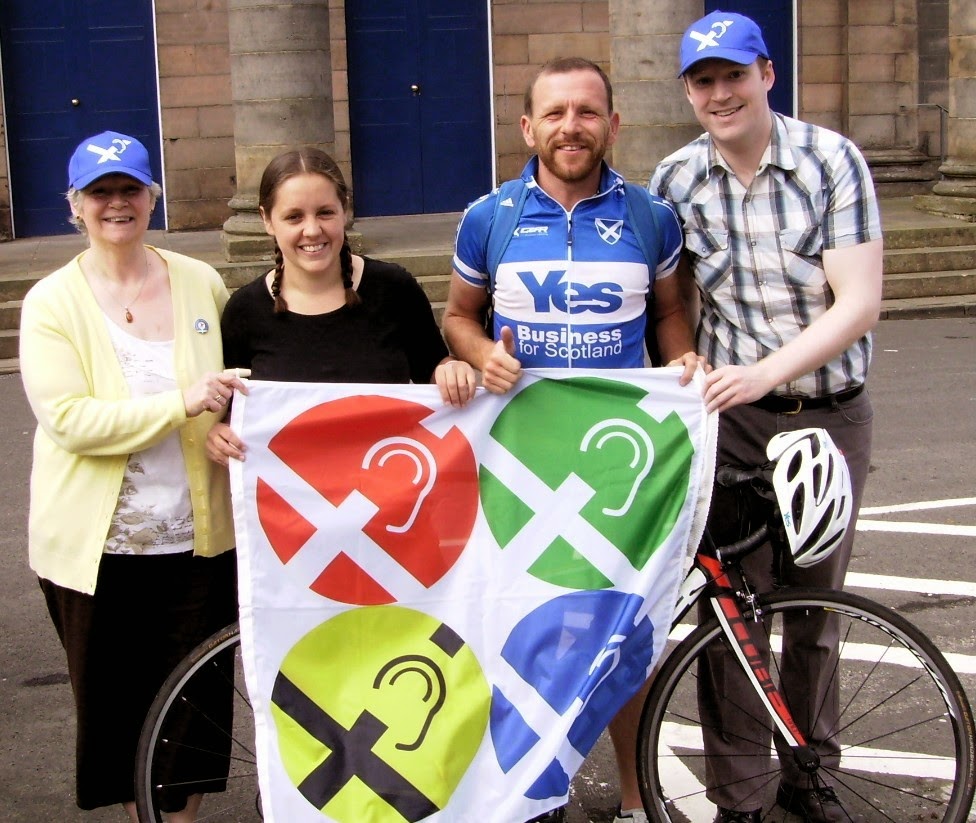
This one was really tough because we have meet so many wonderful people and seen such fantastic sights beyond anything we were expecting. But we had to pick 1 and we decided that this image of Sign for Scotland with Mark Coburn, Indy Cyclist, was our favourite. Mark has done a great job not just for Yes Scotland, but also for Maryhill Foodbank and he's definitely one of our heroes:
  
 
Other images include at the 2013 Independence March and Rally, at the Scrap Trident Rally in Glasgow and wee Mo meeting Yes Scotland board member Tasmina Ahmed-Sheikh:
 
  
Favourite photo we've seen
The British state broadcaster has been at the heart of the no campaign and our favourite photo from online comes from one of the BBC bias demonstrations. This has become even more poignant following the outburst by senior BBC political correspondent Nick Robinson.
 
  
Other images include Kirsty from Yes Scotland, the Radical Independence take-over of Glasgow and the Yes Scotland message to our friends from across the EU.
 
 
Favourite video
We've seen so many great videos during this campaign, but for us at Sign for Scotland, we find ourselves returning to this rendition of our national anthem by the ladies of 'Signed Songs R Us'.
  
  
Other videos include messages from Pink Indy Lassies, 'The morning after' by Lady Alba and the Independence Live broadcast of Veterans for Independence (which featured a live BSL signer).
 
 
Favourite blog post
Now this will be tricky! There have been so many great features that we have read during the campaign and so many more that we haven't that this is going to be just a very incomplete list, but the one that made the strongest connection with the Sign for Scotland team came from Wee Ginger Dug; 'Proud like a Yes swan'.
  
Other memorable reads include 'The McCrone Legacy' by Dale Ross on Wings over Scotland
And Derek Batemans fantastic slapdown of the Editor of the Scotsman in 'To the Editor'
 
Favourite resource
There are lots to choose from the Yes side of the campaign and because of that we've going to stick to the most prominent (although a special mention for Peter Bell's Referendum 2014 has to be made as he has been a great friend to Sign for Scotland and his comments to stories are always thought-provoking and based on reason).
  
The number 1 resource has to be the Wee Blue Book. Get it, share it, download it, send it to everyone you know and send it to everyone you don't know. The more people who read it, the more who will vote Yes.
  
The Scottish Government's White Paper on Independence (the summary of which can be viewed in multiple languages, including BSL), Business for Scotland, and Newsnet Scotland are all well deserving of praise.
 
  
Friends we've lost
I'm certain that everyone will know someone they have lost who would have wanted to see an independent Scotland, so this space is for them. RIP Margo MacDonald.
 
 
Friends we've gained
We've seen so many people campaigning for a better Scotland and we consider each of them a friend. So many thanks to Labour for Independence, Women for Independence, Scots Asians for Yes, the different political parties who back a Yes vote, Scottish CND, the Sunday Herald, Blair Jenkins, Dennis Canavan and everyone else at Yes Scotland.
  
 
Shameless plug
And finally, here are our 3 most popular videos from the campaign: I'm voting Yes, Reasons for Independence and Journey to Yes.
 
 
All that is left to say is 'thank you' to the 1,700+ people who have given us a 'like' on Facebook, the 2,000+ people who follow us on Twitter, those who contributed to our blog reaching over 70,000 hits and those who have added to the 5,000+ views we've had on our YouTube channel.
  
We are so close to regaining the powers we need to make a better Scotland. A more representative democracy, an end to paying for Westminster's waste and folly, a more peaceful foreign policy, a constitution written by us which will guarantee our rights, a cleaner environment, a more competitive economy and the breakup of media monopolies is the prize on offer. Let's take it with both hands and Vote YES!
Drew (and everyone else at Sign for Scotland HQ)

Thursday, 11 September 2014

A story with a cast of 5.3 million

No, this isn’t about a lost Cecil B Demille movie, this is about Scotland.
  
The population of our country is at an all time high and we’re part of a diverse and fluid mix of different cultures that are being blended together to form our identity.  A Scot isn’t just someone who is born here, or whose parents were born here, a Scot is someone who calls this country home.

Picture taken from Sign for Scotland HQ
Sometimes it might seem that we in the Signing community and other minorities are on the outside looking in, but it’s just not true.  We’re as much a part of Scotland as everyone else and we need to make sure that things are better after independence than devolution allowed.  With our government closer to us, we can have greater influence.  We can get rid of the sense of entitlement that too many Westminster MPs feel and have a more diverse and accountable politics.  We can push for reforms, for the fact that we will be independent will prove that the people are strong, and can enforce change.  We can make sure that no-one is left behind, and that everyone has a say.
  
The draft constitution produced by the Scottish Government shows consideration for all of Scotland's domestic languages. There is a determination from different Yes groups, emboldened by the possibilities of independence, to challenge gender and wealth inequality. And we will empower a more democratic and representative form of governance, which is more responsive and reflective of our values and wishes.
 
Sign for Scotland
Westminster isn't working, but if we work together, we can create a better society
The cast may be of millions, but a single person can make a real difference.  Please get involved and help out.  It might not seem like much, but a lot of people doing a little each will go a long way to securing a ‘Yes’ vote next week.
Drew
 
If you like this blog, then please consider visiting our other sites:
Facebook - Sign for Scotland
YouTube - Sign4Scotland
Twitter - Sign4Scotland

Friday, 8 August 2014

FREEDOM (of information)!

We at Sign for Scotland have been busy making our first freedom of information request. On the 5th of July we sent a message to the Scotland Office asking them how many BSL copies of their anti-independence leaflet 'What staying in the United Kingdom means for Scotland' had been issued (the one that was sent to every household in Scotland at our expense).
 
This was inspired by the BBC's FoI request made in May regarding the number of copies of the White Paper on Independence that had been ordered in BSL. The answer (which we didn't receive until today - the 8th of August) might surprise you:
 
'What staying in the United Kingdom means for Scotland'
Number of BSL copies: 0 (zero)

Back in May, John Denerley, from Deaf Connections, stated that the number of BSL copies of 'Scotland's Future', the White Paper on Independence, had been "...ridiculous, shocking, and frankly embarrassing...". We wonder if the BBC will seek a similar quote from him regarding the UK Government's 0 availability (there wasn't even an option on-line to view or request a BSL version).
 
As reported on Newsnet Scotland, the information from the Scottish Government's White Paper has been available in a number of locations and formats. At that time, the BSL summary of Scotland's Future, which is over 2 hours and 20 minutes long, had received over 500 plays, and videos from ourselves and Scottish Deaf Independence had received even more.


But the UK Government's lack of consideration for the Deaf isn't the main issue. The topic that should be our focus is in regards to the BBC. Three questions emerge:
 
First - Did the BBC make a Freedom of Information request regarding Deaf access to the UK Government's referendum material as they did for the Scottish Government's?
 
Second - If not, why not? Freedom of Information requests are not difficult and had produced a story that featured prominently on their news website and was commented on widely. If they did, then why did they withhold this information from the public, and who was involved in the decision?

And finally - Now that they are fully aware, will the BBC give this story the same prominence as they gave to their anti-independence report? If not, why not?

You can view the Scotland Office's full response below. Despite the date showing as the 28th of July, we only received this letter by email today after requesting an update earlier this week. As of yet, no physical copy has been delivered.

 
Unlike the BBC, we are happy to offer them the right of reply to our article.
Drew
  
If you like this blog, then please consider visiting our other sites:
Facebook - Sign for Scotland
YouTube - Sign4Scotland
Twitter - Sign4Scotland

Sunday, 3 August 2014

What would you like in the constitution?

The UK does not have a written, codified constitution. It is the only country in the EU to not have such a document and one of just five in the world (the others being Israel, New Zealand, Saudi Arabia and Canada - although Canadian provinces do have the right to create their own constitution).
 
But what difference does this make? A constitution guarantees the rights and freedoms of all citizens. It ensures that everyone is equal in the eyes of the law and that power lies with the people and not parliament. Constitutions are also important because they can ensure that new laws meet certain standards.

 
The following comes from the National Archives of Australia:
Seven reasons why our Constitution is important to you
  • Australia wouldn't exist without the Constitution. In the 1890s the people of six British colonies (now the states) agreed to unite under one Constitution as the Commonwealth of Australia.
  • We Australians were the first people in the world to vote on our national Constitution. And today, the Constitution can only be changed if we agree to it through a referendum.
  • Imagine trying to envisage what life would be like in 100 years time – and creating a Constitution to meet future needs. That's just what the key players did in the 1890s – they created a Constitution that still has relevance to our complex life today, with our mobile phones and internet connections.
  • Our federal parliament was designed by the Constitution. It allows for an upper and lower house and for elections every three years. It also ensures that Senators and Members of the House of Representatives are directly chosen by the people. And, if we want to, we can stand for Parliament ourselves.
  • Our Constitution obliges all Australians to obey the law – even politicians and governments. The High Court was set up as a separate power from the Parliament and has, at times, overturned decisions made by the Australian Government as unconstitutional.
  • The Constitution also has an impact on our personal lives by dividing up powers between the Commonwealth and the states. The Commonwealth makes laws on a range of issues (such as regulating marriage and divorce) but allows other powers (such as providing roads and transport) to remain with the states. 
  • The Australian Constitution provides some rights for all Australians, such as freedom of religion and the right to compensation if the government acquires your property. 
Instead of having a clear, easy to understand constitution, the UK Government prefers to have power at Westminster. This means that the protections our Australian cousins enjoy are not equally guaranteed to us.

Other countries use their constitution to protect certain groups, including the Deaf. In Austria they included an amendment which reads: "Austrian Sign Language is recognised as an independent language. The laws will determine the details." This may not appear to be much, but every law passed in the Austrian parliament has to ensure that this rule is not broken.

Österreichischer Gehörlosenbund meeting in Austria
Section 17 of the Finnish constitution reads: "Right to one's language and culture [...] The rights of persons using sign language and of persons in need of interpretation or translation aid owing to disability shall be guaranteed by an Act."
 
There are other examples from Europe, Africa and Latin America. This is something which we can push for and improve upon in a Scottish Constitution.
 
The Scottish Government's proposed interim constitution, to be adopted in 2016, includes the following:
  • Setting up an "inclusive and participative" constitutional convention in 2016 to draw up a permanent constitution
  • Giving Scots the right to a healthy environment
  • Committing the government to removal of nuclear weapons
  • Prioritising the promotion of international peace
  • Enshrining the principle of local government
It also contains this message:
"Many constitutions contain provision about national and official languages and although there is no language provision in the Scottish Independence Bill the Constitution Convention, as stated in Question 589 of Scotland's Future, could consider the constitutional status of Scotland's languages such as English, Gaelic, Scots and British Sign Language." The Scottish Independence Bill: A consultation on an interim constitution for Scotland, Page 67
This shows that the needs of BSL users in Scotland are being considered, but we need both a Yes vote in September and to ensure that we get involved.

The final constitution will be written by us, the people who live in Scotland and anyone can contribute. To highlight this point, we have put below our submission to the consultation. It lists what we would like to see entered into the constitution. We want this message to be considered before any law is passed:


But what would you like included in the constitution? You can send a submission to the Scottish Government's consultation which can be found here. But don't forget, the only way to gain a constitution is if Scotland has the powers of an independent country (so we need to vote Yes!).
Drew
 
If you like this blog, then please consider visiting our other sites:
Facebook - Sign for Scotland
YouTube - Sign4Scotland
Twitter - Sign4Scotland

Sunday, 15 June 2014

Who will care for our language more?

This may be an unfair question, although it is one which BSL users in Scotland should consider in the run up to the Independence Referendum in September.  We know that Westminster can be more than a little dismissive of anything other than English, but is this also true of politicians in Scotland?

Kirsty at Yes Scotland headquarters in Hope Street
There is evidence of a greater appetite amongst political parties in Scotland to interact with the Deaf community.  Here is a link to Deputy First Minister Nicola Sturgeon addressing members of the Deaf Community in Glasgow as part of the Scottish Government's National Conversation in 2011.  This event is something which we at Sign for Scotland support and would like to see become the norm in future political campaigns.

The Scottish Green Party is also very welcoming.  In 2007 they became the first party in the UK to produce campaign videos specifically for the Deaf and the hard of hearing.  You can watch one of them below.
 

British Sign Language is used by an estimated 13,000 people in Scotland.  Under First Past The Post, we would need to live in a handful of concentrated areas to make any real difference, but the Scottish Parliament is more proportional, and this gives us the potential to collectively influence election results in a way that hasn't been possible before.

 Minister for External Affairs and International Development - Humza Yousaf MSP
"The UK lags behind countries like New Zealand, Finland, Austria and Hungary when it comes to rights and cultural respect for Deaf people; but the desired changes may still take decades to come to fruition. Sarah tells me that Deaf people in other countries have had to wait 15 to 20 years for Governments to respond with specific legislation." The Limping Chicken, March 12th 2014
We're far more likely to shape policy decisions with independence and that fact alone will make our parliament care more about our language. And the policies that Scotland introduces can help other movements around the world.  The forward thinking approach taken in independent Sweden is one model which Deaf groups use when approaching their own governments and is a good example of what we can achieve.
 
All it takes is a little courage and a 'Yes'.
Drew
 
If you like this blog, then please consider visiting our other sites:
Facebook - Sign for Scotland
YouTube - Sign4Scotland
Twitter - Sign4Scotland

Sunday, 25 May 2014

Not in the News - Late May edition

Welcome to the sixth of our bi-monthly series looking back at the stories which the main stream media in Scotland didn't offer much attention to, and comparing them to those that hit the front pages. Our last edition covering the first two weeks of May can be found here.


U Know I'm Petrified! (of facts!)
What is the most important thing for the police to be investigating online? Terrorist cells, virus programmers, fraudsters, no, it's people who tweet factual and sarcastic messages that highlight UKIP policies!
 
A Green Party blogger re-tweeted an ironic list of '10 great reasons to vote UKIP'. Apparently, making people aware that UKIP intend to cut maternity leave, raise income tax for the poorest, scrap holiday entitlement, privatise the NHS, retract human rights acts, and cut the education budget whilst buying 3 aircraft carriers (all of these claims were sourced) is now worthy of a visit from your local bobby. We would also highlight UKIP's plans to scrap the Scottish Parliament but we're too afraid to do so!

The next coalition government...?
U Know I'm Petrified! (of consistency!)
If you watch BBC coverage then 1) you have our sympathies and 2) you will be familiar with the name Sanya-Jeet Thandi. Ms Thandi was a prominent member of the UKIP youth wing who left the party prior to the European elections. She stated on her blog that the party was running an "anti-immigrant campaign" and trying to "exploit the ignorance in British society". This was the lead political story on the BBC on Wednesday, the 14th of May.

 
But if you watch BBC coverage, then you will be less familiar with the name Gary Wilson, a Labour Party member who was the no campaign co-ordinator within the Edinburgh East Labour Party. Mr Wilson stepped down from this position and joined pro-independence group Labour for Independence.
"I had to step down from my role as I gradually realised that we are not in fact 'better together'. I have listened to all of the arguments whether economic, social or emotional and I am now convinced that independence is the right thing for Scotland." Gary Wilson, Labour for Independence
Why was one of these people highlighted by the BBC and the other ignored? We couldn't possibility say!
 
How news crosses a border
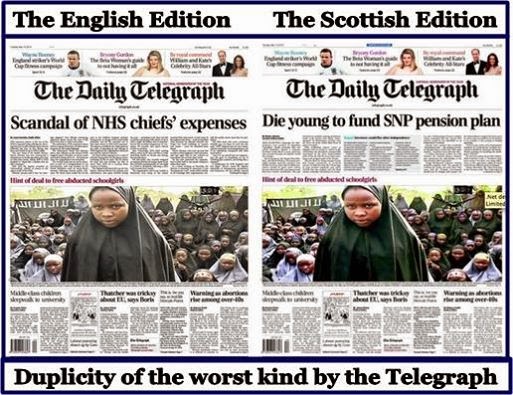
The Daily Telegraph showed once again their understanding of finance with their headline in Scotland reading 'die young to fund SNP pension plan'.


The story comes from the fact that people in Scotland can afford larger pensions at an earlier age for the same price we are currently paying due to our lower average life expectancy. A larger pension (or one which starts earlier) would help to alleviate the poverty which is a major contributor to our earlier deaths, but the Telegraph don't want to talk about that.
 
Reforming how state pensions are organised would also provide benefits and improve sustainability, but the Telegraph don't want to talk about that either.
 
And the principle of having alternative arrangements for state pensions in Scotland doesn't just come from the SNP, but are backed by experts such as Rachel Homes, author of the article 'Scotland better placed to defuse its share of UK pensions time-bomb', but the Telegraph don't want to talk about that too.

If you believe the pension needs of Scotland should be considered, then don't let the Telegraph know - they may think you're a dangerous separatist!
Of course, if we had pensions like those of our neighbours, and if we didn't have unnecessary and widespread poverty and destitution, which is exacerbated by the Westminster system that the Telegraph defends, then we would see much smaller variations in life expectancy. But we're not likely to see the Telegraph produce headlines about that. At least, not in their pretendy, regional Scottish editions (hint: here, here and here).
 
Rince and repeat
We don't need to say much beyond our blogs from the 22nd of April 2013 and the 16th of February:


As pointed out by Reverend Stuart Campbell, "It [the 'no' campaign] seems to be set on an infinite loop". As for the Scotsman...we at Sign for Scotland know they can make worse covers than these.
 
Oil Well that ends Well
"UK's oil, coal and gas 'gone in five years'" was the headline on the BBC on the 16th of May. It follows from countless other stories from 'no' supporting media outlets which have for decades been telling us that North Sea oil is about to run out (you can see links to 29 of them on the Wings over Scotland blog entitled 'The oil debate for busy people').
  

We've been lied to repeatedly by politicians and London centric media outlets for decades whilst Westminster has wasted our natural resources. What is worst is that many people are left unaware of the real situation. Every journalist in Scotland should be ashamed whenever blatently wrong statements such as "we don’t have the resources – like oil and gas – we’d need to keep Scotland afloat" are made.
 
Of course, this latest scare this goes against numerous reports of record investment in the North Sea oil industry as well as the UK Government's own internal expections of future revenue. This story has been lampooned repeatedly and shows that the only thing drying up are the excuses coming from the Westminster Defence League.
 
How valued are journalists?
At the tail end of April, the National Union of Journalists wrote a little to the BBC's Director General, Tony Hall, requesting that the broadcaster resign from anti-independence group the Confederation of British Industry. They stated that the temporary suspension of membership during the official referendum campaigning period wasn't enough. The BBC Scotland members of the NUJ voted to back the following motion:
"This Chapel is concerned by the damage being done to the work of its members, and to the reputation of BBC journalism, by the Corporation's membership of the CBI.

We note that the CBI is seeking to de-register with the electoral commission as a non-party campaigner for the Union. But the damage of assocation remains.

Please, Director General, back your Scottish journalists, allow us to do our jobs, re-assert our impartiality, and immediately resign from the CBI." National Union of Journalists letter to Tony Hall
 
And the respose from the BBC? To not even suspend membership as previously promised:
"As the CBI is no longer registered with the Electoral Commission as part of the Scottish Referendum Act, the BBC believes that it is no longer necessary to suspend its membership." BBC Statement, Thursday, 15th of May
With disrespectful actions such as this, it is no surprise that internal surveys are showing an increasing disillusionment within the British State Broadcaster's Scottish division.
"When asked if "Communication at the BBC is open and honest" only 10 per cent at BBC Scotland NCA agreed." Newsnet Scotland, reporting on the findings of the BBC's latest internal survey, Sunday 18th of May
Unfortunately, it isn't just the BBC who are ignoring the NUJ:
In the communications, one senior union official expresses his frustration at the refusal of the Scottish newspapers to cover the story saying: "the papers have - once again - ignored us. And largely ignored the story..." Newsnet Scotland, 20th of May 2014
Still, it was hilarious to find that the CBI's 'junior' member of staff who signed the application to officially make the organisation part of the 'no' campaign turned out to be CBI Senior Campaign Advisor Jon Harrison and Senior Political Adviser Richard Maughan. But that is of little comfort to the NUJ, who have to do their best in very difficult circumstances.
 
When poll results are misleading
Back in the summer of 2013, Panelbase, a polling agency, produced an opinion poll which showed Yes in the lead. The methodology for this poll, where the referendum question was the third question asked, was criticised by experts including Professor John Curtice.

On the 18th of May, ICM, a polling agency, produced an opinion poll where the referendum question was the third to be asked. Professor Curtice 'hasn't said a word about the same problem'. The only difference we can see...this opinion poll showed extra support for 'no'.
"But in this new poll showing a bigger 12% No lead, the referendum question was asked third - which ought to set alarm bells ringing immediately, because we know that responses to later questions can be substantially influenced by the wording of earlier ones." Scot goes Pop, 19th of May 2014
Of course other polling agencies have been doing the same.


The poll could even got the proportion of male and female voters, as well as other factual details available from census information, wrong! There isn't much point in conducting opinion polls if the numbers they produce are wrong. Unless you are using these polls as a campaigning tool.

The story is...Sign for Scotland?
Sign for Scotland received it's first mention on the BBC (although this certainly isn't their first mention on our website...see here, here, here, here, here above and below for just a few examples!). The headline 'Scottish independence: Deaf voters critical of referendum campaigners' with the first line reading 'Scottish independence referendum campaigners have neglected the needs of deaf voters, it has been claimed'. This article was also mentioned on the Limping Chicken and through the BBC's See Hear Facebook page.

Kirsty, at Yes Scotland HQ last year
The story is about the number of Sign Language DVDs of the White Paper has been issued (29). They spoke to John Denerley of Deaf Connections who said "it's ridiculous, shocking, and frankly embarrassing only 29 copies have been ordered." This comment matched the theme of the piece with the article almost entirely focused on the Scottish Government and Yes Scotland, with no direct criticism of the 'no' campaign. The mention of Sign for Scotland came as part of the response from 'Yes Scotland' (neither ourselves nor Scottish Deaf Independence were approached by the BBC).


As we noted in our Facebook response, the BBC report failed to mention the BSL version of the Scottish Government's White Paper (which you can view here: http://vimeo.com/81532918 and had received over 500 views by the time of the article being published) the size of our group which now has over 1,000 likes and more than 1,600 followers on Twitter (https://twitter.com/Sign4Scotland) or our friends at Scottish Deaf Independence (https://www.facebook.com/ScottishDeafIndy?fref=tshttp%3A%2F%2F).

The BBC found this information through a freedom of information request. As far as we know, no such request was made on UK government produced anti-independence documents.

  
We have produced over 20 videos and Scottish Deaf Independence have made even more. Perhaps if the British State Broadcaster did research beyond 'no' campaign press releases they would know that!

P.S. We'd like to say thank you to Newsnet Scotland for posting an article about this story.

Good morning Scotlandshire!
Back in March, Newsnet Scotland started a public fundraiser for the producing an academic study to review an aspect of BBC output. The ambitious goal of £6,500 was reached and exceeded with 259 donors giving an average of nearly £30 each reaching a final total of £7,065.
 
Newsnet Scotland decided to monitor Good Morning Scotland and the results were startling:


The research team (headed by Professor John Robertson) made several key findings:
  • Broadcasts were balanced, in crude numerical terms, but, in every other respect, unfair to the Yes campaign and favouring the Better Together (no) campaign.
  • Broadcasts began too often with bad news for Yes and, too often, featured heavy repetition of such messages over several hours in a manner conducive to unconscious absorption of warnings.
  • Statements, from the Yes perspective, were often reactive while those favouring BT were commonly initiating.
  • Interviewers intended, too often, to adopt aggressive techniques with Yes supporters while only doing so on two occasions with BT supporters.
  • There was a selection and use of expert witness of dubious credibility and of evidence from partisan sources, the broadcasts were clearly unfair to the Yes campaign.

Certain quotes from the report were disturbing to read:
"A further piece of evidence emerging from these broadcast transcripts which seems clearly to favour BT was the tendency of interviewers and interviewees to interrupt, almost interrupt and to cut in quickly to break flow of statements in support of the Yes campaign. The totals give a ratio of almost exactly 3:1 in favour of BT." Academic Study, May 2014

"The repeated treatment of Sturgeon with multiple interruptions and irritable tones is notable and worthy of reflection. No accusation of deliberate discriminatory practise is suggested but this form of aggressive interviewing directed at a confident and articulate woman and not matched with male equivalents such as Lord Robertson or the former Pentagon adviser is unsettling." Professor John Robertson, May 2014
This report is very similar to one produced in January which found longstanding bias in BBC and STV news programmes. Will the British State Broadcaster react to this analysis? We can think of 193 million reasons why they might not.
 
And finally...
We loved the story 'Too gutless to even lie' from Rev Stuart Campbell at Wings over Scotland. It covers how a newspaper can manipulate a story in such a way that gives an impression which is the opposite of reality. If you only have time to look at one link in this edition of 'not in the news', then make it this one.
 
Join us again in June for our next look at what's 'not in the news'!
Drew

If you like this blog, then please consider visiting our other sites:
Facebook - Sign for Scotland
YouTube - Sign4Scotland
Twitter - Sign4Scotland

Sunday, 11 May 2014

Yes Moray Shop Opening

On Saturday, the 3rd of May Sign for Scotland was at the opening of the Yes Moray shop on Elgin High Street!


There were a lot of people present and a great deal of excitement from passersby. To mark the opening were Tasmina Ahmed-Sheikh, a senior member of Yes Scotland and Women for Independence who previously helped us with our video 'I'm voting Yes' and Richard Lochhead MSP, who is the Scottish Cabinet for Rural Affairs and the Environment.

Tasmina Ahmed-Sheikh with 'Wee Mo'
The shop is the first in Moray and should act as a hub for support for the Yes campaign until the day of the vote. There will be leaflets and different items available, making it useful for both Yes supporters and those who are undecided. You can see for yourself what the shop looks like from our video!


We are certain that the Yes shops around Scotland will have a big impact on the campaign. They are bright, welcoming and full of information. Not every has access to the internet or the time to search for answers, so shops like these help to reach a few more people who otherwise may have felt excluded. This referendum is for everyone who lives in Scotland and they help to secure a few more votes then they will be very worthwhile.


Securing a Yes vote will take a lot of time and effort, but we have more committed activists than the other side. Our aim is to create a more democratic Scotland. We believe that the ability to make decisions for ourselves will result in a fairer, more prosperous society. Days like the 3rd of May reminded us that we are not alone in this campaign and that if we keep up the hard work we will be able to take that first step towards a better Scotland.
Drew

If you like this blog, then please consider visiting our other sites:
Facebook - Sign for Scotland
YouTube - Sign4Scotland
Twitter - Sign4Scotland

Thursday, 1 May 2014

What are the key questions for you?

I was delighted to see BDA Scotland hosting a debate in Edinburgh earlier this year. These types of events are fantastic because it allows as many people as possible to take part in the referendum. Sign for Scotland had a few friends in the audience that day who all said that they had enjoyed themselves and I managed to watch a bit of the live stream of the event. It was a great contribution and one we wholeheartedly thank the BDA for.

So earlier this week I was excited to read the article that BDA Scotland had written about the event. The article focused on 5 'key' questions:
  1. Will the BSL Bill slip down the priority order with the Scottish Parliament if Scotland becomes independent?
  2. Will current provision provided to Deaf people in the UK be continued in an independent Scotland? Example DSA (Disabled Students Award): ATW (Access to Work) and BBC?
  3. Some policy areas that affect Deaf people such as education and health have already been devolved to Scotland. How will independence affect Deaf people in a way that is meaningful to raise Deaf awareness and improve wellbeing of Deaf people?
  4. With recent events in Ukraine which went independent from Russia - are we stronger together or weaker?
  5. SNP want Scotland to become an independent state but keep the pound. It shows they could not run on their own and rely on Westminster for economy and stability.
This blog is going to look at each question in turn, provide some responses and then pose 5 more which are key questions for me.


Importance of BSL
The first question is specifically in regards to the BSL Bill that is going through the Scottish Parliament. I personally don't see why independence would affect the passing of this bill. We know that there are numerous MSPs who take an interest in Sign Language, including Humza Yousaf (minister for external affairs and international development), John Finnie (independent MSP) and Nicola Sturgeon (Deputy First Minister), each of whom were kind enough to feature in our 'I'm voting Yes' video earlier this year.

 
The further point I would make is in regards to the treatment of languages by Westminster and Holyrood. At Westminster, every oath of allegiance must be made in English with only Welsh, Gaelic and Cornish allowed in the form of additions. Compare this to the Scottish Parliament, where in this term alone we have seen swearing in ceremonies in English, Gaelic, Doric, Urdu, Italian and French with no restrictions made.
 
In 2011, as part of the Scottish Government's national conversation, Deputy First Minister Nicola Sturgeon addressed a room of BSL users and the Scottish Green Party produced the first party election videos aimed at the Deaf and hard of hearing. All of this suggests that BSL will be better promoted through governments we control than at distant, archaic Westminster.
 
Disabled Students Award, Access to Work and the BBC
The White Paper produced by the Scottish Government (a BSL version of which can be viewed here) looks at the different options available to an independent Scotland in regards to social welfare. We don't need to accept unfair policies such as the bedroom tax because social welfare expenditure is a much lower percentage of our income than it is in the rest of the UK.
"In 2011/12, the most recent year for which statistics are available, 38 per cent of Scottish tax revenues were spent on social protection[173], compared with 42 per cent for the UK as a whole" White Paper, Chapter 4 'Health, Wellbeing and Social Protection'
The BBC currently shows programmes in over 100 countries, with over 75 nations tuning in at the same time to watch the Dr Who 50th anniversary special. To suggest that Scotland cannot afford the £20 million that Irish television pays for most BBC channels when we currently hand over £193 million every year (which will instead be added to a Scottish broadcaster) is disingenuous at best. The only reason we wouldn't have BBC channels is if we didn't want them.

How will independence affect Deaf people in a way that is meaningful to raise Deaf awareness and improve wellbeing of Deaf people?
The best way to respond to this question is to look at the examples of our neighbours. The following is from a report by The Aspiring Polyglot which analysed Deaf Communities throughout history:
Deaf Swedes During the Late 20th and Early 21st Century
More recently, with a progressive, socialist government committed to a quality lifestyle for all its citizens, Deaf Swedes were able to enjoy a superior lifestyle (Wallin, 194, 1996).  Schools for the deaf were noted for their exceptional success in the instruction of deaf children.  These positive outcomes could be attributed to the bilingual philosophy that had been adopted by the Swedish deaf educational system.  A key part of this program involved members of the Deaf community, who taught Swedish sign language to families with deaf children (Andersson, 1994; Mahsie, 1995).

As soon as families with a deaf child were identified, they were referred to local Deaf-run organizations for support and were paired with Deaf adults who introduced them to Deaf culture’s ready-made solutions for effective living.  In this sense, Deaf adults served as linguistic and cultural role models by providing sign language and cultural lessons.

By being exposed to successful Deaf adults and the readily available solutions to problems of daily living from the Deaf community, the period of grief and frustrations associated with having a deaf baby was remarkably brief for these Swedish parents.  For example, with an early start in learning sign language for both parents and deaf children, communication difficulties were minimized, paving the way for a healthy family relationship right from the beginning.

For Deaf adults in Sweden, government-supported interpreting services were readily available, making it possible for them to participate fully in all aspects of society, including the workforce, social and cultural arenas, and social service (Wallin, 1994). The Aspiring Polyglot
 
Independence allows us to look at the example of our neighbours and to impliment policies tailored to our circumstances. We can take the best legislation not just from Westminster, but from all over Europe and the World and try new ideas of our own. Independence isn't a solution but the means to solutions. It gives options that voting 'no' just can't offer.

With recent events in Ukraine which went independent from Russia - are we stronger together or weaker?
The UK, despite it's vast military spending, has not been able to do anything to influence the situation in Crimea or Eastern Ukraine. In terms of influence and power, the UK is well below the United States, China, Russia and India and is struggling to keep up with Brazil, South Africa, France, Germany, Japan and Nigeria.
 
Westminster has held a veto in the UN security council yet has not used this in isolation for over 40 years, rending its role pointless.

Finally, we look at war. Scotland has been involved in 137 separate conflicts, in 171 different countries, since 1707. This this really the strength you want? Do you really want to have weapons of mass destruction parked a few miles away from our largest city whilst our coastal defences are dependent upon Twitter?

 
Independence means that we can tailor our defence, recruit more personnel, and stop uranium weapons testing in our soil. These are the features that define a strong country.

SNP want Scotland to become an independent state but keep the pound. It shows they could not run on their own and rely on Westminster for economy and stability.
Let's look at everything that wrong with this statement:
1 - Independence allows us to elect whoever we want. This means that no party is guaranteed to be in power (something that cannot be said about Westminster) and thus if we don't vote SNP in 2016 then we won't get SNP policies. A Yes vote is backed by many parties who want Scotland to have its own, independent currency, including the Scottish Green Party, the Scottish Socialist Party and the Scottish Democratic Alliance.
2 - The use of the word 'but' makes no sense. Many countries share currencies.
3 - 'It shows that they could not run on their own and rely on Westminster for economy and stability' is simply nonsense. It shows that they believe this is the best option (not only for Scotland, but for the rest of the UK whose financial stability is in our interests to maintain). Indeed the White Paper lists three other options which are more than capable of working.

And now for my top 5 key questions:
1 -20% of kids in Scotland grow up in poverty. This is more than double the rate of independent Denmark and independent Norway. Is this unnecessary poverty a price worth paying for keeping Westminster in power?

2 - Scotland is an energy exporter with vast resources, yet 1 in 3 households in our country suffers from fuel poverty. Why is it that under Westminster our winter death rate is twice that of independent Sweden and independent Norway even though they suffer harsher climates?

3 - Why has Scotland been involved in 137 separate conflicts in 171 different countries around the world. What guarantee do we have that Westminster won't drag us into more illegal wars in the future?

4 - Westminster has a history of lying to the people of Scotland, from luring us into illegal wars, to the infamous McCrone report which was hidden from the Scottish people for decades. What guarantee do we have that Westminster won't continue to lie to us in the future?

5 - Why has none of the over 50 countries in the world to have gained their independence from Westminster ever went back to London rule?

 
The Scottish BDA do a great deal of excellent work and I hope that they continue to improve access to the referendum debate for BSL users. I also hope that they will look at broadening the range of their key issues in future.
  
If you have 5 key questions, then tell us in the comments below. Our next scheduled blog will be on Sunday, the 11th May. In the meantime, you can watch our latest 'Why Yes' video!

Drew
 
If you like this blog, then please consider visiting our other sites:
Facebook - Sign for Scotland
YouTube - Sign4Scotland
Twitter - Sign4Scotland