Showing posts with label History. Show all posts

Wednesday, 6 August 2014

Indie Dumping and Scapegoating

A guest blog for Sign for Scotland by Hilary Christie.

My teenage years in the fifties were clouded over with anti-communist outpourings from my step-mother who was otherwise a great person. There were reds under every bed and she spouted fire in the direction of any labour politician. I met some of them and thought they were ordinary, pleasant enough human beings. How many evening meals were spoiled by these rantings. My father would leave the room. Then came the Soviet invasion of Hungary in 1956. There was a call put out on the BBC for families to give a temporary home to a refugee. I was delighted. At last an opportunity to show real solidarity with those who had suffered the hated communist  oppression that had benighted our evenings.
  
I asked ,’Can we have a refugee?’ The answer was a tremendous disappointment and at the same time an eye opener: ‘My dear, you are sweet. No, we couldn’t possibly’.  ‘Why not?’  ‘My dear, he would smell so!’  This is theatre. People don’t say such things. But it was said. So we had no refugee. We did not welcome the stranger and I saw that politics was very often not about real life and changing wrongs but about having someone or something to hate. That’s very useful for the hater. Something inside you growls and snarls and conveniently you, subconsciously, choose somebody to hammer and that makes you feel a lot lighter, a lot better for a while, superficially at least. It doesn’t of course rid you of your anger – in fact it almost certainly fuels it and keeps the pot cooking and it most definitely alienates other people by its sheer virulence.
 
So I avoided politics scrupulously for decades while Harold Wilson  ruined our meals; Mrs Thatcher ruined our meals and Tony Blair ruined our meals. And then came the Referendum and it all changed.
 
Now I go around the streets and houses and chap on doors and meet with friendliness, enquiries and blind hatred. One big guy screams, ‘You’re all a load of paedophiles!’
  
An other elderly woman hates Alec Salmond and says ‘If I had a gun I’d shoot him’. I ask what he has done to her that she feels this way. She says, ‘I think he’s out for himself’. That’s a small reason for capital murder.
 
A third person sees me coming, spots my badge and bag and greets me with ‘I’d like to ask you a question.’ I am interested. ‘What are the two most poisonous fish in Scotland?’  I begin to run through jelly fish and so on in my mind. Fool! It dawns on me. Our First and Deputy leaders. I found this so disgusting that I couldn’t speak  about for it a fair while.
 
All these distressed people have the same thing in common, namely a great need to dump, i.e. a need to find a scapegoat to blame and on to whom they can  pour out their anger, frustration and spite. An interesting ‘Dilemmas’ column in the Independent by Virginia Ironside, (30 July 2014) explores scapegoating. She says that one person is selected by someone or a family and those around them learn to despise this victim as well. This person is blamed for all manner of ills. The cause of this hate can be a similarity to someone remembered and disliked from the past. Or, which is more likely, the hater may see in the scapegoat traits that he or she has  personally and is ashamed of . By dumping this hate and rejection of bad traits on to this person then that gets rid of them for a while and they don’t have to be faced or dealt with for the time being.
 
These powerful subconscious feelings have to be avoided. Run from them if you can. Arguing and reasoning are useless. ‘Get the hell out of there,’ she says. Keep clear of the situation.  And then she says a thought stirring thing – in order to survive the hater badly needs you to be around. Take away the prop and the bad feelings will come home to roost. It seems that people are unaware of what they are doing when they are scapegoating. They think it is justified and their hatred deserved. They do not want to listen to moderate arguments.  These take away from them their great weapon. This is dysfunctional behaviour and it stems from deep hurt from the past, buried but living unhealthily inside.
 
So our poor but sturdy First Minister has the unfortunate distinction of being of some use to these unhappy individuals whether they like it or not. It would be good if politics could be free from fly tipping.  May all scapegoats be protected from spite and evil thoughts and come through unscathed.
 
We at Sign for Scotland would like to say a big thank you to Hilary for writing this blog for us!
 
If you like this blog, then please consider visiting our other sites:
Facebook - Sign for Scotland
YouTube - Sign4Scotland
Twitter - Sign4Scotland

Sunday, 20 July 2014

The World at War

On the 28th of July 1914 the world witnessed the start of the First World War.
 
The horror of this conflict remains with us to this day.  A conservative estimate counts the loss of life to have been over 16 million, with a further 20 million wounded.

 
The civilian dead made up approximately 7 million of this total although this disregards those who were conscripted, and those who volunteered under false pretences.  These numbers mean little until we consider that every one of them was a human life, with family, friends and loved ones.  These were people who were sent into a nightmare and never returned home.
 
This was a war which hit Scotland hard.  Scots suffered more than 25% of total British casualties, a number far greater than our share of the population.  Indeed the tremendous cost we paid inspired the American Government in 1927 to gift a memorial specifically to recognise the tremendous sacrifice of Scottish Regiments.  You can still see ‘The Call’ in the west end of Princes Street Gardens in Edinburgh.  It has a simple inscription which states:
“If it be life that waits, I shall live forever unconquered.  If death, I shall die at last, strong in my pride and free.”

It’s a shame that the Government in Westminster didn't hold the same value to our regiments.
 
Prime Minister David Cameron wants to mark the hundredth anniversary of Britain’s formal entry into the war with “a commemoration that, like the Diamond Jubilee celebrations this year (2012), says something about who are as a people.”  I don’t want to commemorate the beginning of the Great War ‘like the Diamond Jubilee celebrations’.
 
David Cameron wants to mark the anniversaries of certain battles, such as the Somme and Gallipoli, and his intention is to spend part of his £50 million ‘commemoration’ budget in educational programmes for school pupils in England to learn about the “sheer scale of sacrifice.”  I don’t see much focus on the reasons for this violent and senseless conflict, or thoughts on what could have been achieved if this war had never taken place.  The estimated financial cost of $186,333,637,000 alone could have achieved so much.


Last November we ran our serialisation of General Smedley Butler's brilliant book 'War is a Racket'. It examined how war generates obscene profits for a handful of people and offered ways to prevent most conflicts from starting or escalating. The themes explored in 'War is a Racket' and other titles should form the basis of any study of the First World War, and the 136 other conflicts Scotland has been involved in under Westminster rule, yet they are ignored in favour of war advocates.
 
 
It is the end of a war that should be remembered and I hope that amongst the pomp and ceremony that is certain to dominate these commemorations that we’ll remember those who lost their lives in this needless and senseless conflict and aspire to keep our youth from experiencing such horrors.  I hope none of us sees another ‘Great War’, but that will be difficult when our leaders don’t understand the first.
Drew
 
If you like this blog, then please consider visiting our other sites:
Facebook - Sign for Scotland
YouTube - Sign4Scotland
Twitter - Sign4Scotland

Tuesday, 17 June 2014

The folly of Trident

Nuclear weapons have no military use. They can't destroy every target, they can't be used anywhere near your own troops and their expense draws funds away from conventional forces, including personnel, equipment and technology. They are utterly worthless against terrorism and always run the risk of being detonated by accident.
  
Even arguments that they prevent war only apply to superpowers like America and Russia, and even then it is debatable.
  
Nuclear weapons have one purpose, destroying mass civilian areas. Mutually Assured Destruction was based on the principle that neither side of the cold war would launch a full scale attack as the retaliation would result in the slaughter of their own citizens in every town and city. And yet this still didn't stop military personnel from suggesting that they should go ahead and do it anyway.
  
Let's look at the effects of what they were contemplating:


Look at how it destroys people's lives:


Look at the devestation it creates:


The effects of an nuclear attack can be classed into four categories: Instantaneous, Near-immediate, Short term and Long term.

Instantaneous
"The heart of a nuclear explosion reaches a temperature of several million degrees centigrade. Over a wide area the resulting heat flash literally vaporises all human tissue. At Hiroshima, within a radius of half a mile, the only remains of most of the people caught in the open were their shadows burnt into stone." CND UK
Near-immediate
"People inside buildings or otherwise shielded will be indirectly killed by the blast and heat effects as buildings collapse and all inflammable materials burst into flames. The immediate death rate will be over 90%. Various individual fires will combine to produce a fire storm as all the oxygen is consumed. As the heat rises, air is drawn in from the periphery at or near ground level. This results in lethal, hurricane force winds as well as perpetuating the fire as the fresh oxygen is burnt. Such fire storms have also been produced by intense, large scale conventional bombing in cities such as Hamburg and Tokyo.

People in underground shelters who survive the initial heat flash will die as all the oxygen is sucked out of the atmosphere.

Outside the area of total destruction there will be a gradually increasing percentage of immediate survivors. However most of these will suffer from fatal burns, will be blinded, bleeding from glass splinters and will have suffered massive internal injuries. Many will be trapped in collapsed and burning buildings. The death rate will be higher than in a normal disaster since most emergency services will be incapable of responding due to their equipment being destroyed and staff killed. The sheer scale of the casualties would overwhelm any country's medical resources. The International Red Cross has concluded that the use of a single nuclear weapon in or near a populated area is likely to result in a humanitarian disaster that will be "difficult to address". There is currently no international plan in place to deliver humanitarian assistance to survivors in the case of a nuclear attack. Most casualties would receive at best minimal, palliative treatment. The best they could hope for would be to die in as little pain as possible." CND UK
Short Term
"Survivors will be affected within a matter of days by radioactive fall-out. The extent of the fall-out will vary according to whether the nuclear bomb detonates in the air (as at Hiroshima) or upon impact on the ground. While the former will entail more blast impact, the latter will throw up much larger quantities of radioactive debris into the atmosphere.

The effects of exposure to high levels of radioactive fall-out include hair loss, bleeding from the mouth and gums, internal bleeding and haemorrhagic diarrhoea, gangrenous ulcers, vomiting, fever, delirium and terminal coma. There is no effective treatment and death follows in a matter of days.

At lower levels of exposure, while there is an increased chance of at least short term survival, the death rate remains high. Those who do survive face many complications. Pregnant women are likely to miscarry or give birth to babies with a range of disabilities. Healing from injuries is often slow, leaving distinctive scar tissue. Damage to the immune system is probable." CND UK
Long Term
"Radiation-induced cancers will affect many, often over twenty years later. Certain cancers such as thyroid cancer in children are particularly associated with exposure to radiation. The children of those exposed to radiation are statistically more likely to be born with abnormalities and suffer from leukaemia. Because of the long period between exposure and the onset of cancer, it is difficult to attribute a particular cancer to a particular cause. The correlation is described as epidemiological, rather as the connection between smoking and lung cancer was statistically established before the medical links had been uncovered.

Nuclear weapons cause severe damage to the climate and environment on a scale incomparable to any other weapon." CND UK
 
The question to ask is: who are willing to use these £100,000,000,000 weapons against? Since Britain first gained access to atomic bombs in October 1952, we have been involved in the following countries and conflicts:
 
Korea (Korean War), Kenya (Mau Mau Uprising), Cyprus (Cyprus Emergency), Egypt (Suez Crisis), Ireland (Border Campaign), Brunei (Brunei Revolt), Indonesia and Malaysia (Indonesia-Malaysia Conflict), Oman (Dhofar Rebellion), Yemen (Aden Emergency), Argentina (Falklands War), Iraq (Gulf Wars), Serbia (Bosnian and Kosovo Wars), Afghanistan (Fourth Anglo-Afghan War), Sierra Leone (Sierra Leone Civil War) and Libya (Libyan Intervention).
 
Which cities should we have destroyed? Should we have slaughtered the 516,000 people who lived in Pyongyang in the early 1950s? Maybe killing the 2,991,000 people in Cairo during the Suez Crisis would have helped? Perhaps levelling Buenos Aires and its 9,920,000 inhabitants would have ended the Falklands conflict quicker? The answer is none: but then what is the point of a deterrent if it is never used?
 
The money that was wasted on nuclear weapons could have been spent in other aspects of the military (or on improving the lives and economy of people at home), so what was the point of them? Did Soviet Premier Konstantin Chernenko say "we launch an attack tod- wait, Britain has a 520 atomic bombs and we only have 45,000, we need to call the whole thing off!"?

 
And then there is the risk of accidents (and there have been lots of very close calls). Here are a few examples:
 
A B52 bomber and a KC-135 tacker aircraft collided over Palomares village in south east Spain. The B-52's four hydrogen bombs (each 100 times more powerful than that dropped on Hiroshima) fell from the craft. Two remained intact whilst the others leaked radiation into the surrounding farmland and coast. Despite other munitions onboard exploding, none of the atomic bombs detonated.
  
Nuclear weapons damage at RAF Lakenheath, Suffolk, 1956
A US airforce B-47 crashed into a storage facility and leaked burning fuel over 3 Mark 6 atomic bombs. Here is the comment from the official report:

"Preliminary exam by bomb disposal officer says a miracle that one Mark six with exposed detonators sheared didn't go."


This story was widely covered in the international press.
"HMS Argyll fired a torpedo by mistake during a training drill at the Devonport dockyard in Plymouth south west England, where nuclear submarines are also docked.

The incident occurred on Wednesday afternoon, during the Navy’s Flag Officer Training.

Workers were shocked to see a 2.6-meter long torpedo shoot out of the side of a ship, fly 200 meters through the air, blast a hole through a security fence and then slam into a metal storage container." Russia Today, 14th of March 2014
These stories (and the many others like them) don't tend to get discussed by the pro-war lobbyists at Westminster. Despite the effects of an accident being partly understood, it is safest to not have these weapons in our territory at all, and to encourage others to do the same.

 
The images we used above are pretty graphic, but they are nothing compared to what you will find with a simple google search. Nuclear weapons have no strategic value. They are a relic of the cold war and are far more trouble than they are worth. Scotland should not have these weapons. Scotland should not be threatening others with industrial slaughter.
  
Our military spending should be focused on the things that actually keep us safe, our military personnel and their equipment. We should look towards offering the world something positive, not violent obsenities. With independence we can rid nuclear, chemical and biological weapons from our shores and legitimately push for disarmament through our example.
Drew
 
If you like this blog, then please consider visiting our other sites:
Facebook - Sign for Scotland
YouTube - Sign4Scotland
Twitter - Sign4Scotland

Tuesday, 13 May 2014

Not in the News - Early May

Welcome to the fifth of our now bi-monthly series looking back at the stories which the main stream media in Scotland didn't offer much attention to, and comparing them to those that hit the front pages.


The 'no' campaign's well fertilized grass roots
The organisation 'vote no borders' was highlighted by the BBC as "A new grassroots pro-Union group. A report in the excellent Craig Murray blog describes in detail just how far the British State Broadcaster is willing to stoop to shore up a 'no' vote.
"The registered office of Vote No Borders, a private limited company, is at 24 Chiswell Street, London, EC2Y 4YX . Which is perhaps surprising for a “Scottish grassroots campaign”.  The directors are Malcolm Offord and Fiona Gilmore.

Now pay close attention: Fiona Gilmore is chief executive of Acanchi a PR Consultany which specializes in “Country Branding”.  Its clients include Israel, Dubai, Bahrain and “England”.  Yes, it actually specifies “England” on the company website.  Acanchi also works for DFID – in short, it gets UK taxpayers’ money, plus Israeli and Gulf Arab money.  Are you familiar with the word fungibility?

Malcolm Offord, it turns out, has donated over 120,000 pounds to the Conservative Party plus made personal donations to Michael Gove.  He is the author of the report “Bankrupt Britain” on the Conservative Home website.  In his paper Offord suggests that further cuts in UK public spending should continue to be made  even after the present debt crisis has been passed and urges government to:
“Reform the bloated benefits system of this country to reduce the burden on the state and, just as importantly, boost the growth rate of the country”
And the wee retired care home nurse Elizabeth Bashir?  Well, she’s not quite as “grassroots” as shown by the BBC either..." Craig Murray, 2nd of May 2014


Investigative work by Douglas Daniel of Wings over Scotland also highlighted the very un-grassroot origins of the entity itself.
"Vote No Borders registered as a permitted participant [by the Electoral Commission] on the 19th March 2014 – 43 days before the launch of their website. If that seems odd, No Borders only registered with Companies House on the 18th March 2014. It became a permitted participant the day after forming.

...within 44 days of forming, this “grassroots” campaign has already managed to amass funding totalling a whopping £150,000, despite having absolutely no public profile. Wow, even we’re a little jealous." Wings over Scotland, 'While we're investigating'
The BBC talked about the gathering momentum behind 'Vote No Borders' just one day after it's public launch (with a feature recorded on the day of its launch). It's almost as the BBC and the 'no' campaign were trying to give people a false impression.

Daily, but sadly not uniquely, Fail
"SALMOND HIT BY PUTIN ROW" boomed the Daily Mail on Friday the 2nd of May. "Support for the Union soars" was written at the very top of the front page. But, as with many articles the Daily Mail writes about regarding Scotland, it is gibberish.
 
The opinion poll by YouGov had been analysised by James Kelly on the excellent 'Scot Goes Pop' blog. The fieldwork for the poll was conducted between the 25th and the 28th of April, with the newspaper coverage of Alex Salmond's interview to GQ Magazine starting on the 28th itself, meaning that it is unlikely to have had any affect on the poll itself.
 
Secondly, and most embarrassingly for the Daily Mail, was that the figures produced are the lowest score for 'no' since the start of the campaign. Indeed, YouGov used to show a lead of 30% for 'no' which is now down to 14%.

So the 'Putin row' had no affect on the opinion poll (which was about Yes Scotland and not Alex Salmond) and the poll itself showed a decline in support for the union. Another fail from another Main Stream Media outlet. We are just surprised that their paper was printed with ink and not drawn in crayon.
  
Cleaning up Westminster
"Westminster MPs 'coercing assistants' into having sex, claims Labour MP" was the headline from Newsnet Scotland on Sunday, the 4th of May. The story was in regards to statements made by John Mann MP to a BBC radio 4 reporter:
Only Labour's John Mann would speak, and in a sensational statement he told the Cox that it was "impossible to say and to quantify the scale of the problem" but insisted, "without question, it is a significant problem ... it has ruined people's lives".

"This is people being coerced into sexual relationships by people using their power position," he added.  "There are people in here whose names would be rightfully held in shame and disgrace from their behaviour ... the shame is they have not been named and the public doesn't know them for what they are really like."

The Labour MP claimed other people in the party knew who the MPs were.  "This is not 'hand on the knee' stuff we are talking about" Mann told the programme, "I'm talking about something much bigger, much more insidious, much more life destroying than that."

Asked if it was about people being pressurised into having sex with their MP, Mann replied: "Yes it is". Newsnet Scotland, 4th of May 2014
Some of the details being revealed were disturbing:
One former researcher described how she was "jumped" by an unnamed party colleague who she managed to "fight off".  She said of Westminster: "This is a man's world, and to be at the top table or even near it, I've always felt I needed to roll with the punches."

The BBC reporter described having been told of young female researchers being fondled and groped by MPs.  The problem, according to Mr Cox, was not restricted to one party but existed in Labour, Conservative and Lib Dem parties.

Another victim told how he had been physically assaulted by three MPs and had experienced suggestive comments from around five others.

"This is very much a cross party consensus.  No one party has a monopoly on this.  I've experienced it from all three Westminster parties" he told the BBC reporter. Newsnet Scotland, 4th of May 2014
These are the types of issues that we never want to see in the Scottish Parliament. Stories such as this, this, this, this and this (all of which were found on the first page of a google search) aren't acceptable. It isn't right that we have "a parliamentary system that is set up to help MPs who have issues with staff members, but not the other way around".
  
To stop this wrongdoing, we need two things: an alert media which will not protect certain politicians and parties, and a police force that will act without fear or favour. I do fear that if we change nothing, nothing will change.
 
One rule for us, one rule for them
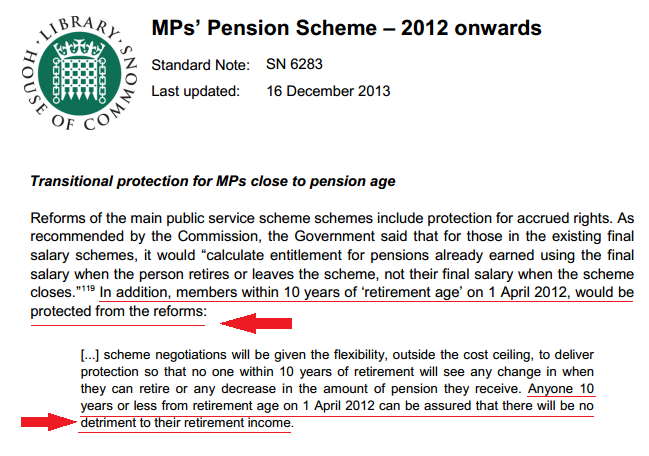
When is your Tory or Lib Dem MP going to receive their state pension?

"They [Conservative and Liberal Democrat MPs] have announced that changes to the State Pension Age would be brought in much sooner than they promised - with less than two years’ notice in some cases. This leaves tens of thousands of women approaching retirement age without a pension they had planned for – sometimes for as long as 6 years.

Many men are also facing much longer waits for a state pension than they had budgeted for. Mind you – Lib Dem and Tory MPs aren’t daft. They’ve made sure MPs close to retirement got a ten-year exemption to changes to their own pensions." Pride's Purge, 3rd of May 2014
Westminster's moto
If I could turn back time...
The BBC, in it's usual impartial way (see: January, February, March, April and April Part 2 editions of 'Not in the News'), ran with the headline "Lord Trimble: Scottish independence vote 'threat to NI peace'" on Friday, the 2nd of May. The very next day, Lord Trimble spoke on the BBC's 'Good Morning Scotland' radio programme and stated his actual views.
"I want to correct what you [BBC] said...[BBC website] reported me as saying that [independence] would threaten the peace process. I did not say that, that is not my view.

Actually, a Yes vote in Scotland would reinforce the argument against violence, because it's a demonstration of how you can achieve major change through the political democratic process." David Trimble, 3rd of May 2014
 
This in and of itself would probably have been enough to be entered into this blog, however the story took two unusual twists. Firstly, the BBC did not change their website story until the 5th of May (two days after being told by the individual themselves on their own programme that they were wrong).
  
The second twist was how the story was changed. Quite often news agencies will post alterations to their existing online output. This is done to fix spelling errors, allow a right of reply or to make a story more readable. However the BBC used this system to change a major aspect of their story (it's title and main argument) instead of issuing a public correction. They then chose to suggest that the change took place on the 2nd of May (thus make future analysis and review more difficult).

"I wonder if we can also go back and stop Jeremy Clarkson learning any nursery rhymes?" BBC Executives [probably]
Unfortunately for the BBC these things can be tracked via websites such as 'NewsDiffs', and as long as we have sites including Wings over Scotland, Newsnet Scotland and Bella Caledonia (amongst others) they'll always be caught out. Perhaps BBC executives just don't care anymore.
  
Anothing thing about pensions that you don't need to know (according to the Main Stream Media)
Wings over Scotland came up with another fantastic article regarding media bias regarding pensions. It has been well known for quite some time that state pensions will be unaffected by Independence, yet the 'no' campaign has continued to use murmur and smear in its poster campaigns to suggest otherwise, but on Tuesday, the 6th of May, there was even more conclusive proof:
"That sounds pretty darned definitive, right? A named UK government pensions minister speaking on the record in Parliament making clear that pensions were NOT at risk. So we looked forward to the big news being all over the media this morning." Reverend Stuart Campbell, Wings over Scotland
We weren't surprised that this story was restricted to a mention in the inside pages of the Herald and the Press & Journal. The BBC website, STV website, Good Morning Scotland radio programme, Daily Record, Scottish Sun, The Times, The Telegraph, Scottish Daily Express and the Scottish Daily Mail all thought that the intervention by Pensions Minister Steve Webb MP wasn't worth your attention.


A lot of the Scottish Media is acting on a 'need-to-know' basis - if it helps the Yes campaign, then you don't need to know!

While you wait
Waiting time figures for Accident & Emergency patients were released this month. 93.5% of people were seen within 4 hours of arrival, which was below the Scottish Government's target of 95% (an earlier target was 98%). The BBC declared 'Three times as many A&E patients waiting over four hours'. But is that the full story...
 
Well no. The BBC, in their impartial wisdom, came up with their 'three times as many patients waiting' quote by comparing the latest sets of figures (December 2013) not with the previous year (which were 90.3% - showing a significant improvement) but with December 2009. Why a seemingly random date as December 2009? Because they were the best recorded figures that had ever been achieved in Scotland.
  
But the BBC has a history of selective figures in this regard. Last year Newsnet Scotland exposed the BBC's claim that the figures for A&E waiting times were the 'worst since monitoring began'. There have been plenty of years where the number of patients seen within four hours was lower than 90.3% - including in 2005:

We're pretty sure a 90.3% success rate is better than 88%
We're sure that Johann Lamont will be astonished!

We like Unicorns!
The Alderman Wotisname Memorial Playing Fields had another great blog, this time looking at the BBC's dismissive attitude towards Scotland. The story began with Professor Gavin McCrone suggesting that an independent Scotland would be better off having it's own currency which is linked to the pound Sterling rather than through a formal currency union. The BBC put its own interpretation on this:
"The title of the piece is “How many unicorns do you earn?”, and below that is a large fantasy fiction style picture of the mythical beast. After asking “How many unicorns would it take to do your weekly shopping?”, the piece begins: “This sounds like the start of a bad joke”." Trevor Chaplin, 7th of May 2014
Instead of offering serious consideration to what was one of the four options listed in the Scottish Government's White Paper on Independence, the BBC made a jokey headline mocking any potential new currency.
Member of 'Unicorns for Independence'
The first name used was the Unicorn, which was a gold coin that was used in Scotland in 1484 to 1525 and named after the heraldic symbol on one side. Second was Groat, which was a coin worth around 4 pence which used throughout the UK (it was never an Scottish currency). This was followed by the 'Penny' (see 'Groat' above) and Merk (which ironically is the name I'd like for a Scottish currency).

The purpose of this piece by the BBC was to associate Scottish money with things that are worthless or fantasy. It is dismissive in tone and substance and does the flagging BBC no favours.
"People pretend they think a Scots currency would be called the Groat to belittle and ridicule the idea, and make the notion of a Scottish economy seem antiquated and obsolete. It's just a cheap shot by people who want to suggest an independent Scotland would be backwards, and a Scottish currency crude and naive.

The Unicorn was introduced to the story not by McCrone, but by BBC reporter Jamie Ross. The imagery is clear enough: the idea of having our own currency is a fantasy, and – as the opening remark tells us – “a bad joke”. This is all very familiar to those who have read Frantz Fanon; Jamie Ross is telling us that once left to our own devices by our Westminster saviours, Scotland “would at once fall back into barbarism, degradation and bestiality” (p169, Fanon, 1967, "The Wretched of the Earth"). Is he doing it on purpose? Possibly, but more likely he just knew what sort of thing would go down well: a jokey, fatuous, and patronising piece. The sort of thing no BBC reporter would ever turn in on Sterling." Trevor Chaplin, 7th of May 2014
  
The Borrowers
"Ireland's borrowing costs fall below those of UK" was the headline for the Financial Times on the 9th of May. As Reverend Stuart Campbell on Wings over Scotland noted:
"Ireland, of course, was in a far deeper financial hole than resource-rich, wealthy Scotland could ever conceivably find itself in. Yet after just six short years it’s already seen as a safer credit risk than the UK." Rev Stuart Campbell, Wings over Scotland
There's nothing to fear but project fear itself.

Young Tories (and why there are so few)
The Scottish wing of the Conversative Party had to cancel their annual youth conference. The reason, only 12 people had bought tickets.

But why is support for the Conservative Party so low amongst young people in Scotland? Perhaps it could be something to do with UK Government policy towards the disabled. Scots Politics wrote an article concerning Disabled Students Allowance in England and Wales being changed:
"There are cuts to laptops, software, accommodation adjustments, non-medical help and the general allowance that can be used for all sorts of necessities for disabled students to access education. These cuts mean students will no longer be entitled to any of the above except in as yet unspecified exceptional circumstances and complex cases." Rihanna Humphrey, Scots Politics 
"How many students currently studying will be unable to afford to stay? How many will have to make difficult choices about which aspect of their assistance is the least essential? How many will find that they cannot continue studying as a result of these changes? These changes take education away from disabled people. They take education from working class disabled people. They take education away from people just like me because we learn a little differently." Rihanna Humphrey, Scots Politics
It doesn't have to be this way. We wrote last year why those who believe in conservative principles should support independence, and every time the puppet masters in London introduce policies like these, it makes it more difficult for 'no' voters to justify keeping power at Westminster.
 
All ring-roads lead to London
A new 22-mile, £30 billion orbital tunnel is being planned for London. The ring-road will have subterranean duel carriageways and there will be two new crossings beneath the river Thames. This is yet another infrasture project which we will be contributing towards that will have no benefit to Scotland.
Planning has already begun on the next London infrastructure subsidy
Finally, we would like to point people towards a fantastic article on Newsnet Scotland 'post referendum reconciliation will not be possible unless we address the poison now'. It provides a great summary of the referendum coverage offered by the BBC, STV and the main stream media in general.
 
Join us again for our next 'not in the paper' review at the end of May!
Drew

If you like this blog, then please consider visiting our other sites:
Facebook - Sign for Scotland
YouTube - Sign4Scotland
Twitter - Sign4Scotland

Every Little Helps!
Sunday the 4th of May was a fantastic day for Yes supporters with the announcement that the Sunday Herald would be backing independence for Scotland. Their well reasoned and impassioned editorial reflected the views of a great number of people and we're certain that any paper backing a 'no' vote will struggle to match its quality and perception. We'd especially like to thank the owners of the Sunday Herald for allowing their editors to make up their own minds on the referendum.
"The Herald & Times Group, publisher of the Sunday Herald, The Herald and the Evening Times, is giving the titles' editors freedom to take their own editorial position on the constitution. The company is non-political and neutral." Sunday Herald, 4th of May 2014

The stylish front page, designed by Alastair Gray, was admired from Shetland to Dumfries and Galloway, but unfortunately not by customers of Tesco in Oban, who were instead greeted with this:


We received messages saying that deliveries to various stores in Oban were disrupted, not just Tesco, although that doesn't explain the sign above. 'Sold out due to excess demand' or 'sorry, no deliveries today' would have made more sense. And despite Tesco being members of the anti-independence organisation the CBI we do believe this is simply a distribution problem, which you can overcome by visiting the Sunday Herald back copies page.

But the overwhelming message from that day is that the Sunday Herald is backing a Yes vote, and every little helps!