Showing posts with label Inequality. Show all posts

Thursday, 14 August 2014

He asked 'what is your vision for a new Scotland' and answer came there none


This is the second guest post by Hilary for Sign for Scotland. You can read her first, Indie Dumping and Scapegoating, here.

 
Yes, poor darling had no answer at all. He was completely flumuxed.  Vision? What’s that?
 
So I ask myself the same question and suggest that we all do that and post in our ideas. 
 
What is my vision for a new Scotland?
 
Firstly   I see a new Scotland not reliant on weapons of mass destruction, that is the real name of Trident. The name ‘Trident’ is a pretty cover up.  Alex Massey said in one of the TV debates that Trident is a complete irrelevance. I like listening to him in the same way that I liked listening to Malcolm Muggeridge and  Boris Johnson. They are all very quick, very sharp and can be very funny but in this instance I think Massey is trying to be amusingly dismissive but is actually being superficial.
  
If you go out and buy a gun and put it in a drawer and never use it , that is not an irrelevance. It marks you out as a person who is or was prepared to use violence against another human being and that is a very different  thing from being someone who would never dream of possessing a weapon that could cause harm . Therefore if we give up weapons of mass destruction our psyche alters. In one way we are defenceless against maniac nations but in many other ways we have alternative defences. We develop alternative means of communicating rather than always having the great explosives at our backs. We know that we have to keep good communications going; we use trade, cultural and educational exchanges, twinnings; our academics and researchers pool their findings. In other words we behave like sensible adults not like cowboys and Indians.

I think this is important. There is no weapons-insurance policy so we have to strive for secure friendships and be watchful over the peacefulness of our state of mind.

It can be done. It is done everywhere except in a few power mad lands.
 
Secondly    I see a Scotland that is much fairer. How about us actually ‘loving our neighbour’?  Who is our neighbour?  Familiar stuff this.  The neighbour is then anyone that you see or know of who is lonely or in need. The difference between the wealthy and those in real need is staggering in our country. In the aftermath of apartheid Desmond Tutu suggested to the wealthy that they adopt a family and look to its real needs. I don’t do that here but the idea is worth playing with. Let us, collectivley look for ideas that can make a real difference.  There is really a whole load of money being flung around.  The coffee houses thrive on it. How we can redistribute money and make a difference  and how we can make others who feel unvalued feel valued I am not qualified to say. You will have better ideas than me. But think we must.
 
Now this is crazy…!  I see a Scotland where we remember Carnegie’s words ‘The man who dies rich dies disgraced’. I would  even enlarge these uncomfortable words and make them even more feared: ‘The man who lives rich lives disgraced’!!  In the States it is considered a good thing to be a philanthropist. It is ‘cool’. There’s a lot of kudos to be gained in big giving and a lot of good feeling from those who benefit. I have aired my views on this before and people immediately think I am calling for more taxes on the rich. I am not doing this at all. Taxes are given grudgingly. The philanthropist gives willingly and publicly. The ‘publicly’ is important. Secret giving is fine and modest but the word philanthropy means ‘love of mankind’ . If a rich man gives anonymously, in many ways, this is good but mankind needs to know its rich people as friends and benefactors who will help in need.  Money is not bad in itself. It can do wonderful things but money kept, hoarded, far away from those in need, rejecting them  …that is bad. And it breeds distaste towards the rich man, not envy but contempt and anger. This is what we see so often in feudal Scotland.   
 
But I knew a rich man in Ardross ,some years ago, a Greek of Scottish descent, John MacTagart, an ill man. He was freehanded with his money, he built a fine community hall, he allowed no fishing out of respect for the fish and no hunting for pleasure on his estate. The deer were managed and a certain amount eaten by the estate workers and the family and the rest was left for the wild animals to feed on . I do not know if this is good management but it gave a very good feel to the countryside and the community. There was respect and responsibility towards all living things and people. But he was only part Scot so the feudal path was unknown to him.
 
The philanthropist should, I think, look around at all those bare areas in Scottish life and see how he or she can fill its many needs, building hospices (which can bear the donor’s name), sports facilities, setting up youth projects and so on and on and on. The rich man should love his country and his fellow Scots, whatever their position in his world view! and should give handsomely and he might then  in return be held in affection. Unfortunately, he keeps well away from the rabble and does not appear to love the land, except in so far as he owns that part of it. The Selfish Giants of Alba.
 
Land reform is thus necessary. The rich could to some extent ward off the worst effects of this by openness and philanthropy but I am pretty sure they won’t.
 
Thirdly I see a Scotland that, even more than now, welcomes the immigrant. I do not mean those extremes examples that are shown as the norm on salacious TV. At my first school my best friends were a girl from Uganda and a Polish girl whose family had managed to escape from Poland in the war. Ever since then I have been excited by ‘the stranger’ and made countless warm and lasting friendships. The immigrant has a lot to offer and a lot to teach us.
 
The immigrants speak our language already or works hard to do so. We are so useless that we often alter their names as it is too much trouble to pronounce the foreign names correctly. Such imperial arrogance! They also work hard, they dress properly, they arrive on time, they are polite and good natured. Our young people who complain that the foreign workers are taking their jobs could learn a lot from them. There was a radio 4 programme recently and an English farmer said he tried to give the local English kids a chance but they weren’t up to fruit picking. They arrived late, grumbled and didn’t pick fast enough. A whole generation, maybe two have lost out on a good attitude to work. The Me lot can’t do it.  I suppose ‘They don’t deserve it!’
 
I understand therefore why lots of jobs are given to the foreigners. They are reliable. 
  
However I think the practice of shipping in loads of workers from abroad and giving them jobs that are not even advertised locally, is quite despicable and I hope this will be outlawed in our new land of peace and plenty. I believe this happens at Walkers in Aberlour. If I am wrong then I apologise immediately. I am repeating the local gossip.
 
In our new Scotland I hope to be assured that asylum seekers will be welcomed. These are a different category of homeless people. They have no safety in their homelands; they have possibly witnessed their family members being murdered, raped or tortured. They may have endured rape and torture themselves. They live in a twilight hell and are haunted by nightmares.  Whitehall has little understanding of their griefs and fears. Freedom From Torture battles hard on their behalf but it is a hard struggle against beaurocracy. I hope our Home Office will show itself compassionate and allow asylum seekers to work and be rehabilitated more quickly.
 
I would like to see a Scotland where people begin to speak languages again. Languages open up new friendships and cultures and other countries are no longer seen just from the outside, as tourists. We should be citizens of the world soon. But languages are a sort of taboo. The presenters on radio Scotland set the example by tittering in embarrassment if anyone so much as says Bonjour! My family say ‘What’s the use of learning languages? They never helped me!’  So our people don’t get the interesting jobs abroad; they miss out and have an inferiority complex. What’s wrong with English?  Plenty if you don’t respect other languages and people and mispronounce foreign proper names.
 
These three things – weapons of mass destruction,  the gulf between the rich and the poor and emigration are the big issues that I would like to see reformed and made good in a New Alba.
 
Please write what you would like and get folk answering Alec’s Oh so Difficult Question for You Know Who.
  
We at Sign for Scotland would like to say a big thank you to Hilary for writing a second blog for us. 

 
If you like this blog, then please consider visiting our other sites:
Facebook - Sign for Scotland
YouTube - Sign4Scotland
Twitter - Sign4Scotland

Sunday, 25 May 2014

Not in the News - Late May edition

Welcome to the sixth of our bi-monthly series looking back at the stories which the main stream media in Scotland didn't offer much attention to, and comparing them to those that hit the front pages. Our last edition covering the first two weeks of May can be found here.


U Know I'm Petrified! (of facts!)
What is the most important thing for the police to be investigating online? Terrorist cells, virus programmers, fraudsters, no, it's people who tweet factual and sarcastic messages that highlight UKIP policies!
 
A Green Party blogger re-tweeted an ironic list of '10 great reasons to vote UKIP'. Apparently, making people aware that UKIP intend to cut maternity leave, raise income tax for the poorest, scrap holiday entitlement, privatise the NHS, retract human rights acts, and cut the education budget whilst buying 3 aircraft carriers (all of these claims were sourced) is now worthy of a visit from your local bobby. We would also highlight UKIP's plans to scrap the Scottish Parliament but we're too afraid to do so!

The next coalition government...?
U Know I'm Petrified! (of consistency!)
If you watch BBC coverage then 1) you have our sympathies and 2) you will be familiar with the name Sanya-Jeet Thandi. Ms Thandi was a prominent member of the UKIP youth wing who left the party prior to the European elections. She stated on her blog that the party was running an "anti-immigrant campaign" and trying to "exploit the ignorance in British society". This was the lead political story on the BBC on Wednesday, the 14th of May.

 
But if you watch BBC coverage, then you will be less familiar with the name Gary Wilson, a Labour Party member who was the no campaign co-ordinator within the Edinburgh East Labour Party. Mr Wilson stepped down from this position and joined pro-independence group Labour for Independence.
"I had to step down from my role as I gradually realised that we are not in fact 'better together'. I have listened to all of the arguments whether economic, social or emotional and I am now convinced that independence is the right thing for Scotland." Gary Wilson, Labour for Independence
Why was one of these people highlighted by the BBC and the other ignored? We couldn't possibility say!
 
How news crosses a border
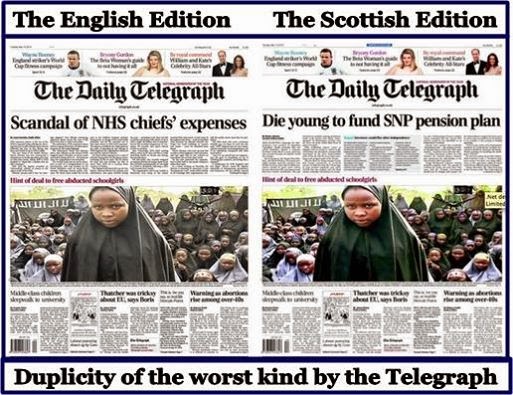
The Daily Telegraph showed once again their understanding of finance with their headline in Scotland reading 'die young to fund SNP pension plan'.


The story comes from the fact that people in Scotland can afford larger pensions at an earlier age for the same price we are currently paying due to our lower average life expectancy. A larger pension (or one which starts earlier) would help to alleviate the poverty which is a major contributor to our earlier deaths, but the Telegraph don't want to talk about that.
 
Reforming how state pensions are organised would also provide benefits and improve sustainability, but the Telegraph don't want to talk about that either.
 
And the principle of having alternative arrangements for state pensions in Scotland doesn't just come from the SNP, but are backed by experts such as Rachel Homes, author of the article 'Scotland better placed to defuse its share of UK pensions time-bomb', but the Telegraph don't want to talk about that too.

If you believe the pension needs of Scotland should be considered, then don't let the Telegraph know - they may think you're a dangerous separatist!
Of course, if we had pensions like those of our neighbours, and if we didn't have unnecessary and widespread poverty and destitution, which is exacerbated by the Westminster system that the Telegraph defends, then we would see much smaller variations in life expectancy. But we're not likely to see the Telegraph produce headlines about that. At least, not in their pretendy, regional Scottish editions (hint: here, here and here).
 
Rince and repeat
We don't need to say much beyond our blogs from the 22nd of April 2013 and the 16th of February:


As pointed out by Reverend Stuart Campbell, "It [the 'no' campaign] seems to be set on an infinite loop". As for the Scotsman...we at Sign for Scotland know they can make worse covers than these.
 
Oil Well that ends Well
"UK's oil, coal and gas 'gone in five years'" was the headline on the BBC on the 16th of May. It follows from countless other stories from 'no' supporting media outlets which have for decades been telling us that North Sea oil is about to run out (you can see links to 29 of them on the Wings over Scotland blog entitled 'The oil debate for busy people').
  

We've been lied to repeatedly by politicians and London centric media outlets for decades whilst Westminster has wasted our natural resources. What is worst is that many people are left unaware of the real situation. Every journalist in Scotland should be ashamed whenever blatently wrong statements such as "we don’t have the resources – like oil and gas – we’d need to keep Scotland afloat" are made.
 
Of course, this latest scare this goes against numerous reports of record investment in the North Sea oil industry as well as the UK Government's own internal expections of future revenue. This story has been lampooned repeatedly and shows that the only thing drying up are the excuses coming from the Westminster Defence League.
 
How valued are journalists?
At the tail end of April, the National Union of Journalists wrote a little to the BBC's Director General, Tony Hall, requesting that the broadcaster resign from anti-independence group the Confederation of British Industry. They stated that the temporary suspension of membership during the official referendum campaigning period wasn't enough. The BBC Scotland members of the NUJ voted to back the following motion:
"This Chapel is concerned by the damage being done to the work of its members, and to the reputation of BBC journalism, by the Corporation's membership of the CBI.

We note that the CBI is seeking to de-register with the electoral commission as a non-party campaigner for the Union. But the damage of assocation remains.

Please, Director General, back your Scottish journalists, allow us to do our jobs, re-assert our impartiality, and immediately resign from the CBI." National Union of Journalists letter to Tony Hall
 
And the respose from the BBC? To not even suspend membership as previously promised:
"As the CBI is no longer registered with the Electoral Commission as part of the Scottish Referendum Act, the BBC believes that it is no longer necessary to suspend its membership." BBC Statement, Thursday, 15th of May
With disrespectful actions such as this, it is no surprise that internal surveys are showing an increasing disillusionment within the British State Broadcaster's Scottish division.
"When asked if "Communication at the BBC is open and honest" only 10 per cent at BBC Scotland NCA agreed." Newsnet Scotland, reporting on the findings of the BBC's latest internal survey, Sunday 18th of May
Unfortunately, it isn't just the BBC who are ignoring the NUJ:
In the communications, one senior union official expresses his frustration at the refusal of the Scottish newspapers to cover the story saying: "the papers have - once again - ignored us. And largely ignored the story..." Newsnet Scotland, 20th of May 2014
Still, it was hilarious to find that the CBI's 'junior' member of staff who signed the application to officially make the organisation part of the 'no' campaign turned out to be CBI Senior Campaign Advisor Jon Harrison and Senior Political Adviser Richard Maughan. But that is of little comfort to the NUJ, who have to do their best in very difficult circumstances.
 
When poll results are misleading
Back in the summer of 2013, Panelbase, a polling agency, produced an opinion poll which showed Yes in the lead. The methodology for this poll, where the referendum question was the third question asked, was criticised by experts including Professor John Curtice.

On the 18th of May, ICM, a polling agency, produced an opinion poll where the referendum question was the third to be asked. Professor Curtice 'hasn't said a word about the same problem'. The only difference we can see...this opinion poll showed extra support for 'no'.
"But in this new poll showing a bigger 12% No lead, the referendum question was asked third - which ought to set alarm bells ringing immediately, because we know that responses to later questions can be substantially influenced by the wording of earlier ones." Scot goes Pop, 19th of May 2014
Of course other polling agencies have been doing the same.


The poll could even got the proportion of male and female voters, as well as other factual details available from census information, wrong! There isn't much point in conducting opinion polls if the numbers they produce are wrong. Unless you are using these polls as a campaigning tool.

The story is...Sign for Scotland?
Sign for Scotland received it's first mention on the BBC (although this certainly isn't their first mention on our website...see here, here, here, here, here above and below for just a few examples!). The headline 'Scottish independence: Deaf voters critical of referendum campaigners' with the first line reading 'Scottish independence referendum campaigners have neglected the needs of deaf voters, it has been claimed'. This article was also mentioned on the Limping Chicken and through the BBC's See Hear Facebook page.

Kirsty, at Yes Scotland HQ last year
The story is about the number of Sign Language DVDs of the White Paper has been issued (29). They spoke to John Denerley of Deaf Connections who said "it's ridiculous, shocking, and frankly embarrassing only 29 copies have been ordered." This comment matched the theme of the piece with the article almost entirely focused on the Scottish Government and Yes Scotland, with no direct criticism of the 'no' campaign. The mention of Sign for Scotland came as part of the response from 'Yes Scotland' (neither ourselves nor Scottish Deaf Independence were approached by the BBC).


As we noted in our Facebook response, the BBC report failed to mention the BSL version of the Scottish Government's White Paper (which you can view here: http://vimeo.com/81532918 and had received over 500 views by the time of the article being published) the size of our group which now has over 1,000 likes and more than 1,600 followers on Twitter (https://twitter.com/Sign4Scotland) or our friends at Scottish Deaf Independence (https://www.facebook.com/ScottishDeafIndy?fref=tshttp%3A%2F%2F).

The BBC found this information through a freedom of information request. As far as we know, no such request was made on UK government produced anti-independence documents.

  
We have produced over 20 videos and Scottish Deaf Independence have made even more. Perhaps if the British State Broadcaster did research beyond 'no' campaign press releases they would know that!

P.S. We'd like to say thank you to Newsnet Scotland for posting an article about this story.

Good morning Scotlandshire!
Back in March, Newsnet Scotland started a public fundraiser for the producing an academic study to review an aspect of BBC output. The ambitious goal of £6,500 was reached and exceeded with 259 donors giving an average of nearly £30 each reaching a final total of £7,065.
 
Newsnet Scotland decided to monitor Good Morning Scotland and the results were startling:


The research team (headed by Professor John Robertson) made several key findings:
  • Broadcasts were balanced, in crude numerical terms, but, in every other respect, unfair to the Yes campaign and favouring the Better Together (no) campaign.
  • Broadcasts began too often with bad news for Yes and, too often, featured heavy repetition of such messages over several hours in a manner conducive to unconscious absorption of warnings.
  • Statements, from the Yes perspective, were often reactive while those favouring BT were commonly initiating.
  • Interviewers intended, too often, to adopt aggressive techniques with Yes supporters while only doing so on two occasions with BT supporters.
  • There was a selection and use of expert witness of dubious credibility and of evidence from partisan sources, the broadcasts were clearly unfair to the Yes campaign.

Certain quotes from the report were disturbing to read:
"A further piece of evidence emerging from these broadcast transcripts which seems clearly to favour BT was the tendency of interviewers and interviewees to interrupt, almost interrupt and to cut in quickly to break flow of statements in support of the Yes campaign. The totals give a ratio of almost exactly 3:1 in favour of BT." Academic Study, May 2014

"The repeated treatment of Sturgeon with multiple interruptions and irritable tones is notable and worthy of reflection. No accusation of deliberate discriminatory practise is suggested but this form of aggressive interviewing directed at a confident and articulate woman and not matched with male equivalents such as Lord Robertson or the former Pentagon adviser is unsettling." Professor John Robertson, May 2014
This report is very similar to one produced in January which found longstanding bias in BBC and STV news programmes. Will the British State Broadcaster react to this analysis? We can think of 193 million reasons why they might not.
 
And finally...
We loved the story 'Too gutless to even lie' from Rev Stuart Campbell at Wings over Scotland. It covers how a newspaper can manipulate a story in such a way that gives an impression which is the opposite of reality. If you only have time to look at one link in this edition of 'not in the news', then make it this one.
 
Join us again in June for our next look at what's 'not in the news'!
Drew

If you like this blog, then please consider visiting our other sites:
Facebook - Sign for Scotland
YouTube - Sign4Scotland
Twitter - Sign4Scotland

Sunday, 18 May 2014

A Vision for Scotland

This month's guest writer for Sign for Scotland is Jean Urquhart MSP. We're delighted and very grateful to have such a well respected figure from the Scottish Parliament write a post of us.


When I was growing up in West Lothian, I remember writing “North Britain” on my school jotters. Scotland to me seemed parochial; the land of Brigadoon and the White Heather Club, and not a positive, progressive, place to be. It was a place I left twice- once for America, and once for London- before returning to live and work in Ullapool.
 

What changes I have seen in Scotland since then. We’re now far more comfortable in our own skin; we recognise our shortcomings at the same time as trumpeting our successes. We have a parliament that can make some- but not all- of the decisions about what type of country we want to be. We have become far more internationalist in our outlook and now have the opportunity to slough off the last remnants of age-old grievances by once more becoming an independent country.
  

If you think that Westminster feels distant in the central belt, it feels like another planet in Ullapool. The balance of power across Britain as a whole is so skewed towards the centre that people feel distant from decisions made about their own communities. As the Jimmy Reid Foundation stated in their report ‘The Silent Crisis’, “we elect fewer people to make our decisions than anyone else and fewer people turn out to vote in those elections than anyone else”. Out of 2,071 Scots- roughly the population of Aviemore-only one will stand for election in their community; in Norway, it’s 1 in every 81. In Sweden, 4.4 people contest each seat; in Scotland, it’s 2.1. Out of 4,270 Scots- the population of Lockerbie- only one is an elected community representative; in Austria, it’s 1 in 200. These figures are often misconstrued as an argument for more bureaucracy, more machine politicians and a bigger trough to feed from; they’re not. What it is an argument for is revitalising the links between ordinary Scots and their democratic structures, addressing the democratic deficit at the lowest level and involving a more diverse cross-section of society in their local community.
  

Independence would shake the snowglobe of British politics and give us a once only opportunity to reshape who makes those decisions and where they make them. The work of island local authorities in engaging with both Westminster and Holyrood to secure further devolution to the isles is particularly instructive and offers a glimpse of what is achievable with independence. The First Minister’s recent speech in the North of England- where he posited the idea of an independent Scotland working in tandem with the North to act as a counterweight to London’s overwhelming pull - shows that the impact of independence could create a healthier balance across the economy of the British Isles as a whole.
  

The most heartening aspect of the independence debate has been the rise of the Jimmy Reid Foundation and their Common Weal project. They have led the way in showing that another Scotland is possible; a Scotland that values its workers, revitalises local decision-making and local governance and recognises that there needs to be a better balance between work and leisure. Their policy proposals are all based on examples from other countries, demonstrating even further the extent to which the British model of an unequal, low-productivity, geographically skewed economy is the exception rather than the norm. They have given some thought as to how a 30-hour working week and a basic citizens’ income could be affordable, workable and desirable, working with renowned economists such as the late Ailsa McKay to also examine how we can adapt the workplace and childcare provision to close the gender gap in the Scottish economy. Given Scotland’s social democratic consensus at a party political level, and the work of the Foundation in speaking to both Labour and the SNP about their ideas, there is no reason that at least part of the Common Weal can be implemented following independence. 
  

A revitalised democracy and a rebalancing of the economy are obviously two of the domestic benefits of independence; however, an independent Scotland also has so much to offer the world itself. Despite the robust nature of the debate, we mustn’t lose sight of how orderly and peaceful our path to a referendum has been. Our experiences, both good and bad, could be of great use to others post-independence. Coupled with the removal of the abhorrently expensive and inhumane Trident nuclear weapons system from Scotland’s shores- one of my major reasons for supporting independence-Scotland would be uniquely placed to establish a Peace Centre that could draw on these experiences and offer support and guidance to others across the world. Combined with membership of the EU and historic ties to countries like Ireland, Poland and Canada, an independent Scotland would look outward as it reassumes its long-vacant seat at the table. Our education system continues to attract international students in their droves, and our renewables and food and drink sectors are known the world over. 
  

On September 18th, the door to a better Scotland will be unlocked for the first time in centuries. All we need is the confidence to cross that threshold and to be the change that we wish to see by voting Yes. 

Jean Urquhart is an independent list MSP for the Highlands and Islands region. She is the Deputy Convener of the Cross-Party Group on Crofting, and is involved to varying extents with the CPGs on Architecture & the Built Environment, Epilepsy, Human Trafficking, Palestine, Poland and Rural Policy. You can visit her website here where she writes about her ideas for an independent Scotland and the work that she does for the people of Highlands and Islands region.
Drew
 
If you like this blog, then please consider visiting our other sites:
Facebook - Sign for Scotland
YouTube - Sign4Scotland
Twitter - Sign4Scotland

Sunday, 9 February 2014

Showing solidarity?

One of the reasons put forward by those wishing a 'no' vote is the idea of solidarity. This argument appears to be kinder than some that we've had to respond to but nevertheless continues the myth that our only value comes from us being run from Westminster. We'll get to that later, but first let's look at the logic:
 
'If Scotland were to vote Yes, then the remainder of the UK would be forced to endure perpetual Tory governments.'

 
In a practical sense, Scotland does not make that much of a difference. We can influence the size of any Labour or Conservative majority, but only twice in the last 70 years has seats from Scotland changed which party formed the government at Westminster, both when we had more representatives. And the number of MPs we are to have will be reduced further from 74 in 1940's, to 59 today, to 52 at the next election, making us less important than we already are.
 
The First Past the Post system championed by Westminster and the 'no' campaign means that elections are decided in a handful of marginal seats, and because Scotland has been politically stable for so long, and the number of marginal seats here are therefore so few, our significance is further lessened.
"We found that in 195 seats (30% of the total) no money was spent on public meetings by any candidate. In those seats the average majority was four points higher. In five seats nothing was spent on advertising. Of these five seats only one, Knowsley, had any money (£40) spent on public meetings at all.
These figures reflect the reality of a system where your vote counts more depending on where you live. As the loss of safe seats is rare, parties target resources on a small number of floating voters in marginal seats. This means that some voters are much more valued by the parties than others, calling into question the fundamental principle of democracy – that all votes are created equal." - Democratic Audit UK
Another fault of the First Past the Post system is that people tend to vote against who they fear instead of for who they want. This makes both parties (Labour and Conservative) afraid to offer any radical policies, and this stifles debate. Why risk wholesale reform when all you need to do to get in is trash the reputation of the opposition?


Because of this, it does not make that much difference which half of Westminster is elected. There has been much written in recent years about how similar the modern Labour and Conservatives Parties are to one another. Here are links to some of them:
Scottish independence and the English working class
Labour and Tories - two cheeks of the same arse?
UK economy: Tories and Labour now have almost identical policies - be afraid
The no campaign highlights another Tory-Labour pact
"Yet in the midst of what is quite clearly a systemic failure of the economics that Thatcher championed, Labour’s reaction to it – and to the ideology of austerity that is being promoted as the route back to “business as usual”  -remains shot through with fear.  Faced with the effect of cuts, Ed Balls’ response is to promise that Labour will keep the cuts and possibly make more of its own.  Faced with the effective destruction of state education, Stephen Twigg’s response is a near-Trappist silence.
Faced with an unprecedented assault on the living standards of the poor and disabled, Liam Byrne’s reaction is to parrot Tory language of sanction and desert, of “hard-working families” rather than citizens empowered as of right. Faced with a society in which low pay is endemic and living standards in free-fall, it falls back on vague language about “predistribution” which, as far as I can see, amounts to little more than asking big business to play nice (some chance).  This is an opposition that could not get its Peers out to amend the Health and Social Care Bill, but whips its MPs into line to attend Parliament’s tributes to Thatcher." - Neil Schofield (Notes from a broken society)
If our staying with Westminster makes almost no difference to which party gets in, no difference to the voting system, and no difference to the policies of future governments, then how exactly does this kind of solidarity help anyone? And even if that weren't the case, is it right that Scotland forces upon the people of England, Wales and Northern Ireland a government which they do not want? Do they not have the responsibility to create a system which fits their needs?


I believe that Scotland can influence the world through deeds. I believe that ending Westminster's wasteful expenditure, from basing military personnel concurrently in over 80 countries around the world, to endless foreign wars, to useless nuclear weapons, will inspire those in the north of England and elsewhere to demand more from their governments. I believe the creation of a codified constitution, written by the people themselves, will guarantee the rights of future generations and inspire other nations to follow suit.
 
Many in the 'no' campaign disagree with this and suggest that Scotland would lose influence even though we have no direct representation at the UN and countless other international organisations, and the only reasons offered mirror those given against women suffrage in the early 20th century. They believe that we have no intrinsic value without Westminster.
 
I feel that our unquestioned solidarity with all Westminster policies is misguided. Let's instead show solidarity with Sweden's education system by matching it's level of spending, let's show solidarity with Finland's research and development focus by adopting the same approach, let's show solidarity with Norway on welfare and pensions and let's show solidarity with all the Scandinavian countries when it comes to poverty:
"Let’s look at probably the most important rating for any Western democracy, poverty rates (per Unicef):
United Kingdom – 19.8%
Sweden – 2.6%
Denmark – 5.1%
Norway – 3.9%
Finland – 4.3%
Jeff Breslin - Means to a Referendum"
And most importantly, let's show solidarity with the people who call Scotland home, and not accept those who actively conspire against our interests.

The diplomat and philosopher Joseph de Maistre said: "Every nation gets the government it deserves." It is the responsibility of the people of Wales to get the government they want for Wales, it is the responsibility of the people of Northern England to get the government they want for Northern England, and it is the responsibility of us to get the government we want for Scotland. It is wrong for us to wish to impose on others a government that they do not want just because we think it would be best, just as it is wrong for others to do the same to us. Solidarity is standing alongside others as equals, not meekly agreeing to follow their every command in the hope that somehow they will change.


Let's show what can be done with a focused, representative parliament. Let's vote Yes and display true solidarity with the people of the world.
Drew
 
If you like this blog, then please consider visiting our other sites:
Facebook - Sign for Scotland
YouTube - Sign4Scotland
Twitter - Sign4Scotland