Showing posts with label Currency. Show all posts

Friday, 22 August 2014

Plans A, B, C, D and E (I know you don't care about currency but it's the only thing the Westminster Defence League talk about)

We at Sign for Scotland were recently asked about the best way to respond to people who bring up the topic of currency. So here is our handly little guide. Just remember that the best references  to this subject can be found in the 'Wee Blue Book' (starting on page 11) and on the Business for Scotland website (especially the article 'Euro, Pound Sterling or Scottish Pound'). The different options available to us are also listed on the Scottish Government's White Paper on Independence (starting page 109).
 
If the show 'Spice and Wolf' can use a wolf deity to explain economics then so can we!

Currency Union
The term ‘Currency Union’ can be a bit mis-leading. It has nothing to do with using the £ itself (as options 2 and 3 below will prove), it only means that the Bank of England will continue to act as ‘lender of second last resort’ (see reference [1] and [2]). The main feature of this approach is that things remain the same for people on both sides of the border. There will be no transaction costs and banks operating in Scotland have a local lender with the ability to shore up their finances. This option gives the Scottish Parliament no direct control over the supply of money, although we have the flexibility to set our own tax types and rates [3] [4].
  
This approach was successfully used by Luxembourg and Belgium for over 7 decades [5] and could be replaced with any of the other options listed at a future date. Below is a video in BSL explaining why Westminster will want a currency union, and why they are pretending to be against it during the referendum campaign.

 
Sterlingisation
Sterlingisation means using a currency without having a central bank. This is the same as ‘Dollarisation’ and is a popular choice around the world [6]. In our case, Sterlingisation results in us using the £ as normal, as well as reduced debt payments to Westminster. This is because the Bank of England holds a number of assets that would be withheld from us [7], and thus we would not be liable for any debt that was accrued to secure those assets.
  
Sterlingisation would not affect the guarantee on savers, which means savers with up to €100,000 in their accounts will continue to be protected [8]. Banks operating in Scotland would not be guaranteed bailouts should they fail, which will force them to act more responsibly [9]. This can be achieved without agreement with Westminster and be replaced with any of the other options listed at a future date.

Scottish Currency pegged to the Pound
The third option is for Scotland to have its own currency that will have the same value as the £. Bank of England notes would continue to be accepted in Scotland, and the Scottish Parliament could, at a future date, decide to remove the peg (see option 4) giving much more freedom of choice to future generations.
 
A Scottish Central Bank would be formed (or an existing bank in Scotland could be changed into a central bank) which would adopt the same functions that the Bank of England currently has. The strength of this central bank would depend upon the post-referendum negotiations: if our share of the Bank of England’s assets were transferred, then the corresponding levels of UK debt would be transferred too. If no assets were transferred, then Scotland would have vastly reduced debt payments. This is the option that Switzerland successfully uses today [10]. Any transaction costs would be small as a Scottish Pound and a Bank of England Pound would have equal value.

The new no campaign poster
Scottish Currency that floats freely
This approach would see Scotland have its own Central Bank and currency. There would be transaction costs when trading with the UK if we picked this choice similar to those we have when trading with the rest of the world. The advantage of this option is that full control over the supply of money would be held by the Scottish Parliament. The result of this option would be that Scottish bank notes would have a higher value than those produced by the Bank of England [11], which means that anyone holding Scottish currency (i.e everyone in Scotland) would become wealthier, as our money could purchase more goods from abroad than before. The downside is that our exports would become more expensive to others and tourists would view Scotland as a more pricey place to visit.

We're pretty sure Holo is not refering to this story here
Euro
Scotland cannot officially use the Euro due to ERM2 [12]. ERM2 demands that any country that wants to join the Eurozone has to be using a currency that is ‘pegged’ to the Euro for at least 2 years. Scotland can only meet this qualification if we adopt option 4 for at least 2 years (which isn’t physically possible as our independence day will be the 24th of March 2016 [13]). Scotland could unofficially use the Euro in the same way as we could use the £ in option 2 however there are few immediate advantages with this approach.
 
  
After Independence there will be even more options to pick from however those will be discussed and debated at elections. We, the people who live in Scotland, will get to decide what we want. That's the spirit of democracy and something that Westminster doesn't offer. And it's one of the best reasons to vote Yes.
Drew
 
If you like this blog, then please consider visiting our other sites:
Facebook - Sign for Scotland
YouTube - Sign4Scotland
Twitter - Sign4Scotland

List of references:
[1] Crisis, Conditions, and Capital – The Effect of International Monetary Fund Agreements on Foreign Direct Investment Inflows [Nathan M Jensen, Department of Political Science, Washington University, St. Louis] - http://jcr.sagepub.com/content/48/2/194
[2] U.S. planned British economic bailout in the 1970s, newly released documents reveal…with haunting echoes today [Dan Atkinson, Mail on Sunday Economics Editor] - http://www.dailymail.co.uk/news/article-1266871/A-warning-British-economy-haunting-echoes--34-years-on.html
[3] The race that’s never run [Reverend Stuart Campbell, Wings over Scotland] - http://wingsoverscotland.com/the-race-thats-never-run/
[4] Tax rates online [KPMG, international audit, tax & advisory company] - http://www.kpmg.com/Global/en/services/Tax/tax-tools-and-resources/Pages/tax-rates-online.aspx
[5] Belgium-Luxembourg Economic Union [Encyclopaedia Britannica] - http://www.britannica.com/EBchecked/topic/59408/Belgium-Luxembourg-Economic-Union
[6] Dollarization [How Money Works, William F Hummel] - http://wfhummel.cnchost.com/dollarization.html
[8] Deposit Guarantee Schemes [The EU Single Market, EC Europa] - http://ec.europa.eu/internal_market/bank/guarantee/index_en.htm
[9] An independent Scotland should use the pound without permission from rUK, says new ASI report [Adam Smith Institute] - http://www.adamsmith.org/blog/money-banking/an-independent-scotland-should-use-the-pound-without-permission-from-ruk/
[10] Swiss National Bank pegs franc to euro [The Week, Business magazine] - http://www.theweek.co.uk/business/2433/swiss-national-bank-pegs-franc-euro
[11] Scottish independence gets boost from Hong Kong’s money markets [South China Morning Post] - http://www.scmp.com/news/hong-kong/article/1224903/scottish-independence-gets-boost-hong-kongs-money-markets
[12] Euro, Pound Sterling or Scottish Pound? [Gordon MacIntyre-Kemp, Business for Scotland] - http://www.businessforscotland.co.uk/euro-pound-or-scottish-pound/
[13] How will Scotland become independent? [Yes Scotland] - http://www.yesscotland.net/answers/how-will-scotland-become-independent

Wednesday, 20 August 2014

The Negotiator

The strength of Scotland's position in post referendum negotiations is completely dependant upon the outcome of the vote. A Yes makes us much, much stronger. A no makes us weaker. Here are the reasons why:
 
 
Strength of Yes
Scotland as a country is fundamentally self-sufficient. We produce excesses of electricity, have abundant supplies of water, export food and textiles and generally have most of the other essentials of life. We have a balance of trade surplus as a result of our natural resources as well as other industries, and with a significant tourism sector we have no problems with brand recognition or sources of revenue.
 
The things that the UK offer aren't important. We don't need a vast military as we have no nearby threats, we don't need a permanent seat in the UN security council, and we certainly don't need nuclear weapons. Our largest market is provided by the EU (and which the EFTA could equally offer) and the currency is fully tradeable. There isn't anything that we need to have from Westminster.
 
The UK however has a debt problem that isn't getting better, and the £ needs more exports to guarantee its value. The UK also has significant trade with Scotland that it will need to protect and the prospect of leaving the EU is very real, making good relations a priority. And, strictly speaking, the liability for current pensioners will not change, as their national insurance contributions were paid to Westminster. Starting with no debt or pension payments will mean Scotland will begin with a very lucrative budget surplus.
 
Finally, the Westminster negotiators are rubbish. Because the path to power is guaranteed, the people who gain high politicial office don't require any special talent or skill. The Westminster system is a lazy system that lacks the competitive nature of a proportional parliament. We will have the more skillful negotiators, and we will be giving them the best possible hand.
  
All of this means that Scotland holds the advantage in any negotiations. And there are plenty of things that could be done to make Westminster squirm (like demand the immediate removal of Trident or insist on an audit of the UK's debt - both of which they will not want).

 
Weakness of no
A no vote leaves Scotland vulnerable. With independence no longer an option (thus making us dependent on Westminster) there is no incentive for any further devolution. Indeed, both halves of Westminster have an incentive to reduce the importance of Holyrood.
 
A no vote also means a cut to the Scottish budget is not only a possibility but a likelihood. The fact is, Scotland more than pays its way and is a net-contributor, but that won't stop Westminster politicians from demanding that spending is cut here. The current system makes no allowance for where money is earned and the only UK 'region' which will be viewed as an exception is London and the South East.

 
With no means to defend ourselves and every reason to cut, Westminster will view a post-no Scotland as a means to secure more votes in England, and deny reform for a generation.
 
You don't have to be a great negotiator to see the difference. A Yes vote means that Westminster is left over an oil and whisky barrel. No leaves us open to no end of cuts and the prospect of a weakened Holyrood. Even if you don't want Scotland to be independent, you can see how independence is the best way to protect our interests.
Drew
  
If you like this blog, then please consider visiting our other sites:
Facebook - Sign for Scotland
YouTube - Sign4Scotland
Twitter - Sign4Scotland

Sunday, 17 August 2014

Not in the News -17th of August Edition

Welcome to another edition of our now weekly series looking back at the stories which the main stream media in Scotland didn't offer much attention to, and comparing them to those that hit the front pages. Our last edition covering early August can be found here.

 
The £1,000,000 questions - Who wants to be in an independent Scotland?
In August it was revealed that the UK Government had spent £1 million on surveys and polls regarding Scottish Independence. The results of these polls was kept secret from the public with the findings being restricted to a handful of individuals in the 'no' campaign.

Our thanks to Cathy Newman of Channel 4 news for reporting this story.
 
Rules are for other people
It is well known that the no campaign has paid 'volunteers' during the campaign to hand out their leaflets, yet the Electoral Commission (who are supposed to provide oversight) have done nothing. Is this because they aren't technically breaking any rules? Wings over Scotland checked the guidelines:

Rules are for other people it seems.
 
Threat! Chaos! Emergency!
These are some of the words that didn't appear in Mark Carney's speech on the 13th of August, although you could be forgiven for thinking that they were if you follow the controlled media.

This was not the scene at the Bank of England
The Governor of the Bank of England reported that his organisation had considered the effects of Scottish Independence as well as the threats made by the Westminster parties to block a formal currency union. Mr Carney did suggest that uncertainty was concerning the markets, but the only way that can disappear is if there were pre-negotiations between the two sides. And remember, only 1 side is refusing to pre-negotiate.
 
No threat, no chaos and no emergency (and soon no Westminster politicians!)
 
Deja vu all over again
The Conservative Party has managed to prove the infinite monkey theorem! The questions sent to MP David Mundell by Cammy Young, Mr Allison, Arthur Langcake, Neil Calvert, Pat Caultay, Hannah Macgregor and Mrs Douglas, were exactly identical to the questions sent to MSP John Lamont by Edna Tait, Andrew Meldrum, Karen Hume, Craig Wood, Rachael Hamilton, Moira Hughes and Trevor Adams (with even the order of the questions being the same!).


To make the co-incidence complete, the replies were identical too (except Mr Lamont avoided some of Mr Mundell's spelling mistakes!).Great minds think alike? (or at least use the same pre-prepared responses).

 
Maybe we need to call Dirk Gently's Holistic Detective Agency to check this out!
 
Things I don't know because I trust the BBC...Healthcare Privatisation!
This is a new series that we're thinking of including the our Not in the News blogs. Our first entry looks at Healthcare Privatisation, with the SI 257 amendment being a good example. The BBC has offered scant comment and for the life of us we have no idea why...
 
 
Protecting Socialism from within the House of Lords (for the bargain price of just £300 quid a day plus expenses!)
John Reid, also known as Baron Reid of Cardowan who once claimed for pouffe cushions and a glittery loo seat amongst other essential expenses, told voters that the Yes campaign was pretending to stand up for ordinary workers. He sited SNP plans to cut corporation tax as proof that they support big businesses (these are obviously different from when the government he was part of reduced taxes for larger firms whilst simultaneously raising them for small businesses).

 
Of course, if you don't like SNP policies, then don't vote for them. Unlike at Westminster where the same two parties share power between them, Holyrood uses a democratic system. No-one is guaranteed to be in office, and we certainly won't have unelected Lords talking to us about principles.
 
What the Daily Mail didn't report!
The Daily Mail isn't a friend to the independence movement, but they did provide even more reassurance over pensions. It was confirmed that a Yes vote will have no effect on the pensions of the Scottish employees of the 'newspaper'. We found this out because one of their staff members anonomously asked the tabloid's pension provider. Funny that this wasn't featured in any of their editions.
 
  
Of course, the Daily Mail knows what Westminster will do with pensions, and their value, but won't report that Scotland's pensioners would be better off independent.
 
Oil oil everywhere (except in the mainstream media!)
North Sea Oil reality
North Atlantic Oil reality
West Coast Oil reality

Join us again on Sunday for our next look at what's 'not in the news'!
Drew
 
If you like this blog, then please consider visiting our other sites:
Facebook - Sign for Scotland
YouTube - Sign4Scotland
Twitter - Sign4Scotland

Wednesday, 25 June 2014

Not in the News - Late June edition

Welcome to the seventh of our bi-monthly series looking back at the stories which the main stream media in Scotland didn't offer much attention to, and comparing them to those that hit the front pages. Our last edition covering early June can be found here.

 
Westminster's £140,000 questions (that we aren't supposed to know the answers to)
It turns out that Westminster has spent £140,000 of taxpayers money on examining Scottish attitudes to independence.


Whilst they are entitled to this, they would not be entitled to share this information with one side of the debate and not formally declare this spending with the Electoral Commission as it offers a distinct and unearned advantage. This was point of a recent freedom of information request made by Reverend Stuart Campbell at Wings over Scotland.


Westminster's £720,000 no campaign leaflets (that the Electoral Commission isn't counting)
The BBC's Tim Reid highlighted a story in June that the UK Government was planning on spending £720,000 of taxpayers money on posting anti-independence leaflets to almost every house in Scotland. This will not be counted against the official no campaign expenditure limit.

 
This isn't particularly surprising. Voters in Quebec will be familiar of state government interventions in referendums and how important they can be. Just see this story from CBC News from 2007. What is surprising is that voters in England, Wales and Northern Ireland are willing to have their taxes spent in this manner (unless this becomes classified under 'Scottish Expenditure').
 
A desperate smear and a regular smear
With 100 days to go the no campaign held a rally. This was how it was described by the Times newspaper:
“[Alistair Darling] was the only politician to speak at the Better Together rally in Glasgow. All the others were ordinary men and women who had volunteered to talk about why they were campaigning to keep Scotland in the United Kingdom.
They were led by Claire Lally, a mother from Clydebank, with a child with serious health problems.” Times newspaper, 10th of June 2014
It was later revealed that this wasn't necessarily accurate, as Ms Lally is in fact a member of Labour's shadow cabinet in Scotland and has been for some time. You can see this screenshot from Jackie Baillie MSP's website welcoming her. And STV highlighted Ms Lally introducing and launching Johann Lamont’s Scottish Labour leadership bid in November 2011.


There is nothing wrong with Ms Lally declaring her support for a no vote, however it is mis-leading to suggest that she is not involved in politics. This prompted an advisor to the First Minister, Campbell Gunn, to contact a newspaper to highlight this point.
 
The issue came when Mr Gunn (wrongly) said that she was also the daughter-in-law of former Lord Provost of Glasgow Pat Lally (who shares the same name). This was incorrect and the advisor issued a public apology.
 
This created the following headlines: "Claire Lally row: First Minister under pressure to fire special adviser" (The Courier), "The dark side has lured Gunn across the line" (Telegraph) and "Make no mistake, Alex Salmond approves of abusive tactics" (Express).

"Only Yes supporters make abusive comments," MSM (probably)
The independence campaign has been bitter at times. Last year, on "Scottish Labour for Scotland" Facebook page, a person named 'Daniel Kelly' made this remark following the announcement that Alex Salmond's aunt had passed away:
"Don't you wish his dear old dad did the same."
When faced with criticism that many senior members of the Labour Party were both members of the group and friends with Daniel Kelly, the official Labour Party response at the time was:
"This desperate smear campaign falls at the first hurdle because this Facebook page is not owned, managed, or operated by Scottish Labour, and it will not detract from the rantings and ravings of SNP candidates - sacked or otherwise - online."
Despite the ill-tempered language, the independence movement in Scotland has been one of the most peaceful in history. It is an inspiration around the world and should be praised. To ensure this remains the case we would prefer if the media stopped presenting the campaign as one side attacking the other (especially when many of the alleged perpretrators have been the victims of death threats).

 
How much hurt Ms Lally experienced from the mistaken identity of her father will never be known (although we suspect it was less than that suffered by David Ferguson in 2010). Hopefully the media will recognise that using terms such as 'attack' and 'vile' are not accurate or helpful, and that blame should be placed upon the few morons who do commit actual abuse, instead of against everyone with a computer who supports independence.
 
Oh dear, Scotsman "newspaper"...
The referendum campaign has been terrible for the Scotsman newspaper. A massive fall in sales, coupled with the disastrous 'Klan Alba' headline which had suggested that anyone considering voting Yes could be Klu Klux Klan and Nazi sympathisers, the tabloid has struggled badly, and in June they took another step towards oblivion with the posting of an untrue statement against Reverend Stu of Wings over Scotland.

  
The Scotsman edition from Friday the 13th of June claimed that he had 'used the site [Wings over Scotland] to call on nationalist campaigners to photograph their opponents so that they can be publically identified." This wasn't true as the response from Revened Stu explains. The newspaper pulled the article from their website, but no correction or apology was issued until the 19th.
 
We don't believe that the Scotsman has much of a future whether Scotland votes Yes or no. The paper appears to have lost any sense of professionalism and will only be remembered as an example of the controlled media at its very worst.
 
Lights, camera, action!
The much ridicled 'no' campaign cinema adverts were recorded at Pacific Quay, the headquarters for the BBC in Scotland. Impartiality from the British State Broadcaster...not a chance!

 
We don't need no education (another Brown in the Westminster wall)
Amongst the promises of more powers (also see here) for the Scottish parliament, there was hints as to what powers the UK Government is looking to take from Scotland. Former Prime Minister Gordon Brown spoke of his desire for education (which has always been in Scottish hands) to be controlled by Westminster.

Gordon Brown's school days
This 'one nation' approach to education is likely to see £9,000 per year tuition fees, and more privatisation of education services. Control over education, health and our legal system can all be lost if we vote no. Only independence guarantees that the wishes of the people of Scotland always matter.

Of course, you could trust Westminster's promises (just don't trust their memory).

BBC Strangelove (or how I learned to stop thinking and love the bomb)
Oh the BBC. They are, by far, the most frequent contributor to our 'not in the news' series. Without them we wouldn't receive our near daily laugh at how ridiculous our media currently is or how, time after time, they consistently miss the point or completely ignore reality. On this occasion, they were discussing the results of the annual British Social Attitudes survey.
 
Here are the results of people's attitudes to the question: 'Are you in favour or against Britain having its own nuclear weapons?'

 
This question does not consider independence or our opportunity to remove Trident and other non-conventional weapons from Scotland, only the principle of whether Britain should host Atomic Bombs. As you can see, the attitude in Scotland is very different from that in England and Wales. So how will this be reported on the BBC in Scotland?

Oh BBC in Scotland. Shall we list the problems with this graphic? Thankfully, Scot Goes Pop has already done this:
  1. The overall survey shows that the Scottish Public are against Britain having nuclear weapons, so it is ridiculous to argue that people want Trident to stay in Scotland when they are against the weapons in principle.
  2. Most respondents are therefore looking at the practical situation based on the assumption that these weapons will remain (essentially because they have already been asked if they want Atomic bombs or not).
  3. This is a sub-sample poll, which means that the margin of error is larger than normal. The 9% lead for the UK scrapping Trident is much more robust than the 4% lead for these weapons staying on the Clyde on the basis that they will remain in the UK arsenal.
There is also a fourth issue: the question asked to people in Scotland was different to those in England and Wales. Despite the BBC reporting that the question was '"do you think that the United Kingdom should be required to remove its weapons in an independent Scotland," the real question asked was:
"How much do you agree or disagree with the following statement? If Scotland becomes an independent country, Britain's nuclear weapons submarines should continue to be based in Scotland." Social Attitudes Survey Question
The Vanguard-class submarines are capable of using alternative munitions, meaning that this question doesn't address the central issue. Of course, the only reason someone would ask such an awkwardly worded question is if they wanted to show artificial support for nuclear weapons in Scotland.
 
The BBC, providing comedy instead of news for just £145.50 a year (perhaps we are being unfair - if they did start reporting news then the Westminster MPs who control their funding may act upon their threats. It's much safer to stay in their good books, isn't it?).
 
Everyone hates you
We've mentioned before that the most cynical aspect of the no campaign is its attempts to portray Scotland as having no value. The international version of this has came back in recent days, with David Cameron asking the Chinese Premier Li Keqiang stating, unsurprisingly, that large centralised states should remain large centralised states.

 
But around the same time, China was making other anouncements, including one confirming support for Argentina's claim over the Falkland Islands (also known as 'Las Malvinas'). Westminster politicians seem happy to support attacks on Scottish sovereignty, but less enthusiastic regarding their control.
 
Cupcakes (a subject close to my heart)
The licence fee is expensive, isn't it? £145.50 for colour TVs. Imagine what you could buy with that money in your pocket. Enough for cupcakes for an entire production crew with change left over! We know this because one BBC executive did just that!

 
Shane Allen, comedy commissioning controller (which I am sure is an absolutely vital job), thought it would be a nice gesture to buy cupcakes for staff involved in the making of two programmes he was involved with. He then thought it would be even nicer if he passed on the £120.00 bill to us. Thank you Shane. I'm glad that I could contribute to the cupcake bill at the BBC!
 
But what other food and drink costs do the BBC pass on to licence fee payers? Well someone did make a freedom of information request but the British State Broadcaster is a little slow in responding...

Money, Money, Money
The BBC (yet again) got its facts wrong.


In the original report regarding the first days of the Republic of Ireland, the BBC wrongly claimed that the Pound ceased to be used and that the state created its own currency from day one. In the corrected version they finally acknowledged that this wasn't true. The Pound was used for 7 years without any issues. We have already explained why this would be the case in our blog 'so who else can't use the pound?'
 
Money, Money, Money (2)
The Sun newspaper was the latest to show that it doesn't understand how currencies work. In June, they produced the headline SCOTS CURRENCY 'BEING PLANNED', which unfortunately for the Sun, wasn't true.
"The lie that an independent Scotland couldn’t use the pound is the most brazen and indisputable falsehood of the entire referendum debate. Even though there’s no chance in any sane reality of Scotland being kicked out of the EU or NATO even temporarily, it’s nevertheless not possible to state as an absolute 100% certainty that neither thing would happen.

But currency is different. It’s an unarguable fact that Scotland could keep using Sterling with or without an official currency union. Everybody knows it. If you put it directly to any No-camp politician (as almost no journalist ever does), they’ll harrumph and grump and say why it’s a bad idea and try to change the subject, but eventually they’ll admit that yes, it’s true – Scotland COULD keep the pound.

And then they’ll put out another leaflet maintaining the lie that it couldn’t." Wings over Scotland, 20th of June
Are you on the list?
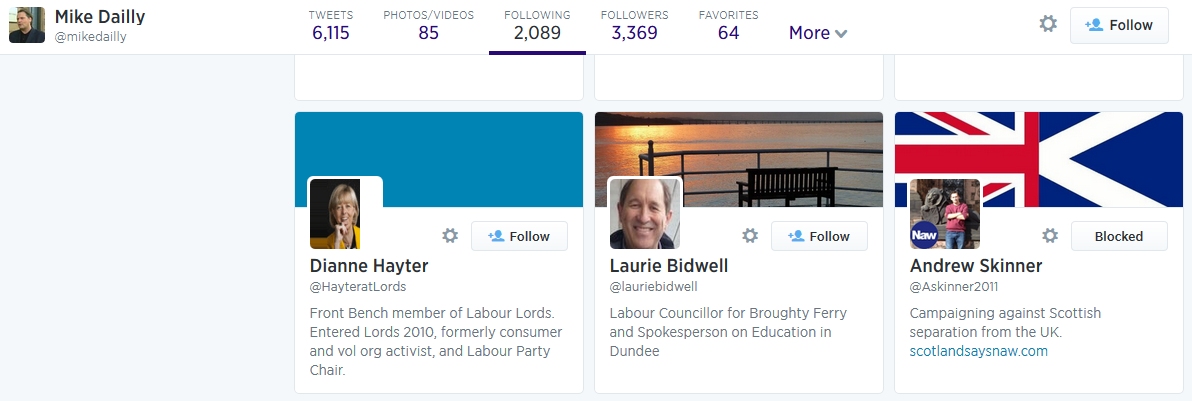
During June, Mike Dailly from Govan Law Centre made an announcement on Twitter that he was "working on publishing a list for the national media of who supports @RevStu on social media". @RevStu is the personal twitter account for Wings over Scotland founder Reverend Stuart Campbell.
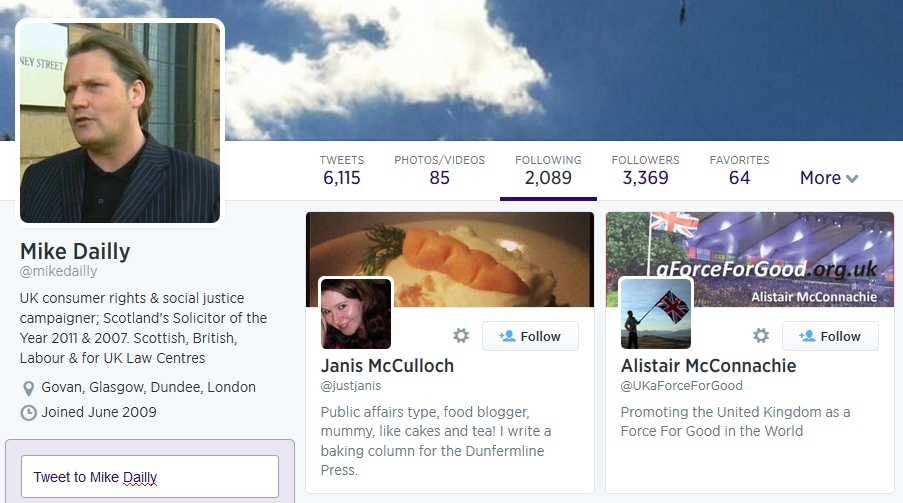
"Ironically for a self-professed socialist and trade union fan, Dailly appeared to be suggesting that he was engaged in creating some sort of a blacklist to be circulated to the media, in which anyone who followed me would be incriminated by association.
 
That this is perhaps a somewhat inconsistent policy for someone who follows the Holocaust-denying ex-UKIPper and present-day loony Alistair McConnachie (see here), and extremist Loyalist nutcases Andrew Skinner and “Stronger United”, among lesser trolls, seems to have gone over Mike’s head somewhat." Reverend Stuart Campbell, Wings over Scotland
And the outcome of this action from Mike Dailly? The number of followers for @RevStu increased by over a third within 24 hours.

 
You can also buy "I'm on the list" items at the Wings over Scotland store!
 
What you can't (but we can) say
Newsnet Scotland released an episode of Duggy Dug entitled 'the no nightmare' in June. The cartoon showed a possible future for Scotland based on statements and policy aims made by the UK Labour and Conservative Parties (the only parties who can form the government at Westminster).

Duggy Dug, the latest evil and dangerous Cybernat!
The video included a cartoon of Johann Lamont MSP dressed in a House of Lords robe with a badge entitled 'Vermin in Ermine'. This was to symbolise that her opposition to independence could be motivated by a potential reward from the British state. The phrase 'Vermin in Ermine' was heavily criticised by certain figures and the official no campaign:
"This is yet another absolutely disgraceful attack on a woman by a nationalist group. We hope that Newsnet do the decent thing, take down the film and apologise. Calling someone 'vermin' because you happen to disagree with them is just not on." Better Together (no) spokesperson.
However, the term 'Vermin in Ermine' was originally coined by former deputy Prime Minister Lord John Prescott. In a statement, a Newsnet Scotland spokesperson said:
"We used John Prescott's 'vermin in ermine' term in order to illustrate the hypocrisy that surrounds Labour politicians when it comes to the House of Lords'. Newsnet Scotland, 21st of June
 
Newsnet also highlighted that claims the video was against women were mis-guided as the animator behind the Duggy Dug cartoons is herself female. We're sure that the newspapers will highlight this double standard and that the no campaign will apologise for their mistake and see the funny side of this parody (or maybe not).
 
Protest? What protest?
The protest against austerity in London was recorded in much of the international press in June. An estimated 50,000 people were present making it a pretty significant story. But the BBC and other controlled media outlets barely offered a mention.
 
 
The BBC had time to cover a much smaller protest by some London Taxi drivers, and to track down a Scot who was cheering on Uruguay at the World Cup, but not this? It's almost as if they were simply there to protect and advance the interests of the British State.
 
Any time, just not then...
On Sunday, the 22nd of June, we met by the news that there would be a debate between First Minister Alex Salmond [Yes] and Alistair Darling MP [no] on STV. On Tuesday, 24th of June, we were told that this wasn't going to take place. The reason...the no campaign didn't like the proposed date.

Yes, the same no campaign which cried, "if he [First Minister Alex Salmond] wants a debate, Alistair Darling...is ready to have one any time, any place, any where," pulled out of the debate because of its timing. Although this has caused much laughter amongst the online community (see here) it does prevent voters in Scotland from receiving both sides of the argument and thus hurts our democracy.
 
The decision by the no campaign to withdraw follows similar approaches taken by various no campaigners across Scotland. They have refused to have a debate between Alistair Darling and Dennis Canavan (the chair of the no and Yes campaigns respectively), refused to have a debate hosted by the Electoral Reform Society between Yes and no campaigners in Glasgow (or to help jointly arrange a meeting with Yes activits) and even told a unionist MSP not attend a debate by 'better together bosses'.

"I would debate, if only I had a little courage," Alistair Darling (probably)
Whilst there has and will be coverage of this attempt to scupper a debate, the controlled media will not highlight all the other instances where voters have been denied a chance to challenge both sides. Of course, there is a reason why those desperate for a no don't want you to see the arguments.

Does David Cameron know where the UK is?
The twitter account UK Prime Minister (@Number10gov) issued a tweet on the 23rd of June stating "By staying united we have much more to share and much more to gain. #UNITEDKingdom" along with a picture of what Mr Cameron's staff must have thought was the UK. There was just one large problem.
 
The Isle of Man Government issued the following reply:

 
In the words of Pride's Purge: "[I]s it only me finds the levels of amateurishness emanating from Cameron’s office truly embarrassing? 
  
Join us again in the middle of July for our next look at what's 'not in the news'!
Drew
 
If you like this blog, then please consider visiting our other sites:
Facebook - Sign for Scotland
YouTube - Sign4Scotland
Twitter - Sign4Scotland